The Mercury · 4 October 2000
CP-2000-021
Will boy dying on TV change anything?
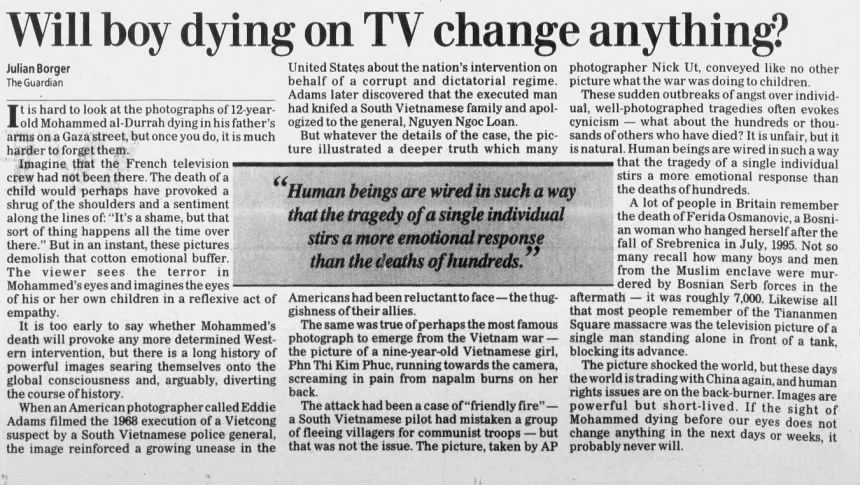
Transcribed from the clipping
Will boy dying on TV change anything? Julian Borger The Guardian United States about the nation's intervention on photographer Nick Ut, conveyed like no other behalf of a corrupt and dictatorial regime.
Adams later discovered that the executed man picture what the war was doing to children. it is hard to look at the photographs of 12-year Lold Mohammed al-Durrah dying in his father's arms on a Gaza street, but once you do, it is much harder to forget them Imagine that the French television crew had not been there.
The death of a child would perhaps have provoked a shrug of the shoulders and a sentiment along the lines of: "It's a shame, but that sort of thing happens all the time over there." But in an instant, these pictures. demolish that cotton emotional buffer.
The viewer sees the terror in Mohammed's eyes and imagines the eyes of his or her own children in a reflexive act of empathy. It is too early to say whether Mohammed's death will provoke any more determined West- ern intervention, but there is a long history of powerful images searing themselves onto the global consciousness and, arguably, diverting the course of history.
When an American photographer called Eddie Adams filmed the 1968 execution of a Vietcong suspect by a South Vietnamese police general. the image reinforced a growing unease in the had knifed a South Vietnamese family and apol- These sudden outbreaks of angst over individ- ogized to the general, Nguyen Ngoc Loan. ual, well-photographed tragedies often evokes But whatever the details of the case, the pic- cynicism - what about the hundreds or thou- ture illustrated a deeper truth which many sands of others who have died?
It is unfair, but it is natural. Human beings are wired in such a way that the tragedy of a single individual "Human beings are wired in such a way that the tragedy of a single individual stirs a more emotional response than the deaths of hundreds. stirs a more emotional response than the deaths of hundreds.
A lot of people in Britain remember the death of Ferida Osmanovic, a Bosni- an woman who hanged herself after the fall of Srebrenica in July, 1995. Not so many recall how many boys and men from the Muslim enclave were mur- • dered by Bosnian Serb forces in the Americans had been reluctant to face - the thug- aftermath - it was roughly 7,000.
Likewise all gishness of their allies. that most people remember of the Tiananmen The same was true of perhaps the most famous Square massacre was the television picture of a photograph to emerge from the Vietnam war - single man standing alone in front of a tank, the picture of a nine-year-old Vietnamese girl, blocking its advance.
Phn Thi Kim Phue, running towards the camera, The picture shocked the world, but these days screaming in pain from napalm burns on her the world is trading with China again, and human rights issues are on the back-burner. Images are The attack had been a case of "friendly fire"- powerful but short-lived.
If the sight of a South Vietnamese pilot had mistaken a group Mohammed dying before our eyes does not of fleeing villagers for communist troops - but change anything in the next days or weeks, it that was not the issue. The picture, taken by AP probably never will.
Cite this item
"Will boy dying on TV change anything?," The Mercury, 4 October 2000. Covering Palestine archive, CP-2000-021. https://coveringpalestine.org/archive/cp-2000-021
This clipping is read closely in the section below
More from the 2000s
- The poetry of Arab pain: Are Israeli students ready?The Bulletin · 7 March 2000
- Israelis argue over teaching Palestinian’s verseThe Oregonian · 7 March 2000
- An uproar over introduction of poet into curriculumThe News Virginian · 7 March 2000
- Poet’s work inflames cultural divideTampa Bay Times · 11 March 2000
- Arafat rejected $30 billion for refugee relocation, aide saysIndianapolis Star · 11 August 2000
- Contested holy sitesThe Columbian · 8 September 2000
- All 193 clippings from the 2000s →
This record is part of Covering Palestine, an archive of American and Anglophone newspaper clippings about Palestinians, 1799 to 2023. Researched and assembled by Maria Robles.
The clipping belongs to the newspaper that printed it, or to the news agency that supplied the copy. It is reproduced here for research, criticism and commentary. The city is derived from the masthead, not read off the clipping.
Something wrong here, or something you know about this clipping? The archive is still being built and corrections are wanted: maria@rozumstudio.com, quoting CP-2000-021.
See it in the archive reel · Full text of every clipping · Dataset