The Jamestown Sun · 20 April 2000
CP-2000-070
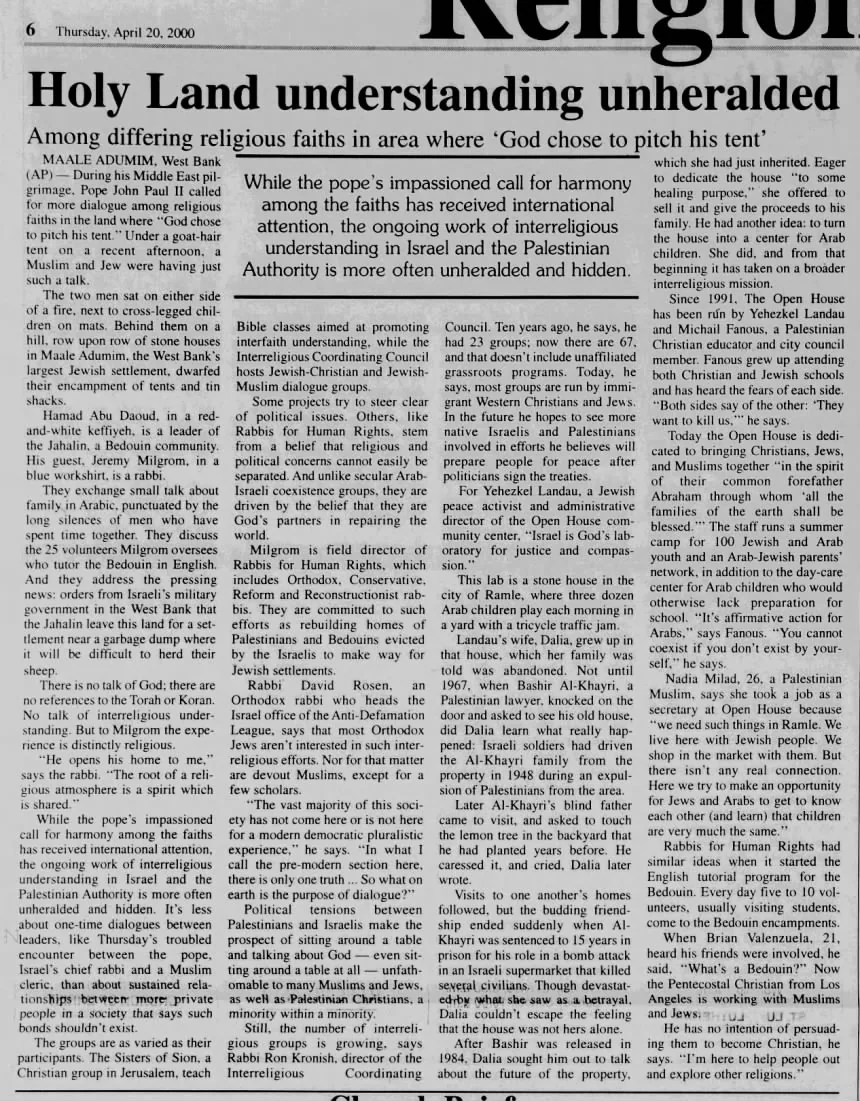
Holy Land understanding unheralded
Among differing religious faiths in area where 'God chose to pitch his tent'
Transcribed from the clipping
MAALE ADUMIM, West Bank (AP) — During his Middle East pilgrimage, Pope John Paul II called for more dialogue among religious faiths in the land where "God chose to pitch his tent." Under a goat-hair tent on a recent afternoon, a Muslim and Jew were having just such a talk. The two men sat on either side of a fire, next to cross-legged children on mats.
Behind them on a hill, row upon row of stone houses in Maale Adumim, the West Bank's largest Jewish settlement, dwarfed their encampment of tents and tin shacks. Hamad Abu Daoud, in a red-and-white keffiyeh, is a leader of the Jahalin, a Bedouin community. His guest, Jeremy Milgrom, in a blue workshirt, is a rabbi.
They exchange small talk about family in Arabic, punctuated by the long silences of men who have spent time together. They discuss the 25 volunteers Milgrom oversees who tutor the Bedouin in English.
And they address the pressing news: orders from Israeli's military government in the West Bank that the Jahalin leave this land for a settlement near a garbage dump where it will be difficult to herd their sheep. There is no talk of God; there are no references to the Torah or Koran. No talk of interreligious understanding.
But to Milgrom the experience is distinctly religious. "He opens his home to me," says the rabbi.
"The root of a religious atmosphere is a spirit which is shared." While the pope's impassioned call for harmony among the faiths has received international attention, the ongoing work of interreligious understanding in Israel and the Palestinian Authority is more often unheralded and hidden.
It's less about one-time dialogues between leaders, like Thursday's troubled encounter between the pope, Israel's chief rabbi and a Muslim cleric, than about sustained relationships between more private people in a society that says such bonds shouldn't exist.
How this transcription was made
Date confirmed on the page (folio).
Context added by this archive
The one clipping in the batch outside the 1967-69 window, and the only one in which Palestinians speak at length in their own voices — three of them, two named with occupations and one with her age.
It also contains, in two sentences, the whole 1948 expulsion told through one house in Ramle: 'Israeli soldiers had driven the Al-Khayri family from the property in 1948 during an expulsion of Palestinians from the area' — the paper's own voice, unhedged, the word 'expulsion' unqualified.
That is the Dalia Landau / Bashir Al-Khayri story later told in Sandy Tolan's 'The Lemon Tree'; the detail of the blind father asking to touch the lemon tree he planted, caressing it and crying, is here in a 2000 AP wire story on page 6 of a North Dakota daily. Worth showing Maria for that alone.
Note also the Jahalin thread: the lede scene is a Bedouin community being ordered off its land to a site next to a garbage dump, reported in passing as 'the pressing news' while the story's subject is interfaith dialogue.
Cite this clipping
"Holy Land understanding unheralded," The Jamestown Sun, 20 April 2000, p. 6. Covering Palestine archive, CP-2000-070. https://coveringpalestine.org/archive/cp-2000-070
More from The Jamestown Sun
- New violence sweeps West Bank and Gaza StripThe Jamestown Sun · 7 October 2000
- Suicide bomber kills seven others in JerusalemThe Jamestown Sun · 20 June 2002
More from the 2000s
- Are refugee camps still temporary?Pittsburgh Post-Gazette · 27 February 2000
- Building, like West Bank peace, still under constructionLansing State Journal · 29 February 2000
- No progress in peace missionLaredo Morning Times · 29 February 2000
- Some Palestinians fed up with ArafatLexington Herald-Leader · 29 February 2000
- Symbols, semantics key to Jerusalem peaceStaten Island Advance · 29 February 2000
- The poetry of Arab pain: Are Israeli students ready?The Bulletin · 7 March 2000
- All 516 clippings from the 2000s →
Last updated 2 November 2026
This record is part of Covering Palestine, an archive of American newspaper clippings about Palestinians, 1724 to 2023. Researched and assembled by Maria Robles.
The clipping belongs to the newspaper that printed it, or to the news agency that supplied the copy. It is reproduced here for research, criticism and commentary. A city here is where the newspaper was published, not where the story came from, and on most records it was taken from the masthead.
Something wrong here, or something you know about this clipping? The archive is still being built and corrections are wanted: maria@rozumstudio.com, quoting CP-2000-070.
Everything printed in 2000 · Printed on this day · See it in the archive reel · Full text of every clipping · Dataset