The Times · 3 August 2001
CP-2001-020
Young Jewish, Palestinian musicians strive for harmony against backdrop of violence
By The Associated Press
Transcribed from the clipping
CHICAGO — The orchestra played behind guarded doors. Photographs of the entire group, some of its members there without their government's permission, were strictly prohibited. So were bags and even umbrellas.
With violence escalating in the Middle East, security was tight as a group of young Palestinian and Jewish musicians came to the United States for a public concert, the end of three weeks aimed at building understanding through music. “The first day we played together, you wouldn't believe it.
It was like fragments that are messed up everywhere,” said Claude Chalhoub, a violinist from Beirut, who was the 73-member orchestra's concertmaster.
The tension came from political differences, but also just from trying to unite a diverse group of young musicians — ages 15 to 26, and from nations such as Israel, Lebanon, Jordan and Egypt — many of whom had never played together.
“Now it's just a great piece,” Chalhoub said before the orchestra performed Beethoven's “Eroica” symphony in front of a nearly packed house at Chicago's Orchestra Hall on Tuesday, the night before a funeral for eight Palestinians killed in an Israeli helicopter raid.
The workshop was the third organized by Daniel Barenboim, music director of the Chicago Symphony Orchestra, but the first in the United States. The others were held in Germany. Barenboim, who is Jewish, already has a reputation for trying to use music to heal — and to stir and challenge.
Just days before the young musicians arrived in Chicago, he angered some Jews by leading a German orchestra in a piece by Richard Wagner, Adolf Hitler's favorite composer, at Israel's most prestigious arts festival. No one should be forced to listen to the music, Barenboim said, but “these associations were not created by Wagner, they were created by Hitler.”
Barenboim hopes the annual West-Eastern Divan Workshop — named for German writer Goethe's imaginary dialogue with 14th century Persian poet Hafiz — will evolve into a year-round institute. He said this year's gathering was particularly poignant, given the increase in bloodshed in the Middle East.
The tension was particularly raw during discussions scheduled in the evenings and led by professors from the University of Chicago and Columbia University, he said. “You feel the pain that these kids feel and then you think, ‘My God, it's better not to talk about it,’” Barenboim said. “And then the next day, it is as if the music washes that all away.”
Planning the latest workshop had its share of tension. Without explanation, Egyptian officials canceled a plan to send 23 students from a conservatory in Cairo, though organizers believe it was a comment on recent Israeli attacks on Palestinians. Israel says the attacks are retaliation for Palestinian aggression.
The situation is so tense that some musicians attended the workshop in secret. Orchestra officials asked that they not be photographed or named for fear they would face jail time once they returned home.
The violence, which has left hundreds of Palestinians and Israelis dead since fighting erupted last September, is disheartening to Saleem Abboud-Ashkar, a Palestinian Israeli who attended the workshop. “Sometimes I think I am optimistic only because there is no other option,” the 24-year-old pianist said. “Optimism becomes only a way of survival.”
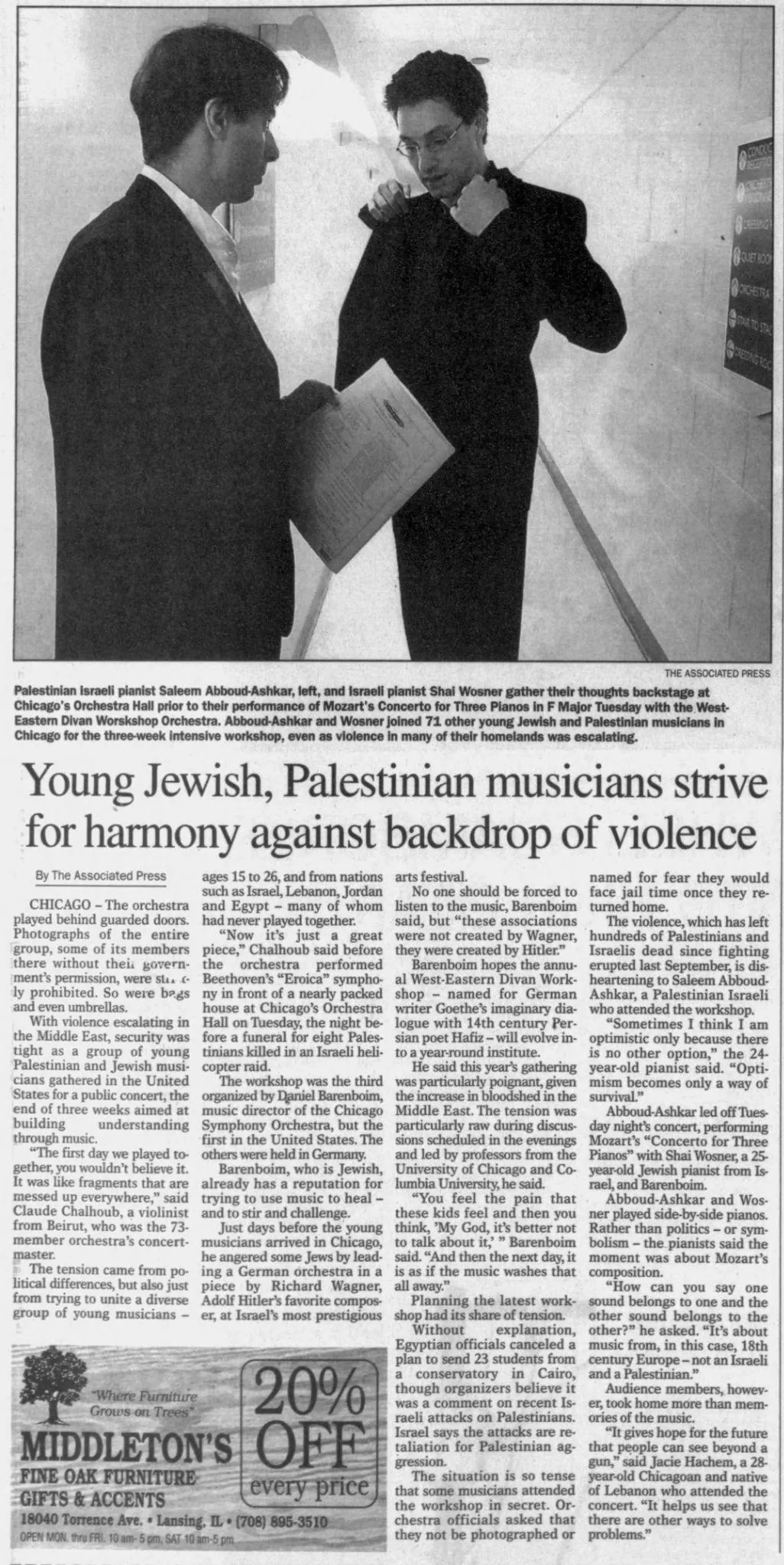
Abboud-Ashkar led off Tuesday night's concert, performing Mozart's “Concerto for Three Pianos” with Shai Wosner, a 25-year-old Jewish pianist from Israel, and Barenboim. Abboud-Ashkar and Wosner played side-by-side pianos. Rather than politics — or symbolism — the pianists said the moment was about Mozart's composition.
“How can you say one sound belongs to one and the other sound belongs to the other?” he asked. “It's about music from, in this case, 18th century Europe — not an Israeli and a Palestinian.” Audience members, however, took home more than memories of the music.
“It gives hope for the future that people can see beyond a gun,” said Jacie Hachem, a 28-year-old Chicagoan and native of Lebanon who attended the concert. “It helps us see that there are other ways to solve problems.”
Context added by this archive
The paper's own spelling of Worskshop in the caption is kept.
Cite this item
"Young Jewish, Palestinian musicians strive for harmony against backdrop of violence," The Times, 3 August 2001. Covering Palestine archive, CP-2001-020. https://coveringpalestine.org/archive/cp-2001-020
More from The Times
- Arab Village Attacked by Bomb SquadsThe Times · 16 February 1948
- Jews Kill ‘Foreign’ Arabs in Mass PushThe Times · 18 February 1948
- (newspaper clipping, West Germany)The Times · 20 August 1969
- Israeli SettlementsThe Times · 13 February 1978
- Jackson meets with ArafatThe Times · 30 September 1979
- ArafatThe Times · 18 January 1989
- 4 more from this paper in the full text →
More from the 2000s
- Palestinians don’t want to give up ‘right of return’The Atlanta Journal-Constitution · 21 January 2001
- Palestinians Deserve Rights, Including Right To ReturnHartford Courant · 23 January 2001
- Bush team plans different Mideast tackThe News Journal · 8 February 2001
- Palestinian women suffer under occupationThe St. Augustine Record · 10 March 2001
- 3 Palestinians killed in West Bank protestThe Turlock Journal · 12 May 2001
- Israeli bulldozers strike deep into GazaAnchorage Daily News · 12 May 2001
- All 175 clippings from the 2000s →
This record is part of Covering Palestine, an archive of American and Anglophone newspaper clippings about Palestinians, 1799 to 2023. Researched and assembled by Maria Robles.
The clipping belongs to the newspaper that printed it, or to the news agency that supplied the copy. It is reproduced here for research, criticism and commentary. The city is derived from the masthead, not read off the clipping.
Something wrong here, or something you know about this clipping? The archive is still being built and corrections are wanted: maria@rozumstudio.com, quoting CP-2001-020.
See it in the archive reel · Full text of every clipping · Dataset