The New York Times · New York, New York · 21 February 2001
CP-2001-041
Bitter, Stark Souvenirs: Sneakers and Slingshots
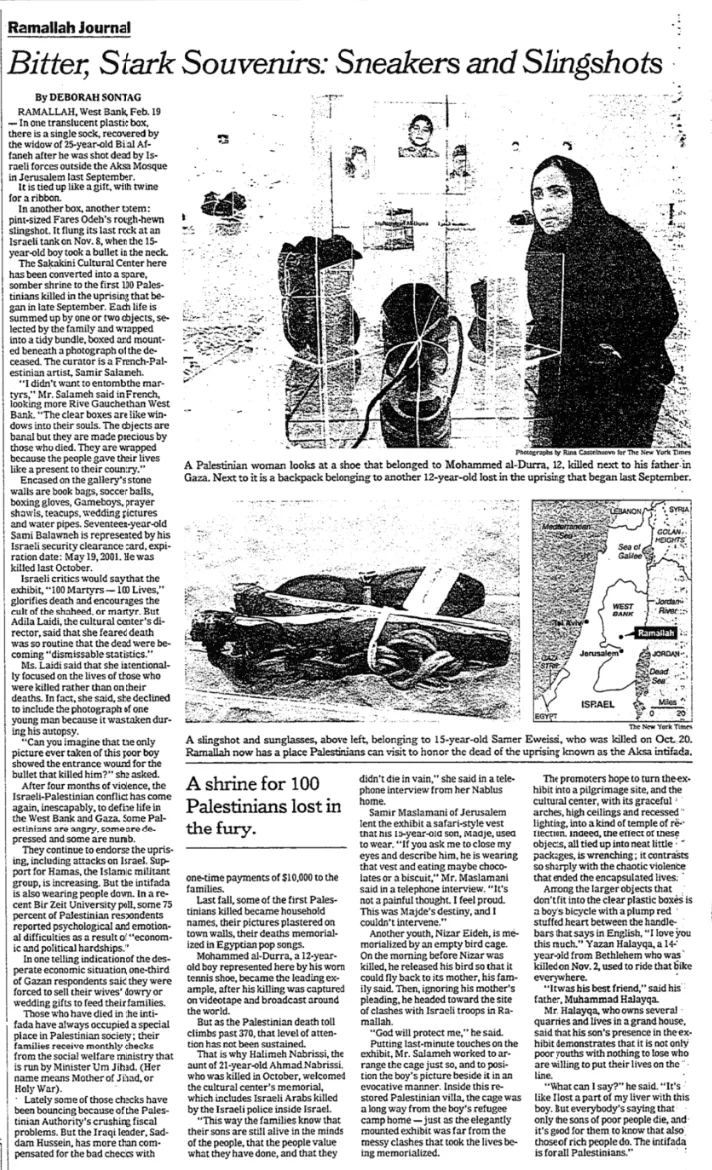
Transcribed from the clipping
RAMALLAH, West Bank, Feb. 19 — In one translucent plastic box, there is a single sock, recovered by the widow of 25-year-old Bial Affaneh after he was shot dead by Israeli forces outside the Aksa Mosque in Jerusalem last September. It is tied up like a gift, with twine for a ribbon. In another box, another totem: pint-sized Fares Odeh’s rough-hewn slingshot.
It flung its last rock at an Israeli tank on Nov. 8, when the 15-year-old boy took a bullet in the neck. The Sakakini Cultural Center here has been converted into a spare, somber shrine to the first 100 Palestinians killed in the uprising that began in late September.
Each life is summed up by one or two objects, selected by the family and wrapped into a tidy bundle, boxed and mounted beneath a photograph of the deceased. The curator is a French-Palestinian artist, Samir Salameh. “I didn’t want to entomb the martyrs,” Mr. Salameh said in French, looking more Rive Gauche than West Bank. “The clear boxes are like windows into their souls.
The objects are banal but they are made precious by those who died. They are wrapped because the people gave their lives like a present to their country.” Encased on the gallery’s stone walls are book bags, soccer balls, boxing gloves, Gameboys, prayer shawls, teacups, wedding pictures and water pipes.
Seventeen-year-old Sami Balawneh is represented by his Israeli security clearance card, expiration date: May 19, 2001. He was killed last October. Israeli critics would say that the exhibit, “100 Martyrs — 100 Lives,” glorifies death and encourages the cult of the shaheed, or martyr.
But Adila Laidi, the cultural center’s director, said that she feared death was so routine that the dead were becoming “dismissable statistics.” Ms. Laidi said that she intentionally focused on the lives of those who were killed rather than on their deaths. In fact, she said, she declined to include the photograph of one young man because it was taken during his autopsy.
“Can you imagine that the only picture ever taken of this poor boy showed the entrance wound for the bullet that killed him?” she asked. […] Samir Maslamani of Jerusalem lent the exhibit a safari-style vest that his 15-year-old son, Madje, used to wear.
“If you ask me to close my eyes and describe him, he is wearing that vest and eating maybe chocolates or a biscuit,” Mr. Maslamani said in a telephone interview. “It’s not a painful thought. I feel proud. This was Madje’s destiny, and I couldn’t intervene.” Another youth, Nizar Eideh, is memorialized by an empty bird cage.
On the morning before Nizar was killed, he released his bird so that it could fly back to its mother, his family said. Then, ignoring his mother’s pleading, he headed toward the site of clashes with Israeli troops in Ramallah. “God will protect me,” he said. Putting last-minute touches on the exhibit, Mr.
Salameh worked to arrange the cage just so, and to position the boy’s picture beside it in an evocative manner. Inside this restored Palestinian villa, the cage was a long way from the boy’s refugee camp home — just as the elegantly mounted exhibit was far from the messy clashes that took the lives being memorialized.
Yazan Halayqa, a 14-year-old from Bethlehem who was killed on Nov. 2, used to ride that bike everywhere. “It was his best friend,” said his father, Muhammad Halayqa. Mr.
Halayqa, who owns several quarries and lives in a grand house, said that his son’s presence in the exhibit demonstrates that it is not only poor youths with nothing to lose who are willing to put their lives on the line. “What can I say?” he said. “It’s like I lost a part of my liver with this boy.
But everybody’s saying that only the sons of poor people die, and it’s good for them to know that also those of rich people do. The intifada is for all Palestinians.”
How this transcription was made
Read from the scan by a machine looking at the image of the page, not by optical character recognition and not by a person. The clipping carries no masthead and no dated folio line, so the date recorded here could not be checked against anything printed on the page. Nothing on the page contradicts it. The transcription above was read from a second scan of this same clipping, supplied in the oct25 batch and ruled a duplicate of this record on 25 October 2026 by stroke-level comparison. The record previously carried the opening of the article only. The image shown is unchanged; only the text it had never been given was added.
Cite this clipping
"Bitter, Stark Souvenirs: Sneakers and Slingshots," The New York Times, 21 February 2001. Covering Palestine archive, CP-2001-041. https://coveringpalestine.org/archive/cp-2001-041
More from The New York Times
- The Maine Colony in PalestineThe New York Times · 12 November 1866
- Jewish Colonization in PalestineThe New York Times · 9 December 1883
- Jewish State in Palestine OpposedThe New York Times · 9 July 1897
- ZIONIST CONGRESS IN BASELThe New York Times · 31 August 1897
- ROME FEARS THE ZIONISTSThe New York Times · 12 September 1897
- PROGRESS OF ZIONISMThe New York Times · 16 December 1901
- 852 more from this paper in the full text →
More from the 2000s
- Palestinian refugees cling to ‘right of return’The Grand Rapids Press · 7 January 2001
- Palestinians don’t want to give up ‘right of return’The Atlanta Journal-Constitution · 21 January 2001
- Palestinians Deserve Rights, Including Right To ReturnHartford Courant · 23 January 2001
- Palestinians who are Israeli citizens weigh the electionThe New York Times · 26 January 2001
- Polls predict landslide for hard-liner Ariel Sharon in Israeli electionThe Herald Sun · 3 February 2001
- Feared road offers clues to Israel voteThe Boston Globe · 4 February 2001
- All 516 clippings from the 2000s →
In these collections
Last updated 2 November 2026
This record is part of Covering Palestine, an archive of American newspaper clippings about Palestinians, 1724 to 2023. Researched and assembled by Maria Robles.
The clipping belongs to the newspaper that printed it, or to the news agency that supplied the copy. It is reproduced here for research, criticism and commentary. A city here is where the newspaper was published, not where the story came from, and on most records it was taken from the masthead.
Something wrong here, or something you know about this clipping? The archive is still being built and corrections are wanted: maria@rozumstudio.com, quoting CP-2001-041.
Everything printed in 2001 · Printed on this day · See it in the archive reel · Full text of every clipping · Dataset