The New York Times · 10 March 2001
CP-2001-060
A Stone’s Throw Is a Freudian Slip
By DINITIA SMITH
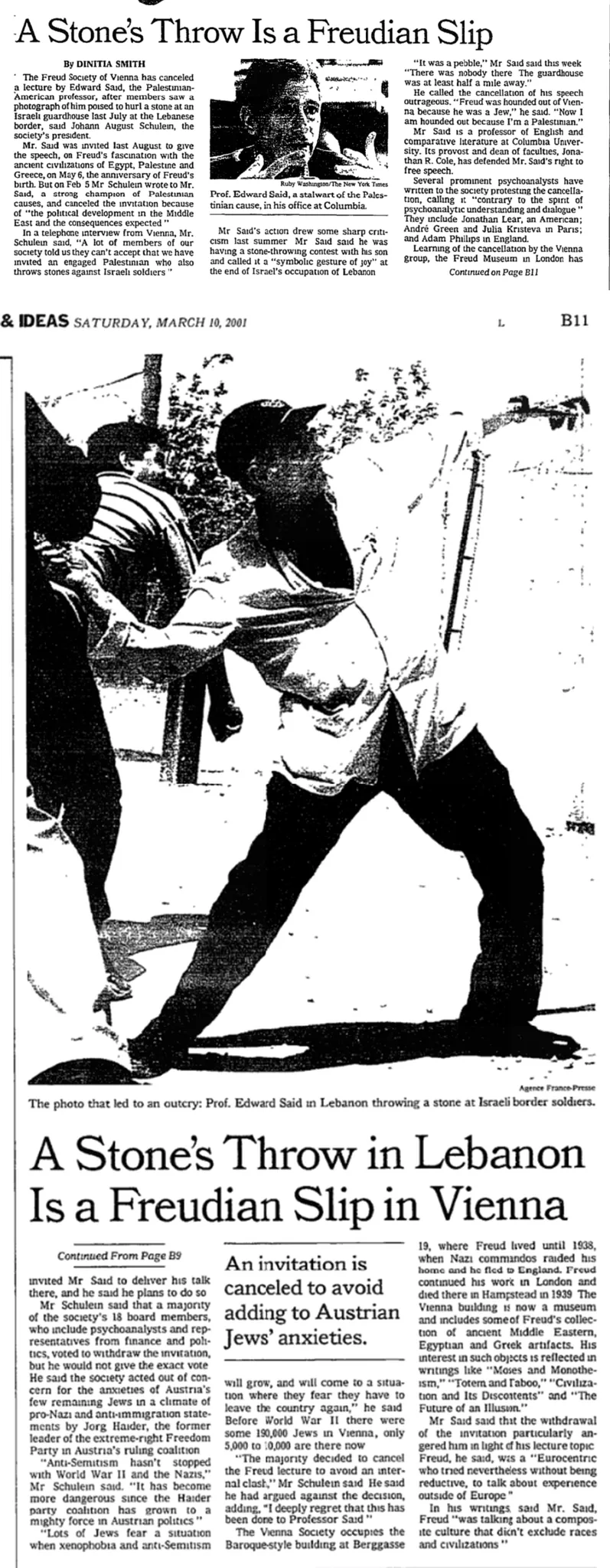
Transcribed from the clipping
The Freud Society of Vienna has canceled a lecture by Edward Said, the Palestinian-American professor, after members saw a photograph of him poised to hurl a stone at an Israeli guardhouse last July at the Lebanese border, said Johann August Schulein, the society’s president. Mr.
Said was invited last August to give the speech, on Freud’s fascination with the ancient civilizations of Egypt, Palestine and Greece, on May 6, the anniversary of Freud’s birth. But on Feb. 5 Mr. Schulein wrote to Mr.
Said, a strong champion of Palestinian causes, and canceled the invitation because of “the political development in the Middle East and the consequences expected.” In a telephone interview from Vienna, Mr. Schulein said, “A lot of members of our society told us they can’t accept that we have invited an engaged Palestinian who also throws stones against Israeli soldiers.” Mr.
Said’s action drew some sharp criticism last summer. Mr. Said said he was having a stone-throwing contest with his son and called it a “symbolic gesture of joy” at the end of Israel’s occupation of Lebanon. “It was a pebble,” Mr. Said said this week. “There was nobody there. The guardhouse was at least half a mile away.” He called the cancellation of his speech outrageous.
“Freud was hounded out of Vienna because he was a Jew,” he said. “Now I am hounded out because I’m a Palestinian.” Mr. Said is a professor of English and comparative literature at Columbia University. Its provost and dean of faculties, Jonathan R. Cole, has defended Mr. Said’s right to free speech.
Several prominent psychoanalysts have written to the society protesting the cancellation, calling it “contrary to the spirit of psychoanalytic understanding and dialogue.” They include Jonathan Lear, an American; André Green and Julia Kristeva in Paris; and Adam Phillips in England. Learning of the cancellation by the Vienna group, the Freud Museum in London has invited Mr.
Said to deliver his talk there, and he said he plans to do so. Mr. Schulein said that a majority of the society’s 18 board members, who include psychoanalysts and representatives from finance and politics, voted to withdraw the invitation, but he would not give the exact vote.
He said the society acted out of concern for the anxieties of Austria’s few remaining Jews in a climate of pro-Nazi and anti-immigration statements by Jorg Haider, the former leader of the extreme-right Freedom Party in Austria’s ruling coalition. “Anti-Semitism hasn’t stopped with World War II and the Nazis,” Mr. Schulein said.
“It has become more dangerous since the Haider party coalition has grown to a mighty force in Austrian politics.” “Lots of Jews fear a situation when xenophobia and anti-Semitism will grow, and will come to a situation where they fear they have to leave the country again,” he said. Before World War II there were some 190,000 Jews in Vienna; only 5,000 to 10,000 are there now.
“The majority decided to cancel the Freud lecture to avoid an internal clash,” Mr. Schulein said. He said he had argued against the decision, adding, “I deeply regret that this has been done to Professor Said.” ... Mr. Said said that the withdrawal of the invitation particularly angered him in light of his lecture topic.
Freud, he said, was a “Eurocentric who tried nevertheless without being reductive, to talk about experience outside of Europe.” In his writings, said Mr. Said, Freud “was talking about a composite culture that didn’t exclude races and civilizations.”
How this transcription was made
Assembled from 2 scans: the section front (s036_1, page B9) and its jump (s036_2, page B11, headed “Continued From Page B9”). The join is verified by the sentence that breaks across them: B9 ends “...the Freud Museum in London has” and B11 opens “invited Mr. Said to deliver his talk there.” Read in seven crops at 5x–10x. A passage on the jump about Freud’s Berggasse 19 house and his book titles is elided from the excerpt with an ellipsis; it is background, not Palestine content. — The jump page carries a printed running line: “& IDEAS SATURDAY, MARCH 10, 2001” with the page number B11 at the right. 10 March 2001 was a Saturday. Maria’s label is confirmed. The paper’s own name does not appear on either cut, but the photo credit on the front of the section reads “Ruby Washington/The New York Times.” — ['Light punctuation drops out of this scan: periods after abbreviations (Mr., Feb.) and some sentence-final periods inside closing quotation marks are not visible at 5x–10x. I have set them to New York Times style where the style is not in question. Individual period and comma placement in this excerpt is therefore reconstructed from house style, not read off the page; the words themselves are read.'] — Two clippings of one article, joined into a single image for the record (s036_1.png, s036_2.png).
Cite this clipping
"A Stone’s Throw Is a Freudian Slip," The New York Times, 10 March 2001, p. B9, continued on B11. Covering Palestine archive, CP-2001-060. https://coveringpalestine.org/archive/cp-2001-060
More from The New York Times
- The Maine Colony in PalestineThe New York Times · 12 November 1866
- Jewish Colonization in PalestineThe New York Times · 9 December 1883
- Jewish State in Palestine OpposedThe New York Times · 9 July 1897
- ZIONIST CONGRESS IN BASELThe New York Times · 31 August 1897
- ROME FEARS THE ZIONISTSThe New York Times · 12 September 1897
- PROGRESS OF ZIONISMThe New York Times · 16 December 1901
- 852 more from this paper in the full text →
More from the 2000s
- Palestinian refugees cling to ‘right of return’The Grand Rapids Press · 7 January 2001
- Palestinians don’t want to give up ‘right of return’The Atlanta Journal-Constitution · 21 January 2001
- Palestinians Deserve Rights, Including Right To ReturnHartford Courant · 23 January 2001
- Palestinians who are Israeli citizens weigh the electionThe New York Times · 26 January 2001
- Polls predict landslide for hard-liner Ariel Sharon in Israeli electionThe Herald Sun · 3 February 2001
- Feared road offers clues to Israel voteThe Boston Globe · 4 February 2001
- All 516 clippings from the 2000s →
Last updated 2 November 2026
This record is part of Covering Palestine, an archive of American newspaper clippings about Palestinians, 1724 to 2023. Researched and assembled by Maria Robles.
The clipping belongs to the newspaper that printed it, or to the news agency that supplied the copy. It is reproduced here for research, criticism and commentary. A city here is where the newspaper was published, not where the story came from, and on most records it was taken from the masthead.
Something wrong here, or something you know about this clipping? The archive is still being built and corrections are wanted: maria@rozumstudio.com, quoting CP-2001-060.
Everything printed in 2001 · Printed on this day · See it in the archive reel · Full text of every clipping · Dataset