Kitsap Sun · Bremerton, WA · 19 August 2002
CP-2002-130
Court bans Army’s use of ‘human shields’
■ A Palestinian teenager was killed after being forced to knock on a suspicious door.
By Mark Magnier, Los Angeles Times
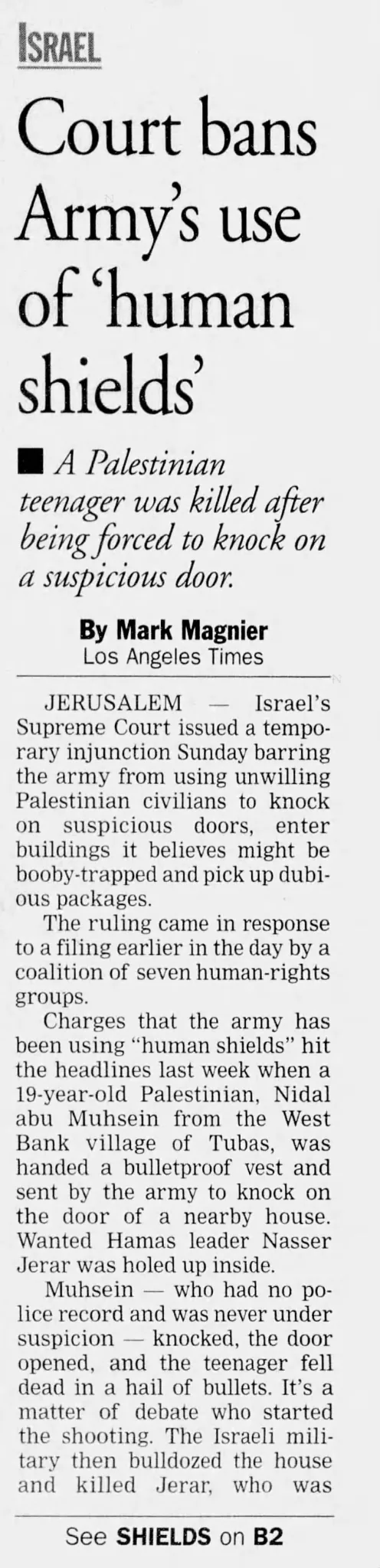
Shown from the top. The whole column — 4.1 times taller than it is wide — is in the enlargement.
Transcribed from the clipping
JERUSALEM — Israel’s Supreme Court issued a temporary injunction Sunday barring the army from using unwilling Palestinian civilians to knock on suspicious doors, enter buildings it believes might be booby-trapped and pick up dubious packages. The ruling came in response to a filing earlier in the day by a coalition of seven human-rights groups.
Charges that the army has been using “human shields” hit the headlines last week when a 19-year-old Palestinian, Nidal abu Muhsein from the West Bank village of Tubas, was handed a bulletproof vest and sent by the army to knock on the door of a nearby house. Wanted Hamas leader Nasser Jerar was holed up inside.
Muhsein — who had no police record and was never under suspicion — knocked, the door opened, and the teenager fell dead in a hail of bullets. It’s a matter of debate who started the shooting. The Israeli military then bulldozed the house and killed Jerar, who was wanted on suspicion of planning several attacks against Israelis, as Muhsein’s body lay amid the rubble.
The high court will decide at an as-yet unscheduled hearing what limits, if any, should be placed on the army’s growing use of Palestinian civilians to serve against their will as deterrents, advance scouts and early warning systems.
The seven human-rights petitioners, led by the Legal Center for Arab Minority Rights in Israel, or Adalah, say such tactics are illegal under both the Geneva Convention and Israeli law.
The army, which terms its use of civilians a “neighbor practice,” argues that the policy provides a necessary and effective deterrent under extreme circumstances, and one that saves both Palestinian and Israeli lives. Muhsein’s family sees the matter differently. “We’ve lost our eldest son.
We are in so much pain,” said Abdul Raouf abu Muhsein, Nidal’s father, who says their child was chosen at random because of his sturdy physique. “I can hardly bear to go into my own house anymore. I still see him here, even though he’s gone.”
How this transcription was made
Date and publication rest on the collector's slide label; no masthead, folio or printed dateline appears on this clipping, and nothing on it contradicts the label. Filed under the archive’s spelling; the page prints “The Kitsap Sun”.
Context added by this archive
Zero “Israeli Arab” vocabulary despite Adalah being the lead petitioner. The story is about Palestinians in the West Bank and uses “Palestinian” throughout; the word “Arab” appears on the page exactly once, inside the name of an Israeli legal NGO.
Cite this clipping
"Court bans Army’s use of ‘human shields’," Kitsap Sun, 19 August 2002, p. B1, continued B2. Covering Palestine archive, CP-2002-130. https://coveringpalestine.org/archive/cp-2002-130
More from Kitsap Sun
- Israeli, Arab tensions come to surface in occupied HebronKitsap Sun · 16 July 1983
- After autopsy, Palestinian, Israeli doctors disagreeKitsap Sun · 12 December 2014
More from the 2000s
- Don’t forget it’s an Israeli occupationThe Daily Press · 1 January 2002
- Soothing Israel’s FearsThe New York Times · 7 January 2002
- Israel, in Reprisal for Killings, Razes Gaza Refugee HomesThe New York Times · 11 January 2002
- Refugees and Reparations in the MideastThe New York Times · 13 January 2002
- Israeli missiles strike naval baseThe Greenville News · 13 January 2002
- Friendship of Palestinian, architect defies oddsThe Bismarck Tribune · 17 January 2002
- All 516 clippings from the 2000s →
Last updated 2 November 2026
This record is part of Covering Palestine, an archive of American newspaper clippings about Palestinians, 1724 to 2023. Researched and assembled by Maria Robles.
The clipping belongs to the newspaper that printed it, or to the news agency that supplied the copy. It is reproduced here for research, criticism and commentary. A city here is where the newspaper was published, not where the story came from, and on most records it was taken from the masthead.
Something wrong here, or something you know about this clipping? The archive is still being built and corrections are wanted: maria@rozumstudio.com, quoting CP-2002-130.
Everything printed in 2002 · Printed on this day · See it in the archive reel · Full text of every clipping · Dataset