The Selma Times-Journal · Selma, Alabama · 14 November 2005
CP-2005-005
‘Paradise’ examines terrorists
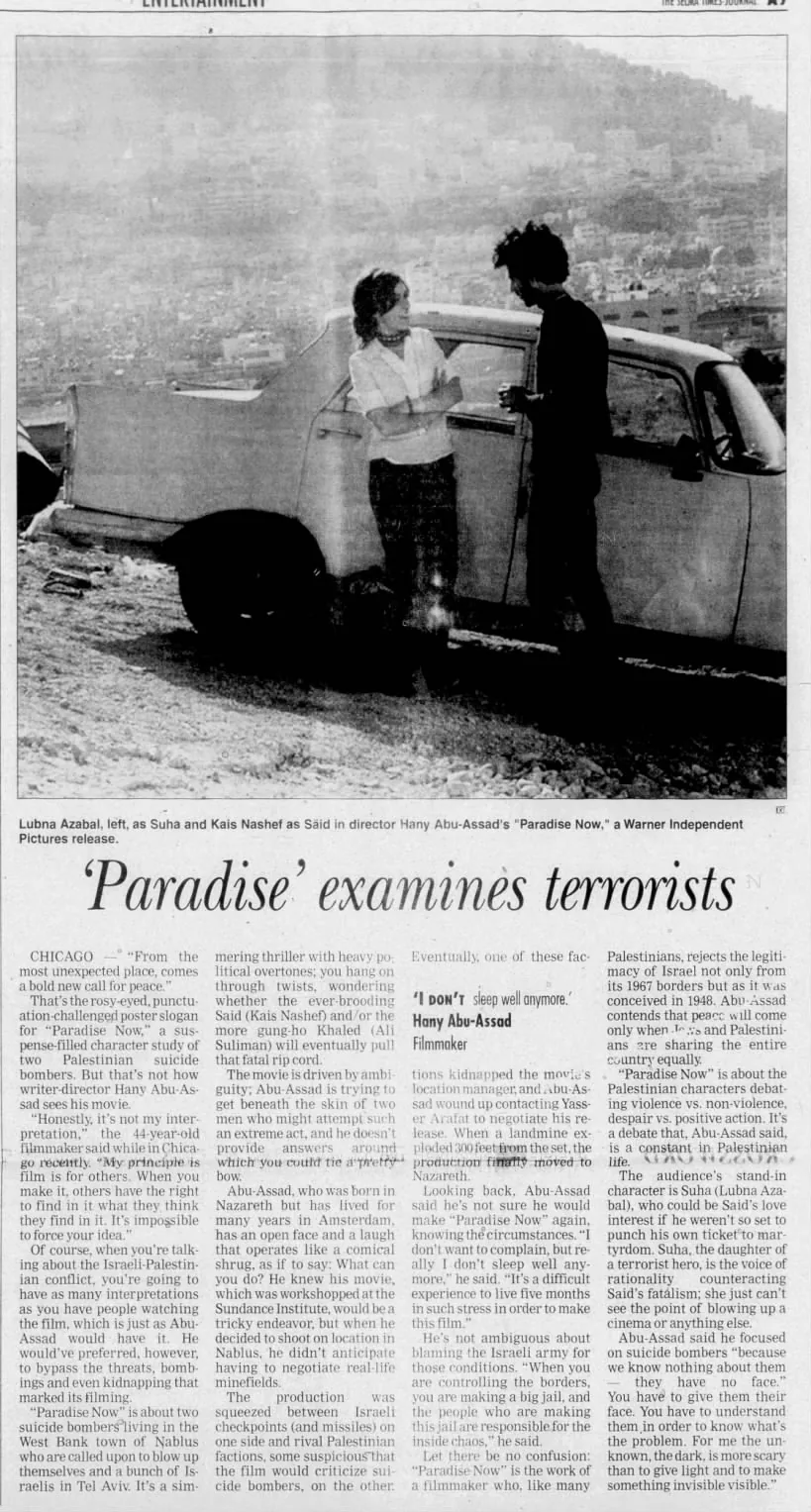
Transcribed from the clipping
“CHICAGO — ‘From the most unexpected place, comes a bold new call for peace.’ That’s the rosy-eyed, punctuation-challenged poster slogan for ‘Paradise Now,’ a suspense-filled character study of two Palestinian suicide bombers. But that’s not how writer-director Hany Abu-Assad sees his movie. ‘Honestly, it’s not my interpretation,’ the 44-year-old filmmaker said while in Chicago recently. ‘My principle is film is for others. When you make it, others have the right to find in it what they think they find in it. It’s impossible to force your idea.’… Abu-Assad, who was born in Nazareth but has lived for many years in Amsterdam, has an open face and a laugh that operates like a comical shrug, as if to say: What can you do?… The production was squeezed between Israeli checkpoints (and missiles) on one side and rival Palestinian factions, some suspicious that the film would criticize suicide bombers, on the other. Eventually, one of these factions kidnapped the movie’s location manager, and Abu-Assad wound up contacting Yasser Arafat to negotiate his release. When a landmine exploded 300 feet from the set, the production finally moved to Nazareth. Looking back, Abu-Assad said he’s not sure he would make ‘Paradise Now’ again, knowing the circumstances. ‘I don’t want to complain, but really I don’t sleep well anymore,’ he said. ‘It’s a difficult experience to live five months in such stress in order to make this film.’ He’s not ambiguous about blaming the Israeli army for those conditions. ‘When you are controlling the borders, you are making a big jail, and the people who are making this jail are responsible for the inside chaos,’ he said. Let there be no confusion: ‘Paradise Now’ is the work of a filmmaker who, like many Palestinians, rejects the legitimacy of Israel not only from its 1967 borders but as it was conceived in 1948. Abu-Assad contends that peace will come only when Jews and Palestinians are sharing the entire country equally. ‘Paradise Now’ is about the Palestinian characters debating violence vs. non-violence, despair vs. positive action. It’s a debate that, Abu-Assad said, is a constant in Palestinian life… Abu-Assad said he focused on suicide bombers ‘because we know nothing about them — they have no face.’ You have to give them their face. You have to understand them in order to know what’s the problem. For me the unknown, the dark, is more scary than to give light and to make something invisible visible.’”
Photograph caption
“Lubna Azabal, left, as Suha and Kais Nashef as Said in director Hany Abu-Assad’s ‘Paradise Now,’ a Warner Independent Pictures release.” Pull quote: “I don’t sleep well anymore.” — Hany Abu-Assad, Filmmaker
Context added by this archive
The headline calls the film an examination of terrorists. The director, given the length of an interview, says the opposite: that he made it because we know nothing about these men and they have no face, and that the unknown frightens him more than making something invisible visible. The clipping stays whole: it also reports that he rejects Israel’s legitimacy as conceived in 1948, and that a faction kidnapped his location manager so that he had to ask Arafat to get the man back. Nine years later the same director tells the Los Angeles Times that his next film is not about the conflict.
Cite this item
"‘Paradise’ examines terrorists," The Selma Times-Journal, 14 November 2005. Covering Palestine archive, CP-2005-005. https://coveringpalestine.org/archive/cp-2005-005
Elsewhere in the archive
- A solemn anniversary for someDetroit Free Press · 16 May 2005 · the same year
- The making of a human bombThe Journal News · 27 October 2005 · the same year
- A Mideast ‘Paradise’ apocalypseNewsday · 28 October 2005 · the same year
This record is part of Covering Palestine, an archive of American and Anglophone newspaper clippings about Palestinians, 1812 to 2022. Researched and assembled by Maria Robles.
The clipping belongs to the newspaper that printed it, or to the wire service that supplied the copy. It is reproduced here for research, criticism and commentary. The city is derived from the masthead, not read off the clipping.
Something wrong here, or something you know about this clipping? The archive is still being built and corrections are wanted: maria@rozumstudio.com, quoting CP-2005-005.
See it in the archive reel · Full text of every clipping · Dataset