Telegram & Gazette · Worcester, Massachusetts · 3 October 2010
CP-2010-011
More than words
Oud masters Le Trio Joubran honor Mahmoud Darwish in their local debut
Siddhartha Mitter, Globe Correspondent
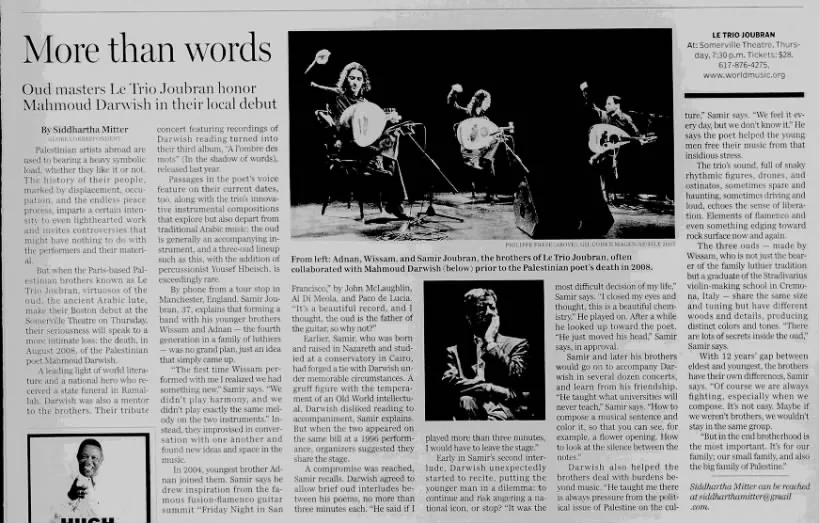
Transcribed from the clipping
“Palestinian artists abroad are used to bearing a heavy symbolic load, whether they like it or not. The history of their people, marked by displacement, occupation, and the endless peace process, imparts a certain intensity to even lighthearted work and invites controversies that might have nothing to do with the performers and their material. But when the Paris-based Palestinian brothers known as Le Trio Joubran, virtuosos of the oud, the ancient Arabic lute, make their Boston debut at the Somerville Theatre on Thursday, their seriousness will speak to a more intimate loss: the death, in August 2008, of the Palestinian poet Mahmoud Darwish… Their tribute concert featuring recordings of Darwish reading turned into their third album, ‘A l’ombre des mots’ (In the shadow of words)… ‘The first time Wissam performed with me I realized we had something new,’ Samir says. ‘We didn’t play harmony, and we didn’t play exactly the same melody on the two instruments.’… Darwish disliked reading to accompaniment, Samir explains. But when the two appeared on the same bill at a 1996 performance, organizers suggested they share the stage. A compromise was reached. Darwish agreed to allow brief oud interludes between his poems, no more than three minutes each. ‘He said if I played more than three minutes, I would have to leave the stage.’ Early in Samir’s second interlude, Darwish unexpectedly started to recite, putting the younger man in a dilemma: to continue and risk angering a national icon, or stop? ‘It was the most difficult decision of my life,’ Samir says. ‘I closed my eyes and thought, this is a beautiful chemistry.’ He played on. After a while he looked up toward the poet. ‘He just moved his head,’ Samir says, in approval. Samir and later his brothers would go on to accompany Darwish in several dozen concerts, and learn from his friendship. ‘He taught what universities will never teach,’ Samir says. ‘How to compose a musical sentence and color it, so that you can see, for example, a flower opening. How to look at the silence between the notes.’ Darwish also helped the brothers deal with burdens beyond music. ‘He taught me there is always pressure from the political issue of Palestine on the culture,’ Samir says. ‘We feel it every day, but we don’t know it.’ He says the poet helped the young men free their music from that insidious stress… The three ouds — made by Wissam, who is not just the bearer of the family luthier tradition but a graduate of the Stradivarius violin-making school in Cremona, Italy — share the same size and tuning but have different woods and details, producing distinct colors and tones… ‘Of course we are always fighting, especially when we compose. It’s not easy. Maybe if we weren’t brothers, we wouldn’t stay in the same group… But in the end brotherhood is the most important. It’s for our family; our small family, and also the big family of Palestine.’”
Photograph caption
“From left: Adnan, Wissam, and Samir Joubran, the brothers of Le Trio Joubran, often collaborated with Mahmoud Darwish (below) prior to the Palestinian poet’s death in 2008.” · Philippe Fresi
Context added by this archive
The first paragraph of this concert preview states the subject of this archive in two sentences, and then the piece goes on to be about three brothers, an instrument and a friendship. The scene at its centre is a poet who disliked being played over, a young musician told he had three minutes, and a nod. What Samir Joubran says Darwish taught him is the thing itself: that there is always pressure from the politics of Palestine on the culture, and that they feel it every day without knowing it. Wissam Joubran builds the family’s ouds and trained at the violin-making school in Cremona.
Cite this item
"More than words," Telegram & Gazette, 3 October 2010. Covering Palestine archive, CP-2010-011. https://coveringpalestine.org/archive/cp-2010-011
Elsewhere in the archive
- No Travel Permits to U.N. ConferenceTelegram & Gazette · 10 July 1985 · the same newspaper
- Palestinian Arabs Clash With PoliceTelegram & Gazette · 26 February 1957 · the same newspaper
- Just how hungry is Gaza?Sunday Telegraph · 6 June 2010 · the same year
- Gaza Strip: Hardship falls below ‘emergency’ threshold, but blockade shutters factories and clinics, and leaves everyone relying on aidThe Santa Fe New Mexican- · 14 June 2010 · the same year
- SLIM PICKINGSThe Miami Herald · 19 August 2010 · the same year
This record is part of Covering Palestine, an archive of American and Anglophone newspaper clippings about Palestinians, 1812 to 2022. Researched and assembled by Maria Robles.
The clipping belongs to the newspaper that printed it, or to the wire service that supplied the copy. It is reproduced here for research, criticism and commentary. The city is derived from the masthead, not read off the clipping.
Something wrong here, or something you know about this clipping? The archive is still being built and corrections are wanted: maria@rozumstudio.com, quoting CP-2010-011.
See it in the archive reel · Full text of every clipping · Dataset