Knoxville News-Sentinel · 5 July 2014
CP-2014-077
Jewish and Muslim students work together for dining options
By Sherif Tarek
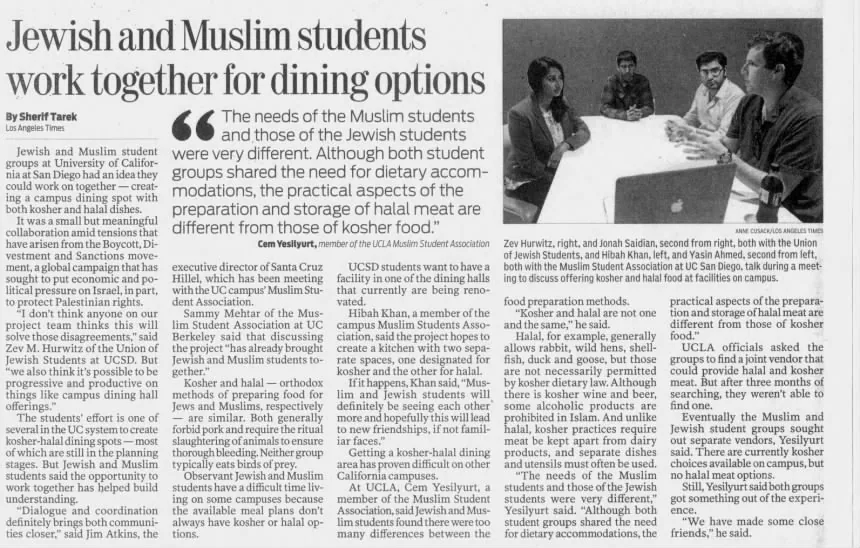
Transcribed from the clipping
Jewish and Muslim student groups at University of California at San Diego had an idea they could work on together — creating a campus dining spot with both kosher and halal dishes.
It was a small but meaningful collaboration amid tensions that have arisen from the Boycott, Divestment and Sanctions movement, a global campaign that has sought to put economic and political pressure on Israel, in part, to protect Palestinian rights. “I don’t think anyone on our project team thinks this will solve those disagreements,” said Zev M.
Hurwitz of the Union of Jewish Students at UCSD. But “we also think it’s possible to be progressive and productive on things like campus dining hall offerings.” The students’ effort is one of several in the UC system to create kosher-halal dining spots — most of which are still in the planning stages.
But Jewish and Muslim students said the opportunity to work together has helped build understanding. “Dialogue and coordination definitely brings both communities closer,” said Jim Atkins, the executive director of Santa Cruz Hillel, which has been meeting with the UC campus’ Muslim Student Association.
Sammy Mehtar of the Muslim Student Association at UC Berkeley said that discussing the project “has already brought Jewish and Muslim students together.” Kosher and halal — orthodox methods of preparing food for Jews and Muslims, respectively — are similar.
Both generally forbid pork and require the ritual slaughtering of animals to ensure thorough bleeding. Neither group typically eats birds of prey. Observant Jewish and Muslim students have a difficult time living on some campuses because the available meal plans don’t always have kosher or halal options.
How this transcription was made
Read from the scan Maria supplied on 17 November 2026, at magnification, band by band. No masthead and no page date line survive on this crop, so the label date 2014-07-05 cannot be confirmed or contradicted from the page. Nothing on the clipping names the paper that printed it either. CAUTION — CREDIT LINE IS NOT THE MASTHEAD. Under the byline this clipping prints ‘By Sherif Tarek’ and, on the line below, ‘Los Angeles Times’; the photograph is credited ‘ANNE CUSACK/LOS ANGELES TIMES’. Those are the source credits on a syndicated story, not the masthead of the paper holding the clipping. `pub` here is Knoxville News-Sentinel and nothing on the page confirms or contradicts it. This record must not be refiled under Los Angeles Times on the strength of those credit lines. No deck. The large block of display type between the headline and the photograph is a pull quote, attributed in a separate line as ‘Cem Yesilyurt, member of the UCLA Muslim Student Association’, and its words repeat verbatim from the body text in the fourth column. `dek` is therefore empty. LOS ANGELES / CAMPUS BODIES. Named exactly as printed: University of California at San Diego (also given as ‘UCSD’ and, in the caption, ‘UC San Diego’ — three spellings of the one campus on one page); the Union of Jewish Students at UCSD; the UC system; Santa Cruz Hillel; the Muslim Student Association at UC Berkeley; ‘the campus Muslim Students Association’ at UCSD; UCLA, ‘the Muslim Student Association’ there, the ‘UCLA Muslim Student Association’ in the pull-quote credit, and ‘UCLA officials’. The Los Angeles end of the story is UCLA: the page reports that UCLA officials asked the groups to find a joint vendor that could provide halal and kosher meat, that after three months of searching they weren’t able to find one, and that there are currently kosher choices available on campus but no halal meat options. PRINTED INCONSISTENCY KEPT. The body sets ‘the campus Muslim Students Association’ (Students, plural) for the UCSD group while the caption and every other reference set ‘Muslim Student Association’ (singular). Both stand as printed. The piece ties the dining project to politics in its second paragraph: the collaboration came ‘amid tensions that have arisen from the Boycott, Divestment and Sanctions movement, a global campaign that has sought to put economic and political pressure on Israel, in part, to protect Palestinian rights.’ That is the article’s own characterisation of BDS. QUOTE BEYOND THE EXCERPT. Cem Yesilyurt of the UCLA Muslim Student Association is quoted in the fourth and fifth columns: ‘Kosher and halal are not one and the same,’ and ‘The needs of the Muslim students and those of the Jewish students were very different. Although both student groups shared the need for dietary accommodations, the practical aspects of the preparation and storage of halal meat are different from those of kosher food.’ and, closing the piece, ‘We have made some close friends.’ None are in `quotes` because none fall inside the excerpt I transcribed; if the UCLA angle matters for the consortium, the excerpt would need to run to roughly 3,500 characters to carry them. SIDES. Nobody on this page is identified as Palestinian or as Israeli, so every person is coded ‘w’. The students quoted are named as representatives of campus organisations rather than as themselves, so I have coded them `ordinary: false`; Hibah Khan and Cem Yesilyurt are given only as ‘a member of’ their associations, which is the weakest of these attributions and could reasonably be read the other way. The body gives ‘Zev M. Hurwitz’ with the middle initial; the photo caption gives ‘Zev Hurwitz’ without it.
Cite this clipping
"Jewish and Muslim students work together for dining options," Knoxville News-Sentinel, 5 July 2014. Covering Palestine archive, CP-2014-077. https://coveringpalestine.org/archive/cp-2014-077
More from Knoxville News-Sentinel
- Palestinians Called Victims of ZionismKnoxville News-Sentinel · 19 November 1975
More from the 2010s
- Roger Waters rips Scarlett Johansson, Neil Young over Israel; SodaStream stock dipsSt. Louis Jewish Light · 5 February 2014
- Palestinian women make strides in high-tech jobsThe Sentinel · 12 February 2014
- Stories in and out of timeStar Tribune · 16 February 2014
- Conflict, paranoia, but little propaganda in ‘Omar’The Oregonian · 21 February 2014
- The front-runnersLos Angeles Times · 23 February 2014
- Masterful ‘Omar’ dives deep into notion of conflictHonolulu Star-Advertiser · 28 February 2014
- All 343 clippings from the 2010s →
Last updated 17 November 2026
This record is part of Covering Palestine, an archive of American newspaper clippings about Palestinians, 1724 to 2023. Researched and assembled by Maria Robles.
The clipping belongs to the newspaper that printed it, or to the news agency that supplied the copy. It is reproduced here for research, criticism and commentary. A city here is where the newspaper was published, not where the story came from, and on most records it was taken from the masthead.
Something wrong here, or something you know about this clipping? The archive is still being built and corrections are wanted: maria@rozumstudio.com, quoting CP-2014-077.
Everything printed in 2014 · Printed on this day · See it in the archive reel · Full text of every clipping · Dataset