Los Angeles Times · Los Angeles, California · 6 May 2018
CP-2018-024
Fear grows in border village
Gazans’ protests have Israelis increasingly anxious as the key date of May 15 nears.
Transcribed from the clipping
KFAR AZA, Israel — It should have been a relaxing time as Shlomit Almog and her husband, Giora, nursed cups of coffee at their favorite cafe, the C Espresso, early on a Friday afternoon. But she can’t distance herself from the news — or the worry. “I can’t disconnect,” she said.
It’s been like this every day since March 30, when, on the Israeli-Gaza Strip border half a mile from their home in Kfar Aza, a prosperous village of about 850 inhabitants, thousands of Palestinians started protesting every Friday.
They begin after Muslims leave mosques following Friday prayers, and most of the demonstrations have turned into bloody clashes with the Israeli military. “I’m glued to TV and radio. I can’t detach,” Almog said, then mentioned to her husband that she had forgotten her purse at home. Her cellphone, however, she didn’t forget, and it pulsed with news alerts.
It was about 1 p.m., half an hour before the rallies would start. The anxiety of Israelis living by the border is escalating as May 15 approaches. That’s when Palestinians observe Nakba, or catastrophe day.
May 15, 1948, was Israel’s full day as a new country — it had declared independence a day earlier — and this year Palestinians are planning to mark the day with huge protests at the Israeli-Gaza Strip border. Hamas, the Palestinian Islamist militia that rules Gaza, projects that thousands of Gazans will storm the insubstantial fence that marks the border.
Friday’s protest was the first without fatalities since the demonstrations, together dubbed the Great March of Return, started. Forty-eight Gazans have died and thousands have been wounded in the clashes, which quickly turned violent.
Almog frets over her daughter and four grandchildren, who live close to the border in Kfar Aza, or Gaza Village, which was established by refugees from Egypt and Morocco in the early 1950s as a kibbutz, or collective settlement. Some parents in Israeli border communities don’t let their kids out of the house as of noon on Fridays.
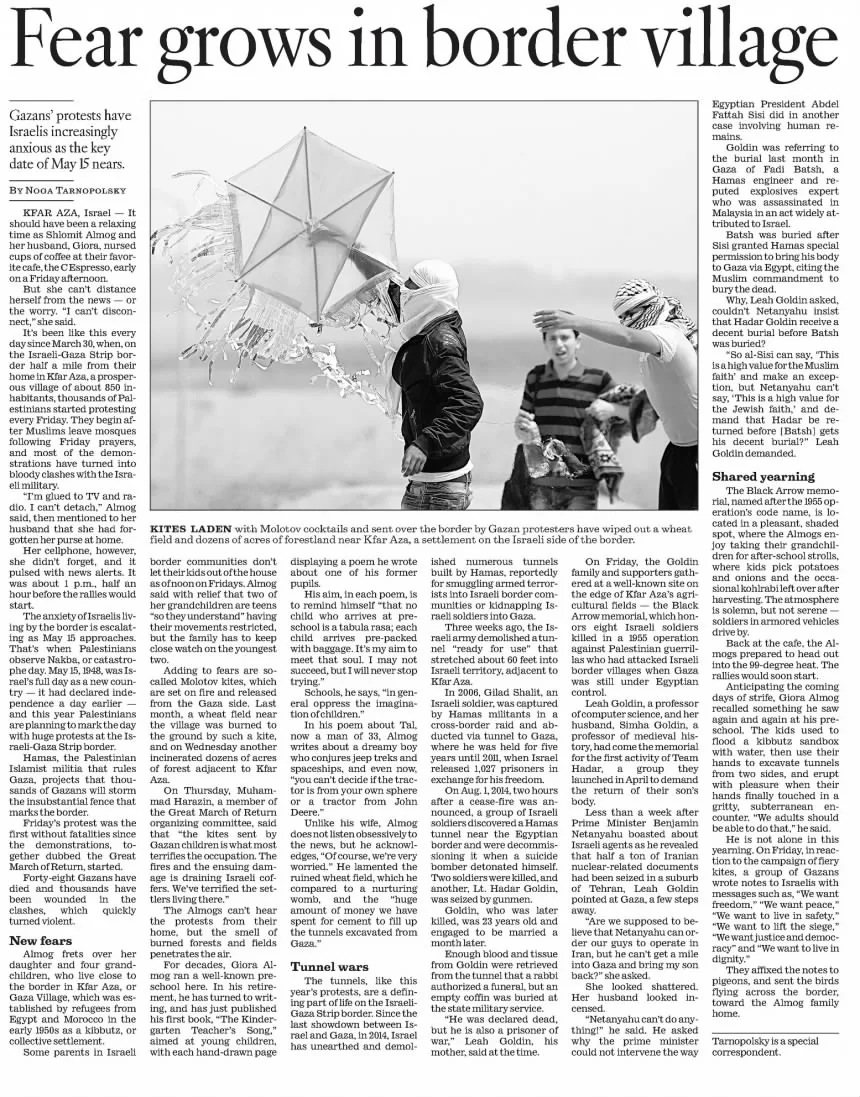
Almog said with relief that two of her grandchildren are teens “so they understand” having their movements restricted, but the family has to keep close watch on the youngest two. Adding to fears are so-called Molotov kites, which are set on fire and released from the Gaza side.
Last month, a wheat field near the village was burned to the ground by such a kite, and on Wednesday another incinerated dozens of acres of forest adjacent to Kfar Aza. On Thursday, Muhammad Harazin, a member of the Great March of Return organizing committee, said that “the kites sent by Gazan children is what most terrifies the occupation.
The fires and the ensuing damage is draining Israeli coffers. We’ve terrified the settlers living there.”
How this transcription was made
Read from the scan by a machine looking at the image of the page, not by optical character recognition and not by a person. The clipping carries no masthead and no dated folio line, so the date recorded here could not be checked against anything printed on the page. Nothing on the page contradicts it.
Cite this clipping
"Fear grows in border village," Los Angeles Times, 6 May 2018. Covering Palestine archive, CP-2018-024. https://coveringpalestine.org/archive/cp-2018-024
More from Los Angeles Times
- Bomb Victim Had Expected DeathLos Angeles Times · 10 July 1972
- Mrs. Meir's Safety StudiedLos Angeles Times · 11 January 1973
- Show of Artists from PalestineLos Angeles Times · 24 June 1977
- Jews of the Arab World?Los Angeles Times · 2 November 1986
- Islamic Group Challenges PLO Over PalestineLos Angeles Times · 5 September 1988
- U.N.: Israel Condemned for Palestinian DeathsLos Angeles Times · 13 October 1990
- 35 more from this paper in the full text →
More from the 2010s
- On edge over Trump’s threatLos Angeles Times · 8 January 2018
- Trump: Palestinians must return to talks to receive aidDaily Tribune News · 26 January 2018
- Palestinian leader Abbas rebukes Trump: 'Shame on you'Daily Tribune News · 26 January 2018
- Trump: Palestine must return to talks to get aidRocky Mount Telegram · 26 January 2018
- COUNTDOWN TO CATASTROPHEChicago Tribune · February 2018
- Healing the divideSt. Louis Jewish Light · 7 February 2018
- All 321 clippings from the 2010s →
Last updated 2 November 2026
This record is part of Covering Palestine, an archive of American newspaper clippings about Palestinians, 1724 to 2023. Researched and assembled by Maria Robles.
The clipping belongs to the newspaper that printed it, or to the news agency that supplied the copy. It is reproduced here for research, criticism and commentary. A city here is where the newspaper was published, not where the story came from, and on most records it was taken from the masthead.
Something wrong here, or something you know about this clipping? The archive is still being built and corrections are wanted: maria@rozumstudio.com, quoting CP-2018-024.
Everything printed in 2018 · Printed on this day · See it in the archive reel · Full text of every clipping · Dataset