The Columbus Dispatch · 6 June 2021
CP-2021-021
Jerusalem evictions could happen
Campaign helped spark recent Gaza war
Joseph Krauss / ASSOCIATED PRESS
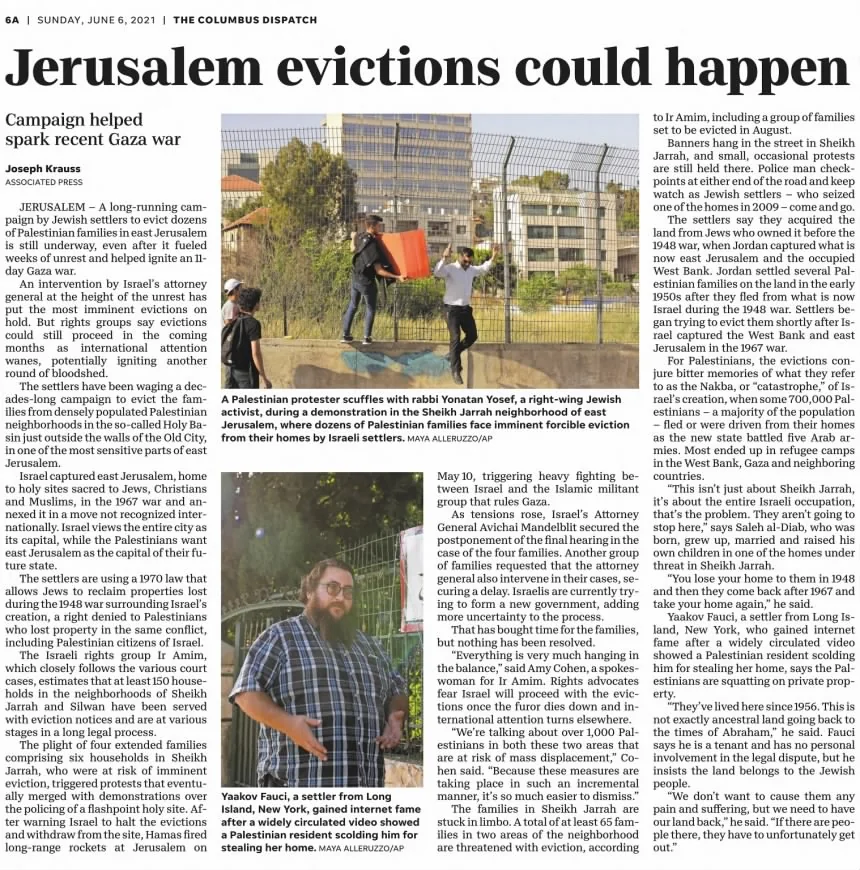
Transcribed from the clipping
JERUSALEM – A long-running campaign by Jewish settlers to evict dozens of Palestinian families in east Jerusalem is still underway, even after it fueled weeks of unrest and helped ignite an 11-day Gaza war. An intervention by Israel’s attorney general at the height of the unrest has put the most imminent evictions on hold.
But rights groups say evictions could still proceed in the coming months as international attention wanes, potentially igniting another round of bloodshed.
The settlers have been waging a decades-long campaign to evict the families from densely populated Palestinian neighborhoods in the so-called Holy Basin just outside the walls of the Old City, in one of the most sensitive parts of east Jerusalem.
Israel captured east Jerusalem, home to holy sites sacred to Jews, Christians and Muslims, in the 1967 war and annexed it in a move not recognized internationally. Israel views the entire city as its capital, while the Palestinians want east Jerusalem as the capital of their future state.
The settlers are using a 1970 law that allows Jews to reclaim properties lost during the 1948 war surrounding Israel’s creation, a right denied to Palestinians who lost property in the same conflict, including Palestinian citizens of Israel.
The Israeli rights group Ir Amim, which closely follows the various court cases, estimates that at least 150 households in the neighborhoods of Sheikh Jarrah and Silwan have been served with eviction notices and are at various stages in a long legal process.
The plight of four extended families comprising six households in Sheikh Jarrah, who were at risk of imminent eviction, triggered protests that eventually merged with demonstrations over the policing of a flashpoint holy site.
After warning Israel to halt the evictions and withdraw from the site, Hamas fired long-range rockets at Jerusalem on May 10, triggering heavy fighting between Israel and the Islamic militant group that rules Gaza. As tensions rose, Israel’s Attorney General Avichai Mandelblit secured the postponement of the final hearing in the case of the four families.
Another group of families requested that the attorney general also intervene in their cases, securing a delay. Israelis are currently trying to form a new government, adding more uncertainty to the process. That has bought time for the families, but nothing has been resolved. “Everything is very much hanging in the balance,” said Amy Cohen, a spokeswoman for Ir Amim.
Rights advocates fear Israel will proceed with the evictions once the furor dies down and international attention turns elsewhere. “We’re talking about over 1,000 Palestinians in both these two areas that are at risk of mass displacement,” Cohen said. “Because these measures are taking place in such an incremental manner, it’s so much easier to dismiss.”
The families in Sheikh Jarrah are stuck in limbo. A total of at least 65 families in two areas of the neighborhood are threatened with eviction, according to Ir Amim, including a group of families set to be evicted in August. Banners hang in the street in Sheikh Jarrah, and small, occasional protests are still held there.
Police man checkpoints at either end of the road and keep watch as Jewish settlers – who seized one of the homes in 2009 – come and go. The settlers say they acquired the land from Jews who owned it before the 1948 war, when Jordan captured what is now east Jerusalem and the occupied West Bank.
Jordan settled several Palestinian families on the land in the early 1950s after they fled from what is now Israel during the 1948 war. Settlers began trying to evict them shortly after Israel captured the West Bank and east Jerusalem in the 1967 war.
For Palestinians, the evictions conjure bitter memories of what they refer to as the Nakba, or “catastrophe,” of Israel’s creation, when some 700,000 Palestinians – a majority of the population – fled or were driven from their homes as the new state battled five Arab armies. Most ended up in refugee camps in the West Bank, Gaza and neighboring countries.
“This isn’t just about Sheikh Jarrah, it’s about the entire Israeli occupation, that’s the problem. They aren’t going to stop here,” says Saleh al-Diab, who was born, grew up, married and raised his own children in one of the homes under threat in Sheikh Jarrah. “You lose your home to them in 1948 and then they come back after 1967 and take your home again,” he said.
Yaakov Fauci, a settler from Long Island, New York, who gained internet fame after a widely circulated video showed a Palestinian resident scolding him for stealing her home, says the Palestinians are squatting on private property. “They’ve lived here since 1956. This is not exactly ancestral land going back to the times of Abraham,” he said.
Fauci says he is a tenant and has no personal involvement in the legal dispute, but he insists the land belongs to the Jewish people. “We don’t want to cause them any pain and suffering, but we need to have our land back,” he said. “If there are people there, they have to unfortunately get out.”
How this transcription was made
Read from the scan by a machine looking at the image of the page, not by optical character recognition and not by a person. The printed date on the page agrees with the date recorded here.
Context added by this archive
This clipping is the short printing of an Associated Press story by Joseph Krauss that this archive also holds in full, at CP-2021-023. The two were compared directly: every six-word sequence here appears in that one. Same copy, stopped early.
It ends on a settler explaining why the families have to go, “If there are people there, they have to unfortunately get out.” The next sentence in the long printing is the count of what has already been done — Ir Amim estimating that settler organizations have already evicted 10 families in Sheikh Jarrah and at least 74 in Silwan.
This printing stops one sentence short of it, and drops the last seven paragraphs: that the Israeli government and the settler organization did not respond to requests for comment, the finding under international law, and the paragraph naming the mechanism as state policy since 1967 rather than settler initiative.
Cite this clipping
"Jerusalem evictions could happen," The Columbus Dispatch, 6 June 2021, p. 6A. Covering Palestine archive, CP-2021-021. https://coveringpalestine.org/archive/cp-2021-021
More from the 2020s
- Joe and Bibi talked, but what's it mean? Biden and Israel, the scorecard.St. Louis Jewish Light · 24 February 2021
- Phoenix family shares recipe for rice dishThe Arizona Republic · 28 April 2021
- Cooking TogetherChicago Tribune · 7 May 2021
- Palestinians fear loss of homes as evictions loomThe Palm Beach Post · 11 May 2021
- Beset by virus, Gaza’s hospitals now struggle with woundedKentucky New Era · 15 May 2021
- Biden supports cease-fireDaily Citizen · 18 May 2021
- All 202 clippings from the 2020s →
Last updated 2 November 2026
This record is part of Covering Palestine, an archive of American newspaper clippings about Palestinians, 1724 to 2023. Researched and assembled by Maria Robles.
The clipping belongs to the newspaper that printed it, or to the news agency that supplied the copy. It is reproduced here for research, criticism and commentary. A city here is where the newspaper was published, not where the story came from, and on most records it was taken from the masthead.
Something wrong here, or something you know about this clipping? The archive is still being built and corrections are wanted: maria@rozumstudio.com, quoting CP-2021-021.
Everything printed in 2021 · Printed on this day · See it in the archive reel · Full text of every clipping · Dataset