The New York Times · New York, New York · 10 June 1917
CP-1917-001
Palestine Not a Solution of Jewish Problem
Zionism Has No Positive Message to Jews in America—Preservation of Hebraic Spirit Needed Rather than Separate Nationality
By Henry Moskowitz
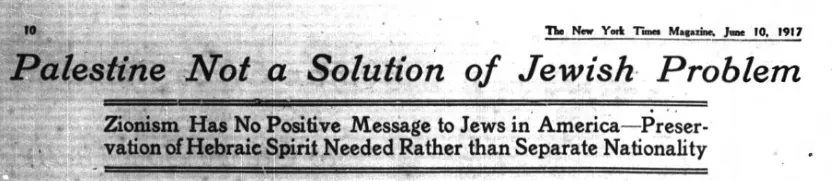
Transcribed from the clipping
ZIONISM, in the last twenty-five years, has become one of the most articulate Jewish weapons directed against anti-Semitism As such, it has been a barometer of the progress anti-Semitism has made in various lands. Whenever a pogrom takes place the adherents of Zionism increase in number.
If there is a lull in the anti-Semitic movement, Zionism registers that lull by a loss in aggressive strength. After the pogrom in 1881 the Zionist movement as a political force received great impetus. Even in America the tragedy of Kishineff brought many unsynagogued Jews into the racial fold.
The sufferings of Israel gave even the agnostic and radical Jew a consciousness of kind from which the Zionist and Nationalist movement gained. This movement became the refuge of many Jews to whom Judaism as a religious message had ceased to appeal. Zionism as a political weapon against anti-Semitism has always represented a minority in Israel.
For the purposes of clear thinking we must consider Zionism, first, as a solution to the general Jewish problem; second, as a movement which can satisfy the soul of the Jew; third, as a limited experiment for the purpose of establishing Jewish colonies and a Jewish cultural centre; and fourth, the message of Zionism, if it has any, to the Jews of America. […] From a practical point of view the existence of Palestine as a home land will not solve the problem except as a refuge for those Jewish dreamers who will consecrate themselves to make their Jewish dreams come true.
But they are not the only dreamers. The dreamers of Israel have lived and suffered and have made their Jewish dreams come true for the world without a Jewish State, and they will still exist. […] To the Jews of America Zionism has no positive message. The American Jew is nationally an American only.
He is thrilled by one flag, which symbolizes the ideals of a democracy in which men and women of all races have joined together to make government of the people, for the people, and by the people a success. […] My conclusion, finally, is that Jewish nationalism as a philosophy of life is not satisfactory; that it is reactionary; that it leads to a racial egotism and that it does not conduce to profound moral and spiritual but rather to romantic emotions.
How this transcription was made
The image is a composite of the two scans that carry this article, joined in printed order and not rescaled. The upper page is the first page: it carries the folio 10, the running head “The New York Times Magazine, June 10, 1917”, the headline, the deck, the byline and four full columns ending “(Continued on Following Page.)”. The lower is the continuation: it repeats the headline as a standing head, opens “(Continued from Preceding Page.)” and runs to the end of the article. The order is fixed by the pages themselves — the first ends mid-sentence “…the many varying shades of Jewish religious, political, social, and economic opinion,” and the continuation picks the sentence up at “the rocks upon which States have been wrecked.” The two scans were measured before joining and needed no rescaling: body measure 722 px against 721 px, line pitch 10 px on both. The continuation was shifted 25 px right so the two text measures sit on one left edge; the folio and both running heads are left visible inside the composite. Until now this record's image was a banner strip of 832 by 181 pixels showing the folio line, the headline and the deck and no body text at all, which is why the record has never carried an excerpt. Both pages have now been read in full from magnified crops. What I could not read: one complete line of type, roughly eight words, at the foot of column 4 of page 10, between “economic opinion,” and the continuation notice, which survives only as ink fragments and does not resolve under magnification or contrast stretching; I have not guessed it, and the sentence is therefore broken across the page turn. A crease across the foot of page 10 strikes one line in each of columns 1 and 2; both are legible at 16x but their punctuation is not reliable. Three readings are uncertain at this scan resolution and are recorded as the sense requires rather than as inventions: the first of the two instances of “pogrom” on page 10, whose final letter is 3 px narrower than the unambiguous second instance; the first word of the continuation, “rocks”, whose vowel is ink-filled; and the last word of the article, “habitat”, crossed by a scratch. Printed errors are kept as set and not repaired: “anti-Semitism As such” and “in Jewish life The Jewish religion” are both missing their full stop on the page, “distictive” appears for distinctive in column 2 although the word is set correctly elsewhere on the same page, and “desinies” appears for destinies on the continuation. The date is printed and is not in question: the running head gives June 10, 1917, matching the record. The page prints no masthead, only the section running head “The New York Times Magazine”; that is a section of this paper, not a second newspaper, and pub is unchanged. The page field is set to 10, the folio printed on the page and now visible in the image; the record previously carried 66, taken from the newspaper's own article index, which numbers across the whole Sunday paper rather than within the Magazine, and that earlier value is probably also correct in its own system. The continuation's folio is not on the scan, so no page range is given. One thing worth saying plainly about a signed feature of this length, some four columns to the page across two pages and near 3,400 words: no Palestinian and no Arab is named on either page, and none is quoted, described or mentioned at all. The words Arab, Moslem, Mohammedan, Turk and inhabitant do not appear, and nothing on the page records that Palestine was then Ottoman territory or that anybody was living in it. Palestine appears throughout only as a destination, a refuge or a proposed state — “if Palestine were obtained”, “the existence of Palestine as a home land” — never as a place with people in it. The two pages carry no attributed quotation from any living person: the only quotation marks belong to arguments the author constructs for a generic unnamed Zionist and to scripture, so the quotes field is deliberately empty rather than filled with a speaker who does not exist on the page.
Context added by this archive
The New York Times Magazine, June 1917, five months before the Balfour Declaration, arguing against the project on its own front. The objection is about what Jews in America need, and it is printed at feature length. Palestine appears in the headline as a proposed solution being declined, not as a place with anyone in it.
Cite this clipping
"Palestine Not a Solution of Jewish Problem," The New York Times, 10 June 1917, p. 10. Covering Palestine archive, CP-1917-001. https://coveringpalestine.org/archive/cp-1917-001
More from The New York Times
- The Maine Colony in PalestineThe New York Times · 12 November 1866
- Jewish Colonization in PalestineThe New York Times · 9 December 1883
- Jewish State in Palestine OpposedThe New York Times · 9 July 1897
- ZIONIST CONGRESS IN BASELThe New York Times · 31 August 1897
- ROME FEARS THE ZIONISTSThe New York Times · 12 September 1897
- PROGRESS OF ZIONISMThe New York Times · 16 December 1901
- 852 more from this paper in the full text →
More from the 1910s
- PLANS IDEAL PALESTINEThe Baltimore Sun · 27 June 1917
- WAR TANKS WHERE SAMSON LIFTED GATES OF GAZASan Antonio Express News · 22 July 1917
- JEWISH SOCIALISTS FOR FREE PALESTINEThe New York Times · 23 July 1917
- Turkish Jews Opposed to Zionism.The American Jewish World · 7 September 1917
- Gaza and Beersheba, Ancient Places, Taken By Modern New ArmiesPittsburgh Post-Gazette · 18 November 1917
- IN PALESTINE.Evening Capital News · 23 November 1917
- All 77 clippings from the 1910s →
In these collections
Last updated 2 November 2026
This record is part of Covering Palestine, an archive of American newspaper clippings about Palestinians, 1724 to 2023. Researched and assembled by Maria Robles.
The clipping belongs to the newspaper that printed it, or to the news agency that supplied the copy. It is reproduced here for research, criticism and commentary. A city here is where the newspaper was published, not where the story came from, and on most records it was taken from the masthead.
Something wrong here, or something you know about this clipping? The archive is still being built and corrections are wanted: maria@rozumstudio.com, quoting CP-1917-001.
Everything printed in 1917 · Printed on this day · See it in the archive reel · Full text of every clipping · Dataset