Honolulu Star-Advertiser · Honolulu, Hawaii · 26 March 1922
CP-1922-001
Odd Customs in Palestine Under Ban
The British Government Frowns on Superstitions of the Fellaheen
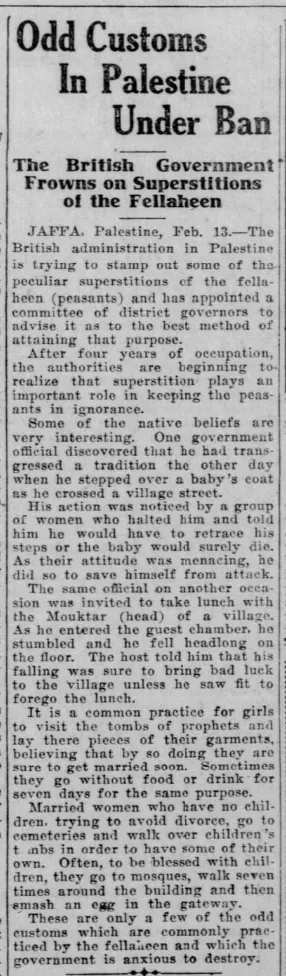
Shown from the top. The whole column — 3.4 times taller than it is wide — is in the enlargement.
Transcribed from the clipping
“JAFFA, Palestine, Feb. 13.—The British administration in Palestine is trying to stamp out some of the peculiar superstitions of the fellaheen (peasants) and has appointed a committee of district governors to advise it as to the best method of attaining that purpose.
After four years of occupation, the authorities are beginning to realize that superstition plays an important role in keeping the peasants in ignorance. Some of the native beliefs are very interesting. One government official discovered that he had transgressed a tradition the other day when he stepped over a baby’s coat as he crossed a village street.
His action was noticed by a group of women who halted him and told him he would have to retrace his steps or the baby would surely die. As their attitude was menacing, he did so to save himself from attack. The same official on another occasion was invited to take lunch with the Mouktar (head) of a village.
As he entered the guest chamber, he stumbled and he fell headlong on the floor. The host told him that his falling was sure to bring bad luck to the village unless he saw fit to forego the lunch. It is a common practice for girls to visit the tombs of prophets and lay there pieces of their garments, believing that by so doing they are sure to get married soon.
Sometimes they go without food or drink for seven days for the same purpose. Married women who have no children, trying to avoid divorce, go to cemeteries and walk over children’s tombs in order to have some of their own. Often, to be blessed with children, they go to mosques, walk seven times around the building and then smash an egg in the gateway.
These are only a few of the odd customs which are commonly practiced by the fellaheen and which the government is anxious to destroy.”
Context added by this archive
A colonial government legislating against village practice, which is something you can only do to a population that is there and is doing it. Honolulu, 1922. The last word of the piece is destroy.
Cite this clipping
"Odd Customs in Palestine Under Ban," Honolulu Star-Advertiser, 26 March 1922, p. 1. Covering Palestine archive, CP-1922-001. https://coveringpalestine.org/archive/cp-1922-001
More from Honolulu Star-Advertiser
- Jewish Bomb Squad Starts Palestine RiotHonolulu Star-Advertiser · 24 December 1947
- Israel has no desire for a pact, while Palestinians have no cloutHonolulu Star-Advertiser · 21 August 2010
- Obama to Israeli youth: Forge peaceHonolulu Star-Advertiser · 22 March 2013
- Masterful ‘Omar’ dives deep into notion of conflictHonolulu Star-Advertiser · 28 February 2014
- 7 killed in shooting outside synagogue in East JerusalemHonolulu Star-Advertiser · 28 January 2023
- Thousands take to streets to protest Gaza conditionsHonolulu Star-Advertiser · 31 July 2023
More from the 1920s
- Stimulate move for the emancipation of women in PalestineLa Crosse Tribune · 26 January 1922
- Women of Palestine Entering the Industrial FieldThe Brooklyn Daily Eagle · 5 February 1922
- PALESTINE AND THE ZIONISTS.The New York Times · 16 April 1922
- THE ANTI-ZIONIST PROTESTThe American Jewish World · 28 April 1922
- PALESTINE ARABS BITTERThe New York Times · 18 May 1922
- Unrest in Asia MinorWashington Post · 23 May 1922
- All 120 clippings from the 1920s →
In these collections
Last updated 2 November 2026
This record is part of Covering Palestine, an archive of American newspaper clippings about Palestinians, 1724 to 2023. Researched and assembled by Maria Robles.
The clipping belongs to the newspaper that printed it, or to the news agency that supplied the copy. It is reproduced here for research, criticism and commentary. A city here is where the newspaper was published, not where the story came from, and on most records it was taken from the masthead.
Something wrong here, or something you know about this clipping? The archive is still being built and corrections are wanted: maria@rozumstudio.com, quoting CP-1922-001.
Everything printed in 1922 · Printed on this day · See it in the archive reel · Full text of every clipping · Dataset