Buffalo Jewish Review · Buffalo, New York · 18 September 1925
CP-1925-006
Making Successful Farmers Out of City-Bred Jews in the Quickest and Cheapest Way
Dr. S. E. Soskin, Distinguished Jewish Colonization Expert, Describes His Widely-Discussed Program of Intensive Colonization Which Will Transform Palestine Into a Great Fruit-Growing and Truck Farming Country, Dotted With Large Colonies on Small Areas
An interview by Israel Goldberg
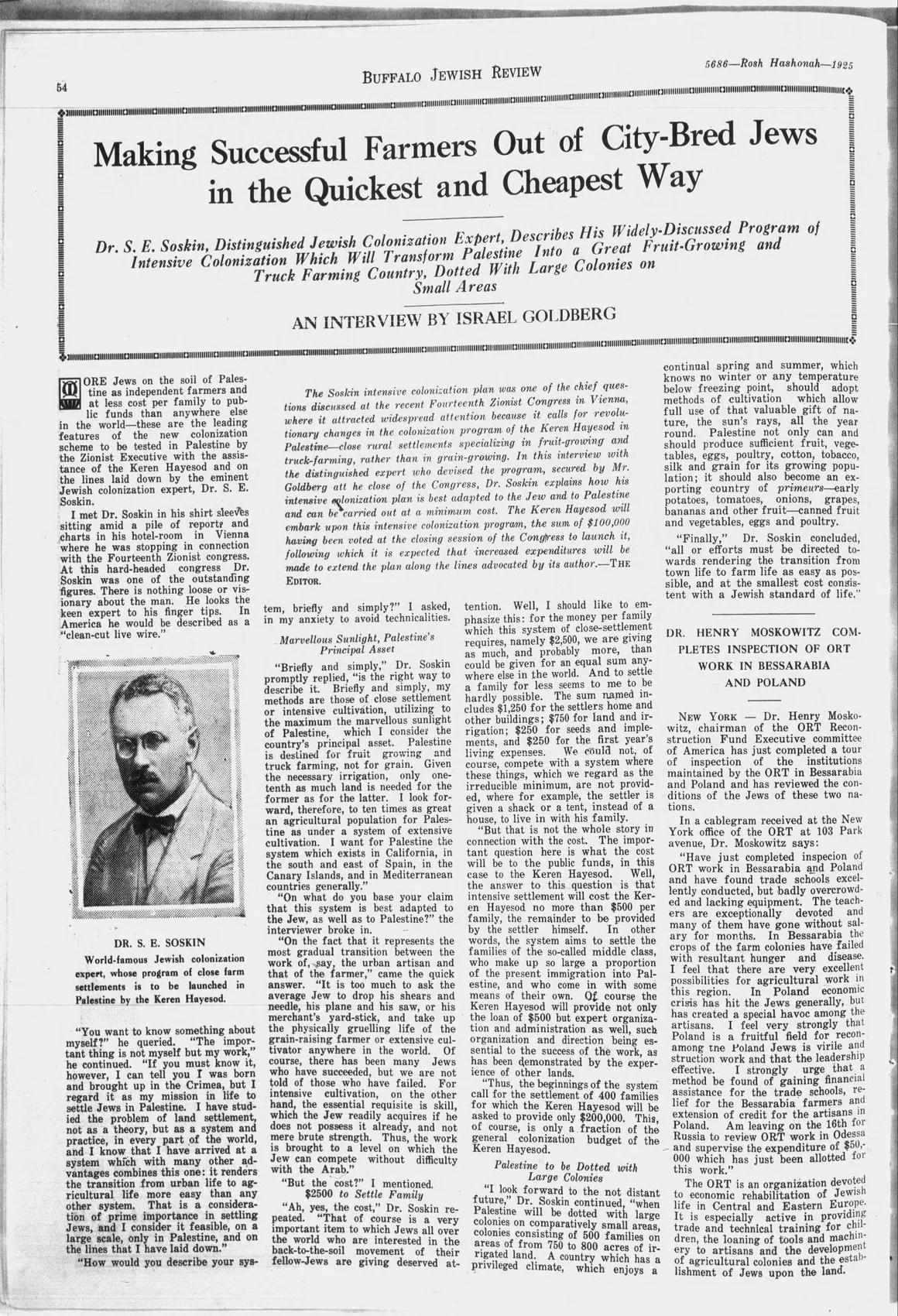
Transcribed from the clipping
“MORE Jews on the soil of Palestine as independent farmers and at less cost per family to public funds than anywhere else in the world—these are the leading features of the new colonization scheme to be tested in Palestine by the Zionist Executive with the assistance of the Keren Hayesod and on the lines laid down by the eminent Jewish colonization expert, Dr. S.
E. Soskin… ‘Briefly and simply, my methods are those of close settlement or intensive cultivation, utilizing to the maximum the marvellous sunlight of Palestine, which I consider the country’s principal asset. Palestine is destined for fruit growing and truck farming, not for grain.
Given the necessary irrigation, only one-tenth as much land is needed for the former as for the latter.
I look forward, therefore, to ten times as great an agricultural population for Palestine as under a system of extensive cultivation…’ ‘On the fact that it represents the most gradual transition between the work of, say, the urban artisan and that of the farmer,’ came the quick answer.
‘It is too much to ask the average Jew to drop his shears and needle, his plane and his saw, or his merchant’s yard-stick, and take up the physically gruelling life of the grain-raising farmer or extensive cultivator anywhere in the world… For intensive cultivation, on the other hand, the essential requisite is skill, which the Jew readily acquires if he does not possess it already, and not mere brute strength.
Thus, the work is brought to a level on which the Jew can compete without difficulty with the Arab.’… ‘I look forward to the not distant future,’ Dr.
Soskin continued, ‘when Palestine will be dotted with large colonies on comparatively small areas, colonies consisting of 500 families on areas of from 750 to 800 acres of irrigated land.’”
Context added by this archive
An interview with a man the paper calls a colonization expert, three times, in a headline and twice in the line beneath it. What the program is for is set out in costings — $2,500 a family, $1,250 for a house, $750 for land and irrigation — and in a sentence about who it is measured against.
Intensive cultivation needs skill rather than brute strength, and so the work is brought to a level on which the Jew can compete without difficulty with the Arab. The Arab appears once in the interview, as the competitor. That same year a British minister told the House of Lords those competitors were cultivating nine million dunam (CP-1925-002).
Cite this clipping
"Making Successful Farmers Out of City-Bred Jews in the Quickest and Cheapest Way," Buffalo Jewish Review, 18 September 1925. Covering Palestine archive, CP-1925-006. https://coveringpalestine.org/archive/cp-1925-006
More from Buffalo Jewish Review
- United Palestine Funds AppealBuffalo Jewish Review · 13 November 1925
- Jewish Colonization Will Extend Beyond Palestine Frontier, Weizmann Tells Actions CommitteeBuffalo Jewish Review · 6 August 1926
- Bishop Dunn Denies Modernization of Palestine by Jews Reduces Sanctity of Holy LandBuffalo Jewish Review · 29 April 1927
- What American Archaeologists Excavated at Tell En-NasbethBuffalo Jewish Review · 15 July 1927
- To Raise $150,000 for Palestine in Twelve DaysBuffalo Jewish Review · 23 September 1927
- Palestine From An Agricultural Expert’s ViewpointBuffalo Jewish Review · 7 October 1927
- 22 more from this paper in the full text →
More from the 1920s
- Dinar and Shekel Reappear In Currency of PalestineThe New York Times · 27 January 1925
- American Energy Is Making New Jewish Homeland in PalestineThe Modern Union · 1 February 1925
- Peace in Palestine When Balfour Party ArrivesWisconsin Jewish Chronicle · 27 March 1925
- Arabs, Jews Unite On Palestine RoadsThe Milwaukee Leader · 23 April 1925
- House of Lords Hears Figures on Cultivatable Land In PalestineWisconsin Jewish Chronicle · 29 May 1925
- A. L. Saltzstein Tells Story Of Trip To PalestineWisconsin Jewish Chronicle · 26 June 1925
- All 120 clippings from the 1920s →
In these collections
Last updated 2 November 2026
This record is part of Covering Palestine, an archive of American newspaper clippings about Palestinians, 1724 to 2023. Researched and assembled by Maria Robles.
The clipping belongs to the newspaper that printed it, or to the news agency that supplied the copy. It is reproduced here for research, criticism and commentary. A city here is where the newspaper was published, not where the story came from, and on most records it was taken from the masthead.
Something wrong here, or something you know about this clipping? The archive is still being built and corrections are wanted: maria@rozumstudio.com, quoting CP-1925-006.
Everything printed in 1925 · Printed on this day · See it in the archive reel · Full text of every clipping · Dataset