Buffalo Jewish Review · Buffalo, New York · 7 October 1927
CP-1927-013
Palestine From An Agricultural Expert’s Viewpoint
Jewish Birthrate Higher in Palestine Than Elsewhere
Dr. Arthur Ruppin
Transcribed from the clipping
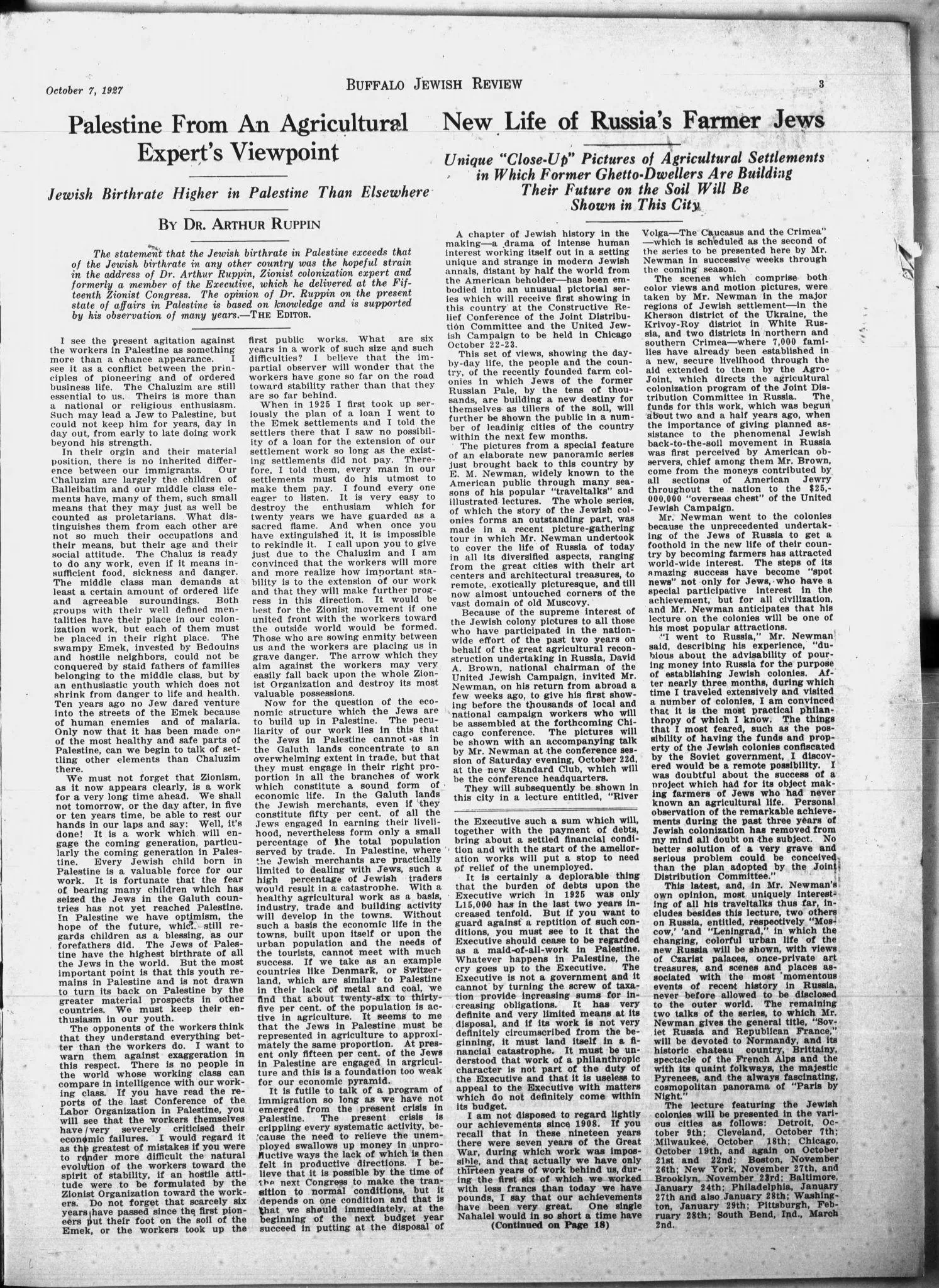
“The statement that the Jewish birthrate in Palestine exceeds that of the Jewish birthrate in any other country was the hopeful strain in the address of Dr. Arthur Ruppin, Zionist colonization expert and formerly a member of the Executive, which he delivered at the Fifteenth Zionist Congress. The opinion of Dr. Ruppin on the present state of affairs in Palestine is based on knowledge and is supported by his observation of many years. — The Editor. I see the present agitation against the workers in Palestine as something more than a chance appearance. I see it as a conflict between the principles of pioneering and of ordered business life… The swampy Emek, invested by Bedouins and hostile neighbors, could not be conquered by staid fathers of families belonging to the middle class, but by an enthusiastic youth which does not shrink from danger to life and health. Ten years ago no Jew dared venture into the streets of the Emek because of human enemies and of malaria. Only now that it has been made one of the most healthy and safe parts of Palestine, can we begin to talk of settling other elements than Chaluzim there. We must not forget that Zionism, as it now appears clearly, is a work for a very long time ahead. We shall not tomorrow, or the day after, in five or ten years time, be able to rest our hands in our laps and say: Well, it’s done! It is a work which will engage the coming generation, particularly the coming generation in Palestine. Every Jewish child born in Palestine is a valuable force for our work. It is fortunate that the fear of bearing many children which has seized the Jews in the Galuth countries has not yet reached Palestine. In Palestine we have optimism, the hope of the future, which still regards children as a blessing, as our forefathers did. The Jews of Palestine have the highest birthrate of all the Jews in the world. But the most important point is that this youth remains in Palestine and is not drawn to turn its back on Palestine by the greater material prospects in other countries.… Now for the question of the economic structure which the Jews are to build up in Palestine. The peculiarity of our work lies in this that the Jews in Palestine cannot — as in the Galuth lands concentrate to an overwhelming extent in trade, but that they must engage in their right proportion in all the branches of work which constitute a sound form of economic life… At present only fifteen per cent. of the Jews in Palestine are engaged in agriculture and this is a foundation too weak for our economic pyramid. It is futile to talk of a program of immigration so long as we have not emerged from the present crisis in Palestine. The present crisis is crippling every systematic activity…”
Context added by this archive
The man who ran Zionist land purchase and settlement, addressing the Fifteenth Zionist Congress, printed in full in an American weekly. Two things are worth reading slowly. The valley is described as invested by Bedouins and hostile neighbours and as something to be conquered — the existing population appearing in the same clause as the malaria. And the birthrate is set out as an instrument: every Jewish child born in Palestine is a valuable force for our work. The page it shares carries a lecture series on Jewish farm colonies in the Soviet Union, where seven thousand families had been settled with American money.
Cite this item
"Palestine From An Agricultural Expert’s Viewpoint," Buffalo Jewish Review, 7 October 1927. Covering Palestine archive, CP-1927-013. https://coveringpalestine.org/archive/cp-1927-013
Elsewhere in the archive
- Bishop Dunn Denies Modernization of Palestine by Jews Reduces Sanctity of Holy LandBuffalo Jewish Review · 29 April 1927 · the same newspaper
- What American Archaeologists Excavated at Tell En-NasbethBuffalo Jewish Review · 15 July 1927 · the same newspaper
- To Raise $150,000 for Palestine in Twelve DaysBuffalo Jewish Review · 23 September 1927 · the same newspaper
- League Commission Inquires Into Phases of Palestine DevelopmentWisconsin Jewish Chronicle · 7 January 1927 · the same year
- Palestine Arabs Friendly To JewThe Birmingham News · 17 January 1927 · the same year
- Glory Of Ancient Palestine May Be Restored By JewsThe News Journal · 13 March 1927 · the same year
This record is part of Covering Palestine, an archive of American and Anglophone newspaper clippings about Palestinians, 1812 to 2022. Researched and assembled by Maria Robles.
The clipping belongs to the newspaper that printed it, or to the wire service that supplied the copy. It is reproduced here for research, criticism and commentary. The city is derived from the masthead, not read off the clipping.
Something wrong here, or something you know about this clipping? The archive is still being built and corrections are wanted: maria@rozumstudio.com, quoting CP-1927-013.
See it in the archive reel · Full text of every clipping · Dataset