Wisconsin Jewish Chronicle · Milwaukee, Wisconsin · 7 January 1927
CP-1927-025
League Commission Inquires Into Phases of Palestine Development
Jewish Telegraphic Agency
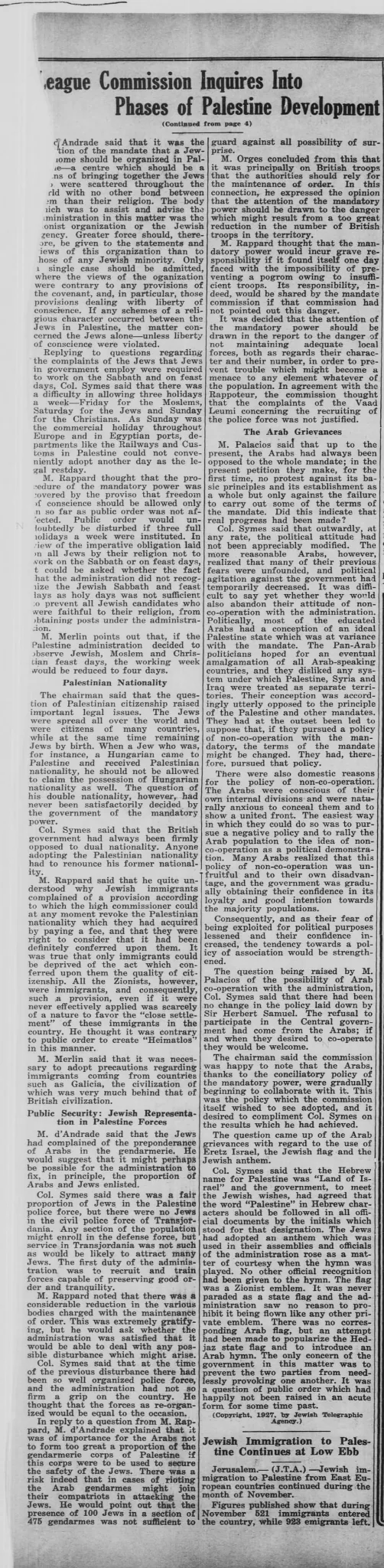
Transcribed from the clipping
“Palestinian Nationality. The chairman said that the question of Palestine citizenship raised important legal issues… Col. Symes said that the British government had always been firmly opposed to dual nationality. Anyone adopting the Palestinian nationality had to renounce his former nationality. M. Rappard said that he quite understood why Jewish immigrants complained of a provision according to which the high commissioner could at any moment revoke the Palestinian nationality which they had acquired by paying a fee… Public Security: Jewish Representation in Palestine Forces. M. d’Andrade said that the Jews had complained of the preponderance of Arabs in the gendarmerie… M. Rappard… was of importance for the Arabs not to form too great a proportion of the gendarmerie corps of Palestine if this corps were to be used to secure the safety of the Jews. There was a risk indeed that in cases of rioting the Arab gendarmes might join their compatriots in attacking the Jews. Col. Symes said there was a fair proportion of Jews in the Palestine police force, but there were no Jews in the civil police force of Transjordania… The Arab Grievances. M. Palacios said that up to the present, the Arabs had always been opposed to the whole mandate; in the present petition they make, for the first time, no protest against its basic principles and its establishment as a whole but only against the failure to carry out some of the terms of the mandate. Did this indicate that real progress had been made? Col. Symes said that outwardly, at any rate, the political attitude had not been appreciably modified… Politically, most of the educated Arabs had a conception of an ideal Palestine state which was at variance with the mandate. The Pan-Arab politicians hoped for an eventual amalgamation of all Arab-speaking countries, and they disliked any system under which Palestine, Syria and Iraq were treated as separate territories. Their conception was accordingly utterly opposed to the principle of the Palestine and other mandates. They had at the outset been led to suppose that, if they pursued a policy of non-co-operation with the mandatory, the terms of the mandate might be changed. They had, therefore, pursued that policy. There were also domestic reasons for the policy of non-co-operation. The Arabs were conscious of their own internal divisions and were naturally anxious to conceal them and to show a united front… Col. Symes said that there had been no change in the policy laid down by Sir Herbert Samuel. The refusal to participate in the Central government had come from the Arabs; if and when they desired to co-operate they would be welcome. The chairman said the commission was happy to note that the Arabs, thanks to the conciliatory policy of the mandatory power, were gradually beginning to collaborate with it… The question came up of the Arab grievances with regard to the use of Eretz Israel, the Jewish flag and the Jewish anthem. Col. Symes said that the Hebrew name for Palestine was ‘Land of Israel’ and the government, to meet the Jewish wishes, had agreed that the word ‘Palestine’ in Hebrew characters should be followed in all official documents by the initials which stood for that designation. The Jews had adopted an anthem which was used in their assemblies and officials of the administration rose as a matter of courtesy when the hymn was played. No other official recognition had been given to the hymn. The flag was a Zionist emblem. It was never paraded as a state flag and the administration saw no reason to prohibit it being flown like any other private emblem. There was no corresponding Arab flag, but an attempt had been made to popularize the Hedjaz state flag and to introduce an Arab hymn. The only concern of the government in this matter was to prevent the two parties from needlessly provoking one another.… Jewish Immigration to Palestine Continues at Low Ebb. Jerusalem. — (J.T.A.) — Figures published show that during November 521 immigrants entered the country, while 923 emigrants left.”
Context added by this archive
A verbatim-style report of the League of Nations Permanent Mandates Commission discussing Palestine, printed in a Milwaukee weekly. Three things in it are hard to find anywhere else in this archive. The British representative explains that Palestinian nationality required renouncing any other and could be revoked by the High Commissioner at will. A commissioner argues that Arabs should not form too large a share of the gendarmerie because they might side with their compatriots. And on flags: the Zionist emblem was flown freely as a private emblem, the Hebrew initials for Land of Israel followed the word Palestine in all official documents, and there was, in the government’s own words, no corresponding Arab flag. The item at the foot reports 521 immigrants arriving in November against 923 emigrants leaving.
Cite this item
"League Commission Inquires Into Phases of Palestine Development," Wisconsin Jewish Chronicle, 7 January 1927. Covering Palestine archive, CP-1927-025. https://coveringpalestine.org/archive/cp-1927-025
Elsewhere in the archive
- World Zionist Org. Seeks Palestine Economic FactsWisconsin Jewish Chronicle · 20 May 1927 · the same newspaper
- Bad Times in PalestineWisconsin Jewish Chronicle · 24 June 1927 · the same newspaper
- Start Relief For Victims Of Palestine EarthquakeWisconsin Jewish Chronicle · 22 July 1927 · the same newspaper
- Palestine Arabs Friendly To JewThe Birmingham News · 17 January 1927 · the same year
- Glory Of Ancient Palestine May Be Restored By JewsThe News Journal · 13 March 1927 · the same year
- Bishop Dunn Denies Modernization of Palestine by Jews Reduces Sanctity of Holy LandBuffalo Jewish Review · 29 April 1927 · the same year
This record is part of Covering Palestine, an archive of American and Anglophone newspaper clippings about Palestinians, 1812 to 2022. Researched and assembled by Maria Robles.
The clipping belongs to the newspaper that printed it, or to the wire service that supplied the copy. It is reproduced here for research, criticism and commentary. The city is derived from the masthead, not read off the clipping.
Something wrong here, or something you know about this clipping? The archive is still being built and corrections are wanted: maria@rozumstudio.com, quoting CP-1927-025.
See it in the archive reel · Full text of every clipping · Dataset