Wisconsin Jewish Chronicle · Milwaukee, Wisconsin · 26 June 1925
CP-1925-003
A. L. Saltzstein Tells Story Of Trip To Palestine
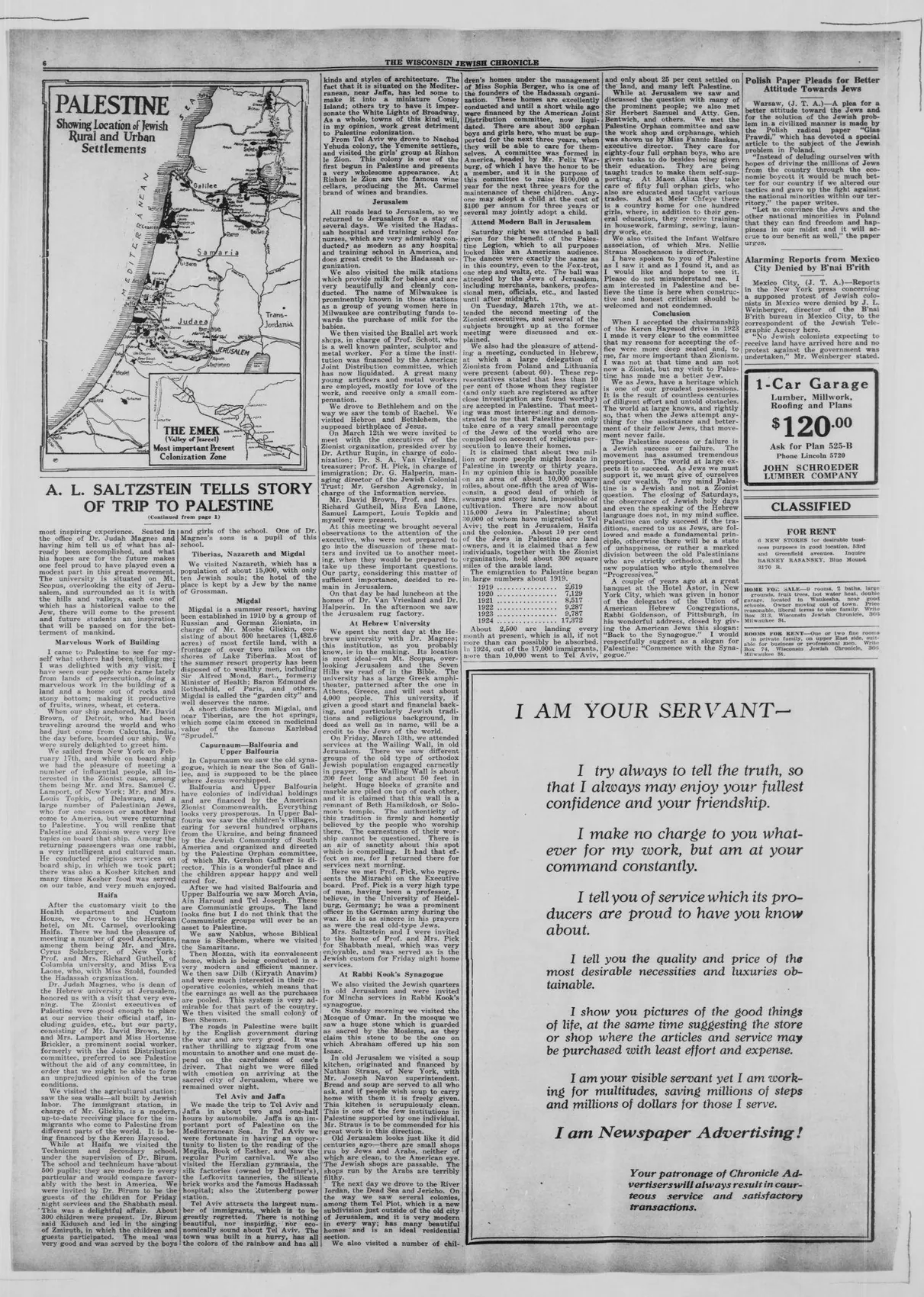
Transcribed from the clipping
“…most inspiring experience. Seated in the office of Dr. Judah Magnes and having him tell us of what has already been accomplished, and what his hopes are for the future makes one feel proud to have played even a modest part in this great movement. The university is situated on Mt.
Scopus, overlooking the city of Jerusalem, and surrounded as it is with the hills and valleys, each one of which has a historical value to the Jew, there will come to the present and future students an inspiration that will be passed on for the betterment of mankind.
Marvelous Work of Building I came to Palestine to see for myself what others had been telling me; I was delighted with my visit. I have seen our people who came lately from lands of persecution, doing a marvelous work in the building of a land and a home out of rocks and stony bottom; making it productive of fruits, wines, wheat, et cetera. When our ship anchored, Mr.
David Brown, of Detroit, who had been traveling around the world and who had just come from Calcutta, India, the day before, boarded our ship. We were surely delighted to greet him. We sailed from New York on February 17th, and while on board ship we had the pleasure of meeting a number of influential people, all interested in the Zionist cause, among them being Mr. and Mrs.
Samuel C. Lamport, of New York; Mr. and Mrs. Louis Topkis, of Delaware, and a large number of Palestinian Jews, who for one reason or another had come to America, but were returning to Palestine. You will realize that Palestine and Zionism were very live topics on board that ship. Among the returning passengers was one rabbi, a very intelligent and cultured man.
He conducted religious services on board ship, in which we took part; there was also a Kosher kitchen and many times Kosher food was served on our table, and very much enjoyed.
Haifa After the customary visit to the Health department and Custom House, we drove to the Herzlean hotel, on Mt. Carmel, overlooking Haifa. There we had the pleasure of meeting a number of good Americans, among them being Mr. and Mrs. Cyrus Solzberger, of New York; Prof. and Mrs.
Richard Gutheil, of Columbia university, and Miss Eva Laone, who, with Miss Szold, founded the Hadassah organization. Dr. Judah Magnes, who is dean of the Hebrew university at Jerusalem, honored us with a visit that very evening.
The Zionist executives of Palestine were good enough to place at our service their official staff, including guides, etc., but our party, consisting of Mr. David Brown, Mr. and Mrs.
Lamport and Miss Hortense Brickler, a prominent social worker, formerly with the Joint Distribution committee, preferred to see Palestine without the aid of any committee, in order that we might be able to form an unprejudiced opinion of the true conditions. We visited the agricultural station; saw the sea walls—all built by Jewish labor.
The immigrant station, in charge of Mr. Glickin, is a modern, up-to-date receiving place for the immigrants who come to Palestine from different parts of the world. It is being financed by the Keren Hayesod. While at Haifa we visited the Technicum and Secondary school, under the supervision of Dr. Birum.
The school and technicum have about 500 pupils; they are modern in every particular and would compare favorably with the best in America. We were invited by Dr. Birum to be the guests of the children for Friday night services and the Shabbath meal. This was a delightful affair. About 300 children were present. Dr.
Birum said Kidusch and led in the singing of Zmiruth, in which the children and guests participated. The meal was very good and was served by the boys and girls of the school. One of Dr. Magnes’s sons is a pupil of this school.
Tiberias, Nazareth and Migdal We visited Nazareth, which has a population of about 15,000, with only ten Jewish souls; the hotel of the place is kept by a Jew by the name of Grossman.
Migdal Migdal is a summer resort, having been established in 1910 by a group of Russian and German Zionists, in charge of Mr. Moshe Glickin, consisting of about 600 hectares (1,482.6 acres) of most fertile land, with a frontage of over two miles on the shores of Lake Tiberias.
Most of the summer resort property has been disposed of to wealthy men, including Sir Alfred Mond, Bart., formerly Minister of Health; Baron Edmund de Rothschild, of Paris, and others. Migdal is called the ‘garden city’ and well deserves the name.
A short distance from Migdal, and near Tiberias, are the hot springs, which some claim exceed in medicinal value of the famous Karlsbad ‘Sprudel.’
Capurnaum—Balfouria and Upper Balfouria In Capurnaum we saw the old synagogue, which is near the Sea of Galilee, and is supposed to be the place where Jesus worshipped. Balfouria and Upper Balfouria have colonies of individual holdings and are financed by the American Zionist Commonwealth. Everything looks very prosperous.
In Upper Balfouria we saw the children’s villages, caring for several hundred orphans from the Ukraine, and being financed by the Jewish Community of South America and organized and directed by the Palestine Orphan committee, of which Mr. Gershon Gaffner is director. This is a wonderful place and the children appear happy and well cared for.
After we had visited Balfouria and Upper Balfouria we saw Morch Avia, Ain Haroud and Tel Joseph. These are Communistic groups. The land looks fine but I do not think that the Communistic groups will ever be an asset to Palestine. We saw Nablus, whose Biblical name is Shechem, where we visited the Samaritans.
Then Mozza, with its convalescent home, which is being conducted in a very modern and efficient manner. We then saw Dilb (Kiryath Anavim) and were much interested in their co-operative colonies, which means that the earnings as well as the purchases are pooled. This system is very admirable for that part of the country. We then visited the small colony of Ben Shemen.
The roads in Palestine were built by the English government during the war and are very good. It was rather thrilling to zigzag from one mountain to another and one must depend on the carefulness of one’s driver. That night we were filled with emotion on arriving at the sacred city of Jerusalem, where we remained over night.
Tel Aviv and Jaffa We made the trip to Tel Aviv and Jaffa in about two and one-half hours by automobile. Jaffa is an important port of Palestine on the Mediterranean Sea. In Tel Aviv we were fortunate in having an opportunity to listen to the reading of the Megila, Book of Esther, and saw the regular Purim carnival.
We also visited the Herzlian gymnasia, the silk factories (owned by Delfiner’s), the Lefkovitz tanneries, the silicate brick works and the famous Hadassah hospital; also the Rutenberg power station. Tel Aviv attracts the largest number of immigrants, which is to be greatly regretted. There is nothing beautiful, nor inspiring, nor economically sound about Tel Aviv.
The town was built in a hurry, has all the colors of the rainbow and has all kinds and styles of architecture. The fact that it is situated on the Mediterranean, near Jaffa, has led some to make it into a miniature Coney Island; others try to have it impersonate the White Lights of Broadway.
As a whole, towns of this kind will, in my opinion, work great detriment to Palestine colonization. From Tel Aviv we drove to Nachod Yehuda colony, the Yemenite settlers, and visited the girls’ group at Rishon le Zion. This colony is one of the first begun in Palestine and presents a very wholesome appearance.
At Rishon le Zion are the famous wine cellars, producing the Mt. Carmel brand of wines and brandies.
Jerusalem All roads lead to Jerusalem, so we returned to Jerusalem for a stay of several days. We visited the Hadassah hospital and training school for nurses, which are very admirably conducted; as modern as any hospital and training school in America, and does great credit to the Hadassah organization.
We also visited the milk stations which provide milk for babies and are very beautifully and cleanly conducted. The name of Milwaukee is prominently known in those stations as a group of young women here in Milwaukee are contributing funds towards the purchase of milk for the babies. We then visited the Bzallel art work shops, in charge of Prof.
Schott, who is a well known painter, sculptor and metal worker. For a time the institution was financed by the American Joint Distribution committee, which has now liquidated. A great many young artificers and metal workers are employed, mostly for love of the work, and receive only a small compensation. We drove to Bethlehem and on the way we saw the tomb of Rachel.
We visited Hebron and Bethlehem, the supposed birthplace of Jesus. On March 12th we were invited to meet with the executives of the Zionist organization, presided over by Dr. Arthur Rupin, in charge of colonization; Dr. S. A. Van Vriesland, treasurer; Prof. H. Pick, in charge of immigration; Dr. G. Halperin, managing director of the Jewish Colonial Trust; Mr.
Gershon Agronsky, in charge of the Information service. Mr. David Brown, Prof. and Mrs. Richard Gutheil, Miss Eva Laone, Samuel Lamport, Louis Topkis and myself were present.
At this meeting we brought several observations to the attention of the executive, who were not prepared to go into the discussion of these matters and invited us to another meeting, when they would be prepared to take up these important questions. Our party, considering this matter of sufficient importance, decided to remain in Jerusalem.
On that day be had luncheon at the homes of Dr. Van Vriesland and Dr. Halperin. In the afternoon we saw the Jerusalem rug factory.
At Hebrew University We spent the next day at the Hebrew university with Dr. Magnes; this institution, as you probably know, is in the making. Its location is most ideal—on Mt. Scopus, overlooking Jerusalem and the Seven Hills we read of in the Bible.
The university has a large Greek amphitheater, patterned after the one in Athens, Greece, and will seat about 4,000 people. This university, if given a good start and financial backing, and particularly Jewish traditions and religious background, in deed as well as in name, will be a credit to the Jews of the world.
On Friday, March 13th, we attended services at the Wailing Wall, in old Jerusalem. There we saw different groups of the old type of orthodox Jewish population engaged earnestly in prayer. The Wailing Wall is about 200 feet long and about 50 feet in height.
Huge blocks of granite and marble are piled on top of each other, and it is claimed that this wall is a remnant of Beth Hamikdosh, or Solomon’s temple. The authenticity of this tradition is firmly and honestly believed by the people who worship there. The earnestness of their worship cannot be questioned. There is an air of sanctity about this spot which is compelling.
It had that effect on me, for I returned there for services next morning. Here we met Prof. Pick, who represents the Mizrachi on the Executive board. Prof. Pick is a very high type of man, having been a professor, I believe, in the University of Heidelburg, Germany; he was a prominent officer in the German army during the war.
He is as sincere in his prayers as were the real old-type Jews. Mrs. Saltzstein and I were invited to the home of Prof. and Mrs. Pick for Shabbath meal, which was very enjoyable, and was served as is the Jewish custom for Friday night home services.
At Rabbi Kook’s Synagogue We also visited the Jewish quarters in old Jerusalem and were invited for Mincha services in Rabbi Kook’s synagogue. On Sunday morning we visited the Mosque of Omar. In the mosque we saw a huge stone which is guarded as sacred by the Moslems, as they claim this stone to be the one on which Abraham offered up his son Isaac.
In old Jerusalem we visited a soup kitchen, originated and financed by Nathan Straus, of New York, with Mr. Joseph Navon superintendent. Bread and soup are served to all who ask, and if people wish soup to carry home with them it is freely given. This kitchen is scrupulously clean. This is one of the few institutions in Palestine supported by one individual. Mr.
Straus is to be commended for his great work in this direction. Old Jerusalem looks just like it did centuries ago—there are small shops run by Jews and Arabs, neither of which are clean, to the American eye. The Jewish shops are passable. The shops run by the Arabs are terribly filthy. The next day we drove to the River Jordan, the Dead Sea and Jericho.
On the way we saw several colonies, among them Tel Piot, which is a new subdivision just outside of the old city of Jerusalem, and it is very modern in every way; has many beautiful homes and is an ideal residential section. We also visited a number of children’s homes under the management of Miss Sophia Berger, who is one of the founders of the Hadassah organization.
These homes are excellently conducted and until a short while ago were financed by the American Joint Distribution committee, now liquidated. There are about 300 orphan boys and girls here, who must be supported for the next three years, when they will be able to care for themselves. A committee was formed in America, headed by Mr.
Felix Warburg, of which I have the honor to be a member, and it is the purpose of this committee to raise $100,000 a year for the next three years for the maintenance of these children. Anyone may adopt a child at the cost of $100 per annum for three years or several may jointly adopt a child.
Attend Modern Ball in Jerusalem Saturday night we attended a ball given for the benefit of the Palestine Legion, which to all purposes looked like an American audience. The dances were exactly the same as in this country, even to the Fox-trot, one step and waltz, etc.
The ball was attended by the Jews of Jerusalem, including merchants, bankers, professional men, officials, etc., and lasted until after midnight. On Tuesday, March 17th, we attended the second meeting of the Zionist executives, and several of the subjects brought up at the former meeting were discussed and explained.
We also had the pleasure of attending a meeting, conducted in Hebrew, at which a large delegation of Zionists from Poland and Lithuania were present (about 60). These representatives stated that less than 10 per cent of those whom they register (and only such are registered as after close investigation are found worthy) are accepted in Palestine.
That meeting was most interesting and demonstrated to me that Palestine can only take care of a very small percentage of the Jews of the world who are compelled on account of religious persecution to leave their homes. It is claimed that about two million or more people might locate in Palestine in twenty or thirty years.
In my opinion this is hardly possible on an area of about 10,000 square miles, about one-fifth the area of Wisconsin, a good deal of which is swamps and stony land, impossible of cultivation. There are now about 115,000 Jews in Palestine; about 30,000 of whom have migrated to Tel Aviv; the rest in Jerusalem, Haifa and the colonies.
About 10 per cent of the Jews in Palestine are land owners, and it is claimed that a few individuals, together with the Zionist organization, hold about 300 square miles of the arable land. The emigration to Palestine began in large numbers about 1919. 1919 … 2,619. 1920 … 7,129. 1921 … 8,517. 1922 … 9,287. 1923 … 9,787. 1924 … 17,372.
About 2,500 are landing every month at present, which is all, if not more than can possibly be absorbed. In 1924, out of the 17,000 immigrants, more than 10,000 went to Tel Aviv, and only about 25 per cent settled on the land, and many left Palestine.
While at Jerusalem we saw and discussed the question with many of the prominent people; we also met Sir Herbert Samuel and Atty. Gen. Bentwich, and others. We met the Palestine Orphan committee and saw the work shop and orphanage, which was shown us by Miss Fannie Raskas, executive director.
They care for eighty-four full orphan boys, who are given tasks to do besides being given their education. They are being taught trades to make them self-supporting. At Maon Aliza they take care of fifty full orphan girls, who also are educated and taught various trades.
And at Meier Chfeye there is a country home for one hundred girls, where, in addition to their general education, they receive training in housework, farming, sewing, laundry work, etc. We also visited the Infant Welfare association, of which Mrs. Nellie Straus Moschenson is director.
I have spoken to you of Palestine as I saw it and as I found it, and as I would like and hope to see it. Please do not misunderstand me. I am interested in Palestine and believe the time is here when constructive and honest criticism should be welcomed and not condemned.
Conclusion When I accepted the chairmanship of the Keren Hayesod drive in 1923 I made it very clear to the committee that my reasons for accepting the office were more deep seated and, to me, far more important than Zionism. I was not at that time and am not now a Zionist, but my visit to Palestine has made me a better Jew.
We as Jews, have a heritage which is one of our proudest possessions. It is the result of countless centuries of diligent effort and untold obstacles. The world at large knows, and rightly so, that when the Jews attempt anything for the assistance and betterment of their fellow Jews, that movement never fails. The Palestine success or failure is a Jewish success or failure.
The movement has assumed tremendous proportions. The world at large expects it to succeed. As Jews we must support it, we must give of ourselves and our wealth. To my mind Palestine is a Jewish and not a Zionist question. The closing of Saturdays, the observance of Jewish holy days and even the speaking of the Hebrew language does not, in my mind suffice.
Palestine can only succeed if the traditions, sacred to us as Jews, are followed and made a fundamental principle, otherwise there will be a state of unhappiness, or rather a marked division between the old Palestinians who are strictly orthodox, and the new population who style themselves ‘Progressives.’
A couple of years ago at a great banquet at the Hotel Astor, in New York City, which was given in honor of the delegates of the Union of American Hebrew Congregations, Rabbi Goldenson, of Pittsburgh, in his wonderful address, closed by giving the American Jews this slogan: ‘Back to the Synagogue.’
I would respectfully suggest as a slogan for Palestine: ‘Commence with the Synagogue.’”
How this transcription was made
Transcribed in full from the scan, read column by column at nine times magnification. The first pass read only the map and its captions, the headline, the section heads and the Nazareth paragraph; the account runs to five columns and is now read off the page. It carries the standing line (Continued from page 1), so the opening sentence is broken. Spellings are the paper’s own, including Capurnaum, Bzallel, Heidelburg and Rupin.
Context added by this archive
A Milwaukee man’s account of his trip, printed beside a map of Palestine whose legend explains what the map is for: it shows the location of Jewish rural and urban settlements, and the Jezreel valley is labeled the most important present colonization zone. The country is drawn as a distribution of one population.
Nazareth then appears in the text with its real size and its real composition — a population of about 15,000, with only ten Jewish souls — and the rest of the country’s people appear twice more: as shopkeepers whose shops are terribly filthy, and not at all in the arithmetic of who the land can hold.
The word Palestinians is in this account twice, and both times it means Jews: a large number of Palestinian Jews on the ship, and, at the close, the old Palestinians who are strictly orthodox. The writer says plainly that he is not a Zionist.
Cite this clipping
"A. L. Saltzstein Tells Story Of Trip To Palestine," Wisconsin Jewish Chronicle, 26 June 1925, p. 6. Covering Palestine archive, CP-1925-003. https://coveringpalestine.org/archive/cp-1925-003
More from Wisconsin Jewish Chronicle
- Peace in Palestine When Balfour Party ArrivesWisconsin Jewish Chronicle · 27 March 1925
- House of Lords Hears Figures on Cultivatable Land In PalestineWisconsin Jewish Chronicle · 29 May 1925
- 88 Jews Left Palestine in MayWisconsin Jewish Chronicle · 7 August 1925
- The Evil Eye in PalestineWisconsin Jewish Chronicle · 18 September 1925
- Palestine Arab Executive Makes Issue of Haifa Court SentenceWisconsin Jewish Chronicle · 26 February 1926
- League Commission Inquires Into Phases of Palestine DevelopmentWisconsin Jewish Chronicle · 7 January 1927
- 26 more from this paper in the full text →
More from the 1920s
- Dinar and Shekel Reappear In Currency of PalestineThe New York Times · 27 January 1925
- American Energy Is Making New Jewish Homeland in PalestineThe Modern Union · 1 February 1925
- Arabs, Jews Unite On Palestine RoadsThe Milwaukee Leader · 23 April 1925
- Zionism at First Hand Shows Bitter Fight Between Jew and Arab; Jews Gaining; Future Cloudy but Immigrants Have FaithBrooklyn Eagle · 6 September 1925
- The Removal Of Hebrew Letters From Palestine Stamps Demand Of ArabsThe Jewish Press · 17 September 1925
- Making Successful Farmers Out of City-Bred Jews in the Quickest and Cheapest WayBuffalo Jewish Review · 18 September 1925
- All 120 clippings from the 1920s →
In these collections
Last updated 2 November 2026
This record is part of Covering Palestine, an archive of American newspaper clippings about Palestinians, 1724 to 2023. Researched and assembled by Maria Robles.
The clipping belongs to the newspaper that printed it, or to the news agency that supplied the copy. It is reproduced here for research, criticism and commentary. A city here is where the newspaper was published, not where the story came from, and on most records it was taken from the masthead.
Something wrong here, or something you know about this clipping? The archive is still being built and corrections are wanted: maria@rozumstudio.com, quoting CP-1925-003.
Everything printed in 1925 · Printed on this day · See it in the archive reel · Full text of every clipping · Dataset