Brooklyn Eagle · Brooklyn, New York · 6 September 1925
CP-1925-004
Zionism at First Hand Shows Bitter Fight Between Jew and Arab; Jews Gaining; Future Cloudy but Immigrants Have Faith
Palestine Mandate Is Great Britain’s Thorniest Administrative Problem—Success in Agriculture Is Fundamental for Immigrants—Arabs Being Beaten in Race for Land and Population—Trouble Certain If British Control Should Be Relaxed—Lord Balfour’s Life Endangered.
By H. V. Kaltenborn
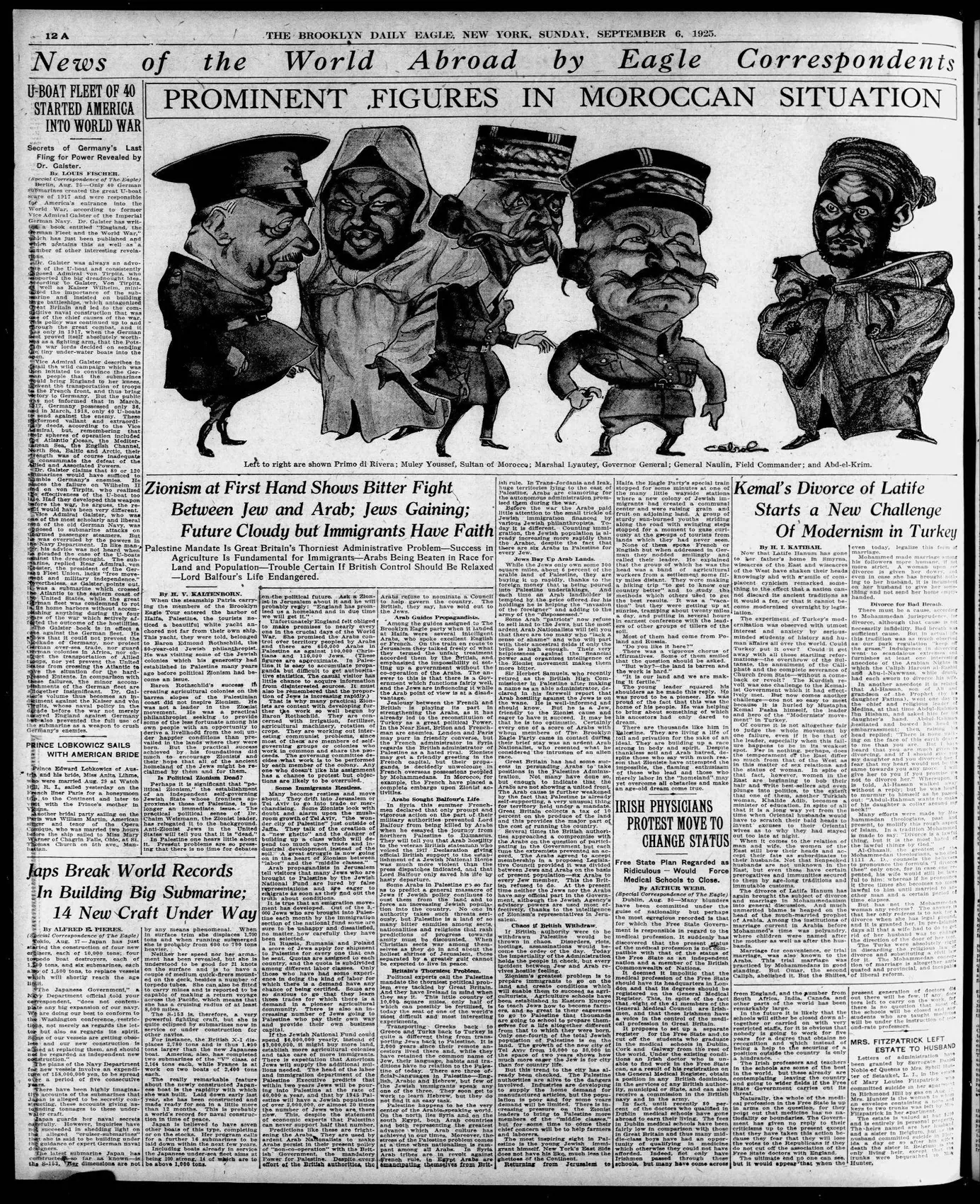
Transcribed from the clipping
“When the steamship Patria carrying the members of the Brooklyn Eagle Tour entered the harbor of Haifa, Palestine, the tourists noticed a beautiful white yacht anchored not far from their own ship. This yacht, they were told, belonged to Baron Edmond Rothschild, the 80-year-old Jewish philanthropist.
He was visiting some of the Jewish colonies which his generosity had established in Palestine many years ago before political Zionism had become an issue. Baron Rothschild’s success in creating agricultural colonies on the barren slopes of the Palestinian coast did not inspire Zionism. He was not a leader in the Zionist movement.
He was a practical philanthropist seeking to provide some of the less fortunate among his own people with an opportunity to derive a livelihood from the soil under happier conditions than prevailed in the lands where they were born.
But the practical success achieved by his foundations did much to encourage Zionists and their hope that all of the ancient homeland of the Jews might be reclaimed by them and for them.
Is Political Zionism Dead? Perhaps it is significant that ‘political Zionism,’ the establishment of an independent self-governing Jewish State whose frontiers approximate those of Palestine, is no longer an immediate issue. The practical political sense of Dr. Chaim Weizmann, the Zionist leader, has relegated it to the background.
Anti-Zionist Jews in the United States will tell you that it is ‘dead.’ In Palestine one hears little about it. Present problems are so pressing that there is no time for debates on the political future. Ask a Zionist in Jerusalem about it and he will probably reply: ‘England has promised us a homeland and in due time we will get it.’
Unfortunately England felt obliged to make promises to nearly every one in the crucial days of the World War. She promised the Arabs control over territory peopled by Arabs and there are 650,000 Arabs in Palestine as against 100,000 Christians and 110,000 Jews. (These figures are approximate.
In Palestine it is easy to accumulate propaganda but difficult to get authoritative statistics. The casual visitor has little chance to acquire information from disinterested sources. It must also be remembered that the proportion of Jews is increasing rapidly.) That is why many practical Zionists are content with developing further the work so well begun by Baron Rothschild.
They are concerned with irrigation, fertilizer, agricultural machinery, rotation of crops. They are working out interesting communist problems, since most of them are members of self-governing groups or colonies who work in common and share the proceeds. The governing committee decides what work is to be performed by each member of the colony.
Any one who doesn’t like his assignment has a chance to protest but objections are likely to be overruled.
Some Immigrants Restless. Many become restless and move about. They drift into Jerusalem or Tel Aviv to go into trade or merchandising. Some Zionists look with doubt and alarm upon the mushroom growth of Tel Aviv, ‘the wonder city of Palestine’ just outside of Jaffa.
They talk of the creation of a ‘new ghetto’ and the danger of building up a class which will depend too much upon trade and industrial development instead of the soil. A great struggle is now going on in the heart of Zionism between ‘labor’ and the ‘middle classes.’
Arab propagandists in Jerusalem tell visitors that many Jews who are brought to Palestine by the Jewish National Fund are lured by false representations and are eager to emigrate as soon as they find out the truth about conditions. It is true that an emigration movement has developed.
Out of the 3,000 Jews who are brought into Palestine each month by the immigration section of the national fund some are sure to be unhappy and dissatisfied, no matter how carefully they have been selected. In Russia, Rumania and Poland a score of Jews apply for shipment to Palestine for every one that can be sent.
Quotas are assigned to each country, and the quota is subdivided among different labor classes. Only those who have had some experience in doing the kind of labor for which there is a demand have any chance of being certified. Some are so anxious to go that they learn those trades for which there is a demand in a pioneer agricultural community.
There is also an increasing number of Jews going to Palestine who pay their own way and provide their own business capital. If the Jewish National Fund could spend $6,000,000 yearly, instead of $3,000,000, it might buy more land, establish more agricultural colonies and take care of more immigrants.
There is expectation that American Jews will supply the additional millions needed.
The head of the labor and immigration department of the Palestine Executive predicts that within two years Jews will be pouring into Palestine at the rate of 60,000 a year, and that by 1945 Palestine will have a Jewish population of over 2,000,000, or almost 20 times the number of Jews who are there now.
This, despite the statement of economic experts that Palestine can never support half that number. Predictions like these are frightening the Arabs. They are used by ardent Arab Nationalists to make Arabs persist in their present policy of ‘non-co-operation’ with the British Government, the mandatory Power for Palestine.
Despite every effort of the British authorities, the Arabs refuse to nominate a Council to help govern the country. The British, they say, have sold out to the Jews.
Arab Guides Propagandists. Among the guides assigned to The Brooklyn Eagle party when it landed at Haifa were several intelligent Arabs, who spoke excellent English or French.
On the train en route to Jerusalem they talked freely of what they termed the unfair treatment accorded them by the British, and emphasized the impossibility of setting up a government without the co-operation of the Arabs.
The answer to this is that there is a Government which functions fairly well, and the Jews are influencing it while the Arab point of view is at a disadvantage. Jealousy between the French and British is playing its part in strengthening the Arabs, as it has already led to the reconstitution of Turkey as a great political Power.
In the Near East, Briton and Frenchman are enemies. London and Paris may purr in friendly converse, but the French administrator in Syria regards the British administrator of Palestine as a hated rival. Zionists may get a friendly greeting in the French capital, but their propaganda is decidedly unwelcome in French overseas possessions peopled by Mohammedans.
In Morocco, for example, the French have placed a complete embargo upon Zionist activities.
Arabs Sought Balfour’s Life In Syria this summer Frenchmen declared that only prompt and vigorous action on the part of their military authorities prevented Lord Balfour from being killed by Arabs when he essayed the journey from northern Palestine to Damascus.
They will tell you that Arab hostility to the veteran British statesman who voiced the 1917 Declaration giving official British support to the establishment of a Jewish National Home was much more violent than the press dispatches indicated, and that Lord Balfour only saved his life by hasty departure.
Some Arabs in Palestine go so far as to predict a general massacre of Jews if Jewish policy continues to oust them from the land and to force an increasing Jewish population into the country.
No one in authority takes such threats seriously, but Palestine is a land of so many bitter enmities among sects, nationalities and religions that rash predictions of progress towards amity must be discounted. When Christian sects war among themselves as they do in and about the holiest shrines of Jerusalem, those separated by a greater gulf cannot be expected to live in peace.
Britain’s Thorniest Problem. Political experts call the Palestine mandate the thorniest political problem ever tackled by Great Britain. And they have Ireland in mind when they say it.
This little country of 10,000 square miles, only half of which can possibly be fertilized, is today the seat of one of the world’s most difficult and most interesting experiments. Transporting Greeks back to Greece and Turks back to Turkey is quite a different thing from transporting Jews back to Palestine.
It is 2,000 years since their remote ancestors lived there and, while they have retained the common name of Jew, their language, habits and traditions have no relation to the Palestine of today. There are three official languages in Palestine—English, Arabic and Hebrew, but few of the Jewish immigrants speak any one of the three.
They soon get to work to learn Hebrew, but they do not find it an easy task. Palestine happens to be the very center of the Arabic-speaking world. On the north lies Syria and on the south Egypt, both Arab countries and both representing the greatest advance which Arab culture has achieved in our times.
Moreover, the stress of the Palestine problem comes at a time when nationalism is rampant among all Arabs. In Syria Arab tribes are in revolt against French rule, in Egypt Arabs are emancipating themselves from British rule.
In Trans-Jordania and Irak, huge territories lying to the east of Palestine, Arabs are clamoring for the autonomous administration promised them during the war. Before the war the Arabs paid little attention to the small trickle of Jewish immigration financed by various Jewish philanthropists. Today it is different.
Counting immigration, the Jewish population is already increasing more rapidly than the Arabic, despite the fact that there are six Arabs in Palestine for every Jew.
Jews Buy Up Arab Lands. While the Jews only own some 300 square miles, about 6 percent of the arable land of Palestine, they are buying it up rapidly, thanks to the foreign money that is being poured into Palestine undertakings.
And each time an Arab landholder is tempted by the price offered for his holdings he is helping the ‘invasion of the foreigner’ and adding to the army of the ‘dispossessed.’
Some Arab ‘patriots’ now refuse to sell land to the Jews, but the most ardent Arab Nationalists will tell you that there are too many who ‘lack a sense of shame’ and who will part with their ancestral fields if only the bribe is high enough.
Their very helplessness against the financial power and organized intelligence of the Zionist movement makes them more bitter. Sir Herbert Samuels, who recently retired as the British High Commissioner in Palestine after making a name as an able administrator, declared in his farewell report that Arab hostility against the Jews is on the wane.
He is well-informed and should know. But he is a Jew friendly to the Zionist cause and eager to have it succeed. It may be that he is too optimistic. Certainly every one of a score of Arabs with whom members of The Brooklyn Eagle Party came in contact during their brief stay was an ardent Arab Nationalist, who resented what he considered the intrusion of an alien race.
Great Britain has had some success in persuading Arabs to take positions in the Palestine Administration. Not many have done so, but enough to indicate that the Arabs are not showing a united front. The Arab cause is further weakened by the fact that Palestine is already self-supporting, a very unusual thing for territory held under a mandate.
Great Britain collects a tax of 10 percent on the produce of the land and this provides the major part of the cost of running the country. Several times the British authorities approached a compromise with the Arabs on the question of participating in the Government but each time the extremists prevented an accord.
The Arabs agreed to accept membership in a proposed Legislative Council provided it was divided between Jews and Arabs on the basis of present population—six Arabs to every Jew member. This the British refused to do.
At the present time neither the Jews nor the Arabs have any official part in the Government, although the Jewish Agency’s advisory powers are used most effectively, thanks to the intelligence of Zionism’s representatives in Jerusalem.
Chaos if British Withdraw. If British authority were to be withdrawn Palestine would be thrown in chaos. Disorders, riots, lootings, assassinations would become the order of the day. Today the impartiality of the Administration holds the people in check, but every incident between Jew and Arab revives hostile feeling.
Zionism’s greatest problem is to prepare immigrants to go on the land and create conditions which will enable them to succeed as agriculturists.
Agriculture schools have been established in Eastern Europe to teach Jews how to become farmers, and so great is their eagerness to go to Palestine that thousands are going to school to prepare themselves for a life altogether different from that to which they were born. Only one-fourth of the total Jewish population of Palestine is on the land.
The growth of the new city of Tel Aviv from 10,000 to 30,000 in the space of two years shows how much more eager the Jew is for city than for country life. But this trend to the city has already been checked. The Palestine authorities are alive to the dangers involved.
Industries are developing to supply the home demand for manufactured articles, but the population is poor and for some years demand will be limited. There is increasing pressure on the Zionist leaders to bring to Palestine more members of the ‘middle classes,’ but for some time to come their chief concern will be to help farmers and laborers.
The most inspiring sight in Palestine is the young Jewish immigrant himself. New York’s East Side does not have his like, much less the ghettoes of the Continent.
Returning from Jerusalem to Haifa the Eagle Party’s special train stopped for some minutes at one of the many little wayside stations where a new colony of Jewish immigrants had created a communal center and were raising grain and fruit on adjoining land.
A group of sturdy sun-burned youths striding along the road with swinging steps stopped for a moment to gaze curiously at the groups of tourists from lands which they had never seen. None of them spoke French or English but when addressed in German they nodded smilingly and called their leader.
He explained that the group of which he was the head was a band of agricultural workers from a settlement some fifty miles distant. They were making a hiking trip ‘to get to know our country better’ and to study the methods which others used to get the best results.
It was a ‘vacation’ but they were getting up at sunrise, tramping about twenty miles a day, and putting in several hours in earnest conference with the leaders of other groups of tillers of the soil. Most of them had come from Poland and Russia. ‘Do you like it here?’ There was a vigorous chorus of affirmatives.
Some of them smiled that the question should be asked. ‘But why?—the land is barren and the work is hard.’ ‘It is our land and we are making it fertile.’ The young leader squared his shoulders as he made this reply. He was proud to be a pioneer. He was proud of the fact that this was the home of his people.
He was helping to bring about something of which his ancestors had only dared to dream. There are thousands like him in Palestine. They are living a life of toil and privation for the sake of an ideal. They are building up a race strong in body and spirit.
Despite thankless soil and Arab hatred, despite those who say with much reason that Zionists have attempted the impossible, the flaming enthusiasm of those who lead and those who merely labor in the ‘homeland’ may yet overcome all obstacles and make an age-old dream come true.”
How this transcription was made
Transcribed in full from the scan, read column by column at eight and nine times magnification. The first pass read only the headline block, the summary, the byline and the section heads; the article runs to five columns and is now read off the page. Spellings and figures are the paper’s own, including Irak, Sir Herbert Samuels and Rumania.
Context added by this archive
A Brooklyn correspondent’s dispatch, 1925, and the summary line is the whole argument in nine words: Arabs Being Beaten in Race for Land and Population. A race, with a winner, for land and for numbers — printed as a neutral description of what the mandate was for.
The section heads on the page are Is Political Zionism Dead?, Some Immigrants Restless, Arab Guides Propagandists, Arabs Sought Balfour’s Life, Britain’s Thorniest Problem, Jews Buy Up Arab Lands and Chaos if British Withdraw.
The count is in the copy twice: 650,000 Arabs against 100,000 Christians and 110,000 Jews, and again as six Arabs in Palestine for every Jew — a ratio the Arabs then proposed as the basis for a Legislative Council, which the correspondent records the British refusing.
Above it on the same page is a row of caricatures of Prominent Figures in Moroccan Situation, Abd-el-Krim at the end of the line.
Cite this clipping
"Zionism at First Hand Shows Bitter Fight Between Jew and Arab; Jews Gaining; Future Cloudy but Immigrants Have Faith," Brooklyn Eagle, 6 September 1925, p. 12A. Covering Palestine archive, CP-1925-004. https://coveringpalestine.org/archive/cp-1925-004
More from Brooklyn Eagle
- THROUGH PALESTINE.Brooklyn Eagle · 21 February 1890
- From Zionist sources we learn that the Jaffa riots were directly traceable to hatred of the British mandateBrooklyn Eagle · 6 May 1921
- Fear Economic DominationBrooklyn Eagle · 19 December 1926
- Press Silenced by HopelessnessBrooklyn Eagle · 19 December 1926
- Money Printed in 3 LanguagesBrooklyn Eagle · 18 January 1931
- This Is Not the Time to Preach Racism With Palestine ProblemBrooklyn Eagle · 12 May 1940
More from the 1920s
- Dinar and Shekel Reappear In Currency of PalestineThe New York Times · 27 January 1925
- American Energy Is Making New Jewish Homeland in PalestineThe Modern Union · 1 February 1925
- Peace in Palestine When Balfour Party ArrivesWisconsin Jewish Chronicle · 27 March 1925
- Arabs, Jews Unite On Palestine RoadsThe Milwaukee Leader · 23 April 1925
- House of Lords Hears Figures on Cultivatable Land In PalestineWisconsin Jewish Chronicle · 29 May 1925
- A. L. Saltzstein Tells Story Of Trip To PalestineWisconsin Jewish Chronicle · 26 June 1925
- All 120 clippings from the 1920s →
In these collections
Last updated 2 November 2026
This record is part of Covering Palestine, an archive of American newspaper clippings about Palestinians, 1724 to 2023. Researched and assembled by Maria Robles.
The clipping belongs to the newspaper that printed it, or to the news agency that supplied the copy. It is reproduced here for research, criticism and commentary. A city here is where the newspaper was published, not where the story came from, and on most records it was taken from the masthead.
Something wrong here, or something you know about this clipping? The archive is still being built and corrections are wanted: maria@rozumstudio.com, quoting CP-1925-004.
Everything printed in 1925 · Printed on this day · See it in the archive reel · Full text of every clipping · Dataset