The Flint Journal · Flint, Michigan · 4 October 1932
CP-1932-005
HEBREW BOTANIST STUDIES REMEDIES
Medical Herbs Used by Arabs Under Scientific Scrutiny.
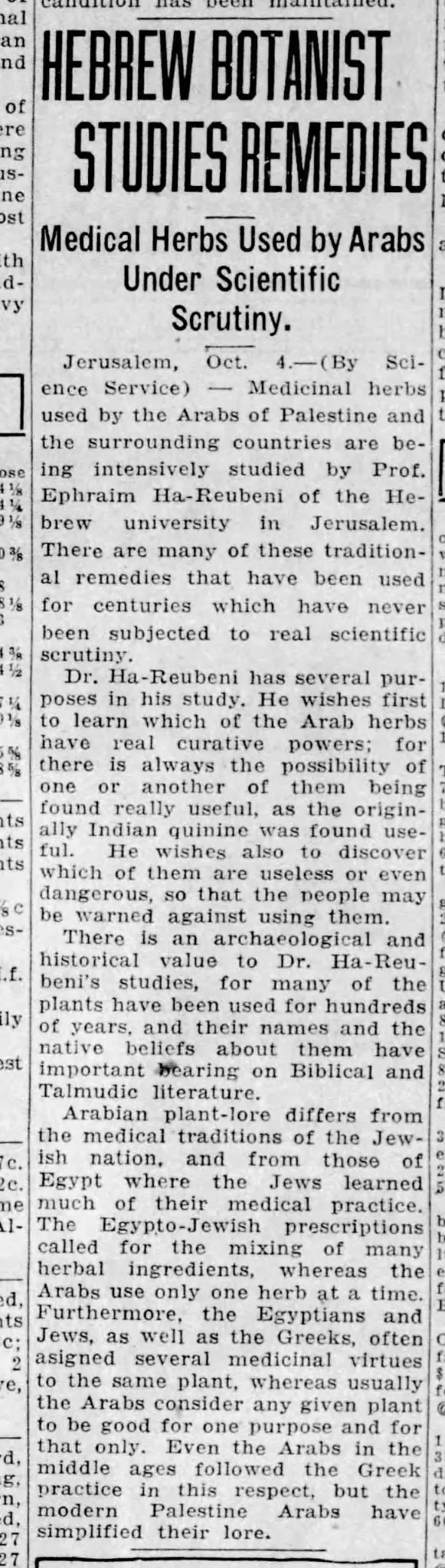
Shown from the top. The whole column — 3.5 times taller than it is wide — is in the enlargement.
Transcribed from the clipping
Jerusalem, Oct. 4.—(By Science Service) — Medicinal herbs used by the Arabs of Palestine and the surrounding countries are being intensively studied by Prof. Ephraim Ha-Reubeni of the Hebrew university in Jerusalem. There are many of these traditional remedies that have been used for centuries which have never been subjected to real scientific scrutiny. Dr.
Ha-Reubeni has several purposes in his study. He wishes first to learn which of the Arab herbs have real curative powers; for there is always the possibility of one or another of them being found really useful, as the originally Indian quinine was found useful.
He wishes also to discover which of them are useless or even dangerous, so that the people may be warned against using them. There is an archaeological and historical value to Dr. Ha-Reubeni’s studies, for many of the plants have been used for hundreds of years, and their names and the native beliefs about them have important bearing on Biblical and Talmudic literature.
Arabian plant-lore differs from the medical traditions of the Jewish nation, and from those of Egypt where the Jews learned much of their medical practice. The Egypto-Jewish prescriptions called for the mixing of many herbal ingredients, whereas the Arabs use only one herb at a time.
Furthermore, the Egyptians and Jews, as well as the Greeks, often asigned several medicinal virtues to the same plant, whereas usually the Arabs consider any given plant to be good for one purpose and for that only. Even the Arabs in the middle ages followed the Greek practice in this respect, but the modern Palestine Arabs have simplified their lore.
How this transcription was made
Transcribed by optical character recognition and read back against the scan by hand.
Cite this clipping
"HEBREW BOTANIST STUDIES REMEDIES," The Flint Journal, 4 October 1932. Covering Palestine archive, CP-1932-005. https://coveringpalestine.org/archive/cp-1932-005
More from The Flint Journal
- Million Homeless Palestinian Arabs Camped in Middle EastThe Flint Journal · 13 August 1953
- Key to Solution in Mideast Rests on Fate of RefugeesThe Flint Journal · 18 June 1967
- Church Group Backs Palestinian RefugeesThe Flint Journal · 5 October 1969
- Israel Accused in Assassination BlastThe Flint Journal · 9 July 1972
- Palestinian killed in Gaza stripThe Flint Journal · 16 April 1982
- Israeli soldiers force four squatters to leaveThe Flint Journal · 20 August 1985
- 1 more from this paper in the full text →
More from the 1930s
- Palestine Arabs Boycott List ApprovedThe New York Times · 8 January 1932
- ZIONISTS MARK JUBILEE.The New York Times · 11 January 1932
- Greek Church Arabs Win Election StayThe New York Times · 27 January 1932
- Palestine CustomsThe Utica Sun · 28 January 1932
- Want Palestine Cut Into 2 StatesThe New York Times · 5 February 1932
- Says Jews and Arabs Are Reaching AmityThe New York Times · 1 March 1932
- All 218 clippings from the 1930s →
Last updated 17 November 2026
This record is part of Covering Palestine, an archive of American newspaper clippings about Palestinians, 1724 to 2023. Researched and assembled by Maria Robles.
The clipping belongs to the newspaper that printed it, or to the news agency that supplied the copy. It is reproduced here for research, criticism and commentary. A city here is where the newspaper was published, not where the story came from, and on most records it was taken from the masthead.
Something wrong here, or something you know about this clipping? The archive is still being built and corrections are wanted: maria@rozumstudio.com, quoting CP-1932-005.
Everything printed in 1932 · Printed on this day · See it in the archive reel · Full text of every clipping · Dataset