The New York Times · 16 February 1947
CP-1947-071
Formula for Troubled Palestine
Dr. Judah Leon Magnes advocates an independent, bi-national state with Jews and Arabs sharing all the responsibilities.
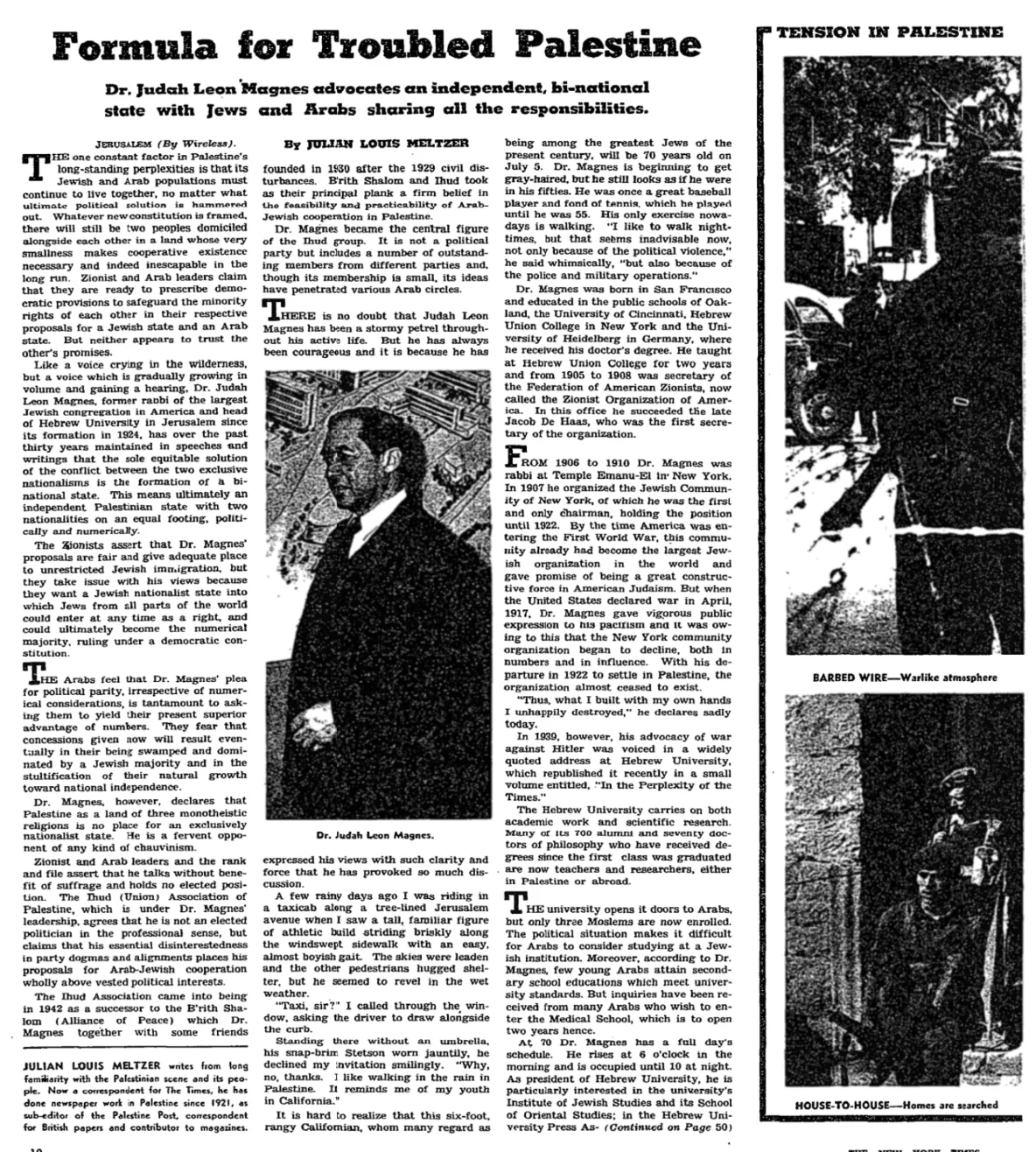
Transcribed from the clipping
JERUSALEM (By Wireless). THE one constant factor in Palestine’s long-standing perplexities is that its Jewish and Arab populations must continue to live together, no matter what ultimate political solution is hammered out.
Whatever new constitution is framed, there will still be two peoples domiciled alongside each other in a land whose very smallness makes cooperative existence necessary and indeed inescapable in the long run.
Zionist and Arab leaders claim that they are ready to prescribe democratic provisions to safeguard the minority rights of each other in their respective proposals for a Jewish state and an Arab state. But neither appears to trust the other’s promises. … THE university opens it doors to Arabs, but only three Moslems are now enrolled.
The political situation makes it difficult for Arabs to consider studying at a Jewish institution. Moreover, according to Dr. Magnes, few young Arabs attain secondary school educations which meet university standards. But inquiries have been received from many Arabs who wish to enter the Medical School, which is to open two years hence.
… (Continued from Page 12) sociation for the creation of which he was mainly responsible in 1926, and in the Medical School, the joint creation of Hebrew University and Hadassah, the women’s Zionist organization of America. In this connection he is chairman of the Hadassah Council in Palestine.
He also is chairman of the Middle East Advisory Committee of the American-Jewish Joint Distribution Committee. “I HAVE been trying for years to withdraw from various activities,” said Dr.
Magnes, “and I feel that the time has come when I should cease to be a Chairman with a capital C, although perhaps I may remain as chairman of some committees with a small c.” As I sat talking with him in the study of his home the other day, there were three books lying on his desk. He said he was reading all three at the same time.
They were a volume by an Oxford don, T. D.
Weldon, “States and Morals”; a book by an Arab publicist, Edward Atiyah, “An Arab Tells His Story,” and Solomon Schechter’s “Some Aspects of Rabbinic Theology,” which he is re-reading carefully because he says he would like the Hebrew University Press Association to translate and publish it in Hebrew.
He is similarly interested in having the best books written by the Mount Scopus scholars translated and published in English. What has always impressed me about Dr. Magnes in our long acquaintance has been his humanness and his way of shunning the limelight.
His humor is a synthesis of both qualities and often runs to a delight in incongruous situations, to which he is very much alive. One memory I cherish is of seeing Dr. Magnes many years ago walking down a main thoroughfare of Jerusalem on a summer’s day in the company of one of his three sons. Father and son carried ice cream cones, which they were gravely licking.
As a postscript, he chuckles today: “I still like ice cream.” DR. MAGNES is thinking a great deal these days, he tells me, about the problems explicit in the theme, “The Uniqueness of Israel,” that is, combination in Judaism of the highest universalist principles and the religious nationalism of the Jewish people.
“It is, I think, one of the most essential tasks of Jewish scholarship today to clarify this paradox,” he said. “I am convinced that such a clarification would give Judaism a practical program, both in its relation to the outside world and to the distraught Jewish people itself.” Dr.
Magnes’ views on the feasibility of establishing a unified bi-national Palestine state have deeply impressed the Arab intelligentsia—among the Arab peasantry there is real daily cooperation with their Jewish neighbors—and it is true that, of the Jews living in Palestine, Dr.
Magnes probably is among the few whom Arabs of all classes feel to be completely and dispassionately sincere about the concept of Semitic racial cooperation. If there is any misgiving among thinking Arabs, it is that Dr. Magnes’ views are not popular among his own people and that he has little following.
“MY unconquerable conviction that the Jews and Arabs must and can live together,” said Dr. Magnes, “stems from two elements of my training: first, the study of the Hebrew prophets and the Bible since my youth; second, my education as a liberal and my early life in what was at that time more or less an American frontier State—California.” Dr.
Magnes and his friends feel that a partition of Palestine, with the creation of separate Arab and Jewish states, will keep both peoples permanently apart “on either side of two unsatisfactory boundaries” and will set up extremist irredentae, which in turn will lead to armed conflict between the two races.
Moreover, they assert that the partitions issue may provoke internecine strife among the Jews of Palestine themselves. THEIR proposal calls for an undivided bi-national Palestine in which Jews and Arabs would live and work in unison, having an equal share in the development, progress and administration of the Holy Land.
One of their postulates is that this state of cooperative Arab-Jewish existence is possible, and it is formed from the testimony on every hand (Continued on Page 52) [photo caption, right column, under a portrait photograph:] Jewish colonist in Palestine.
How this transcription was made
Transcribed from a scan of the printed page. No running head and no printed date survive on the scan. The YEAR is fixed from the article's own content - the subject 'will be 70 years old on July 5', and Judah Magnes was born on 5 July 1877 - which places the piece in the first half of 1947; the day rests on the slide label and is consistent with a Sunday magazine. THE FOOT OF THE PAGE IS SLICED BY THE EDGE OF THE SCAN: a folio at the left and the words '...E NEW YORK TIMES' at the right survive only as the upper two-thirds of their characters. The paper's name is legible enough to support the attribution; the PAGE NUMBER IS NOT, and has deliberately been left empty rather than guessed - its first digit is a 1 and its second has a closed round top that could be 0, 6, 8 or 9. A few millimetres more at the foot would settle both. THE EXCERPT CONTAINS AN ELISION, marked with an ellipsis. The printed 'opens it doors' for 'its doors' is as set. The photo_caption field holds four caption elements from a photograph stack, joined by slashes. The article is marked '(Continued on Page 50)'; page 50 is not among these scans. Read from crops magnified to between thirteen and twenty-eight times page scale. The other part of this article was added on 2 November 2026 from a second clipping (m001_1.png).
Cite this clipping
"Formula for Troubled Palestine," The New York Times, 16 February 1947. Covering Palestine archive, CP-1947-071. https://coveringpalestine.org/archive/cp-1947-071
More from The New York Times
- The Maine Colony in PalestineThe New York Times · 12 November 1866
- Jewish Colonization in PalestineThe New York Times · 9 December 1883
- Jewish State in Palestine OpposedThe New York Times · 9 July 1897
- ZIONIST CONGRESS IN BASELThe New York Times · 31 August 1897
- ROME FEARS THE ZIONISTSThe New York Times · 12 September 1897
- PROGRESS OF ZIONISMThe New York Times · 16 December 1901
- 852 more from this paper in the full text →
More from the 1940s
- 'America Should Lead in Solving Palestine Problem'Elmira Star-Gazette · 1 January 1947
- Forcing Palestine to Become a World Problem(newspaper unidentified) · 1 January 1947
- Ire of Palestinian Jews Stressed in Book ReviewThe Post-Standard · 9 January 1947
- PALESTINE YOUTHS SPORTS CONSCIOUSThe New York Times · 21 February 1947
- The Truth Behind Those HeadlinesSt. Louis Jewish Light · 6 March 1947
- BEERSHEBA ARABS FLEEING TO EGYPTThe New York Times · 10 March 1947
- All 334 clippings from the 1940s →
Last updated 2 November 2026
This record is part of Covering Palestine, an archive of American newspaper clippings about Palestinians, 1724 to 2023. Researched and assembled by Maria Robles.
The clipping belongs to the newspaper that printed it, or to the news agency that supplied the copy. It is reproduced here for research, criticism and commentary. A city here is where the newspaper was published, not where the story came from, and on most records it was taken from the masthead.
Something wrong here, or something you know about this clipping? The archive is still being built and corrections are wanted: maria@rozumstudio.com, quoting CP-1947-071.
Everything printed in 1947 · Printed on this day · See it in the archive reel · Full text of every clipping · Dataset