Nevada State Journal · Reno, Nevada · 10 October 1951
CP-1951-002
The Forrestal Diaries
Futile Attempt to Take Palestine Issue Out of Politics And Retain Arab Friendships for U. S. Security
James Forrestal, edited by Walter Millis; syndicated serialization
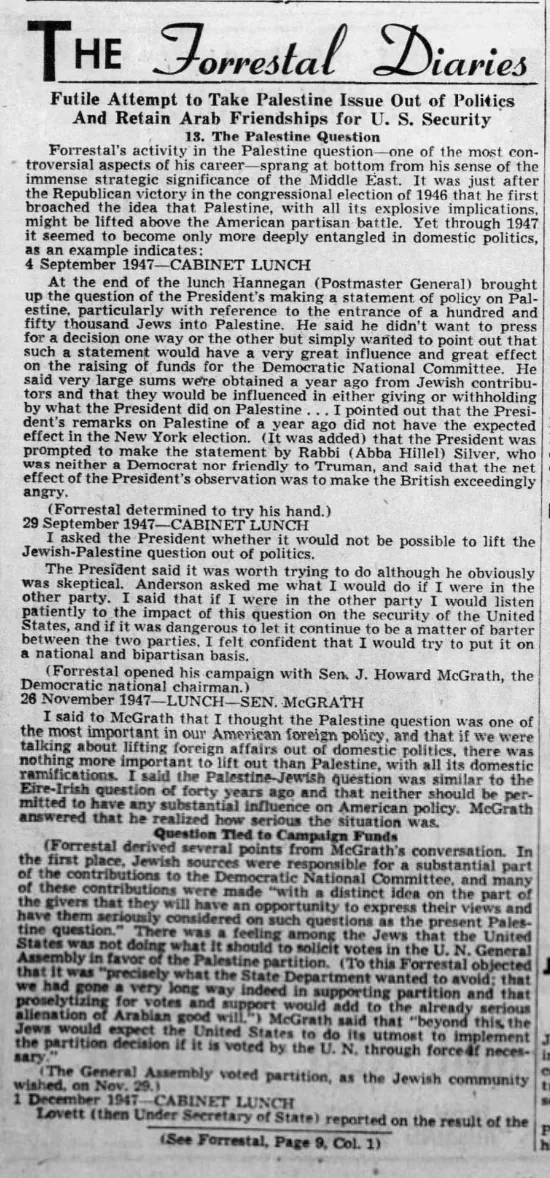
Transcribed from the clipping
“THE Forrestal Diaries
Futile Attempt to Take Palestine Issue Out of Politics And Retain Arab Friendships for U. S. Security
13. The Palestine Question Forrestal’s activity in the Palestine question—one of the most controversial aspects of his career—sprang at bottom from his sense of the immense strategic significance of the Middle East.
It was just after the Republican victory in the congressional election of 1946 that he first broached the idea that Palestine, with all its explosive implications, might be lifted above the American partisan battle. Yet through 1947 it seemed to become only more deeply entangled in domestic politics, as an example indicates:
4 September 1947—CABINET LUNCH At the end of the lunch Hannegan (Postmaster General) brought up the question of the President’s making a statement of policy on Palestine, particularly with reference to the entrance of a hundred and fifty thousand Jews into Palestine.
He said he didn’t want to press for a decision one way or the other but simply wanted to point out that such a statement would have a very great influence and great effect on the raising of funds for the Democratic National Committee.
He said very large sums were obtained a year ago from Jewish contributors and that they would be influenced in either giving or withholding by what the President did on Palestine … I pointed out that the President’s remarks on Palestine of a year ago did not have the expected effect in the New York election.
(It was added) that the President was prompted to make the statement by Rabbi (Abba Hillel) Silver, who was neither a Democrat nor friendly to Truman, and said that the net effect of the President’s observation was to make the British exceedingly angry. (Forrestal determined to try his hand.)
29 September 1947—CABINET LUNCH I asked the President whether it would not be possible to lift the Jewish-Palestine question out of politics. The President said it was worth trying to do although he obviously was skeptical. Anderson asked me what I would do if I were in the other party.
I said that if I were in the other party I would listen patiently to the impact of this question on the security of the United States, and if it was dangerous to let it continue to be a matter of barter between the two parties, I felt confident that I would try to put it on a national and bipartisan basis. (Forrestal opened his campaign with Sen. J.
Howard McGrath, the Democratic national chairman.)
26 November 1947—LUNCH—SEN. McGRATH I said to McGrath that I thought the Palestine question was one of the most important in our American foreign policy, and that if we were talking about lifting foreign affairs out of domestic politics, there was nothing more important to lift out than Palestine, with all its domestic ramifications.
I said the Palestine-Jewish question was similar to the Eire-Irish question of forty years ago and that neither should be permitted to have any substantial influence on American policy. McGrath answered that he realized how serious the situation was.
Question Tied to Campaign Funds (Forrestal derived several points from McGrath’s conversation.
In the first place, Jewish sources were responsible for a substantial part of the contributions to the Democratic National Committee, and many of these contributions were made ‘with a distinct idea on the part of the givers that they will have an opportunity to express their views and have them seriously considered on such questions as the present Palestine question.’
There was a feeling among the Jews that the United States was not doing what it should to solicit votes in the U. N. General Assembly in favor of the Palestine partition.
(To this Forrestal objected that it was ‘precisely what the State Department wanted to avoid; that we had gone a very long way indeed in supporting partition and that proselytizing for votes and support would add to the already serious alienation of Arabian good will.’) McGrath said that ‘beyond this, the Jews would expect the United States to do its utmost to implement the partition decision if it is voted by the U.
N. through force if necessary.’ (The General Assembly voted partition, as the Jewish community wished, on Nov. 29.)
1 December 1947—CABINET LUNCH Lovett (then Under Secretary of State) reported on the result of the…”
Context added by this archive
An American daily serializing the private diary of the first Secretary of Defense, four years after the fact, with the Palestine chapter set out under its own number.
What it records is the partition vote discussed at cabinet lunches as a domestic political question: the Postmaster General raising it in connection with fundraising, and Forrestal proposing to lift it out of party politics and failing.
The account of who gave money and why is Forrestal’s own, written in 1947 and printed here in 1951; the archive reproduces it as the paper printed it and does not endorse its framing.
Cite this item
"The Forrestal Diaries," Nevada State Journal, 10 October 1951. Covering Palestine archive, CP-1951-002. https://coveringpalestine.org/archive/cp-1951-002
More from the 1950s
- Anti-Zionists to Fight ‘Nationalism’Wisconsin Jewish Chronicle · 9 November 1951
- Arab Refugees Come HomeEl Reno American · 12 January 1950
- UN Ignores Tragic Plight Of Palestine’s ChristiansPittsburgh Post-Gazette · 25 January 1950
- Immigrants Use Arab PropertiesPress of Atlantic City · 20 August 1950
- Jewish Immigrants Get Former Arab PropertyStar Herald · 27 August 1950
- Immigrants Taking Over Arab PropertyEnid Morning News · 8 September 1950
- All 79 clippings from the 1950s →
This record is part of Covering Palestine, an archive of American and Anglophone newspaper clippings about Palestinians, 1799 to 2023. Researched and assembled by Maria Robles.
The clipping belongs to the newspaper that printed it, or to the news agency that supplied the copy. It is reproduced here for research, criticism and commentary. The city is derived from the masthead, not read off the clipping.
Something wrong here, or something you know about this clipping? The archive is still being built and corrections are wanted: maria@rozumstudio.com, quoting CP-1951-002.
See it in the archive reel · Full text of every clipping · Dataset