The Elkhart Truth · Elkhart, IN · 14 April 1951
CP-1951-017
Cana, Scene of Miracle of Wine, Example of Tolerance
Transcribed from the clipping
CANA OF GALILEE: (AP) The village where Christ in the presence of his mother performed his first miracle, as told in John I, 1-11, today sets a fine example of inter-ecclesiastical peace.
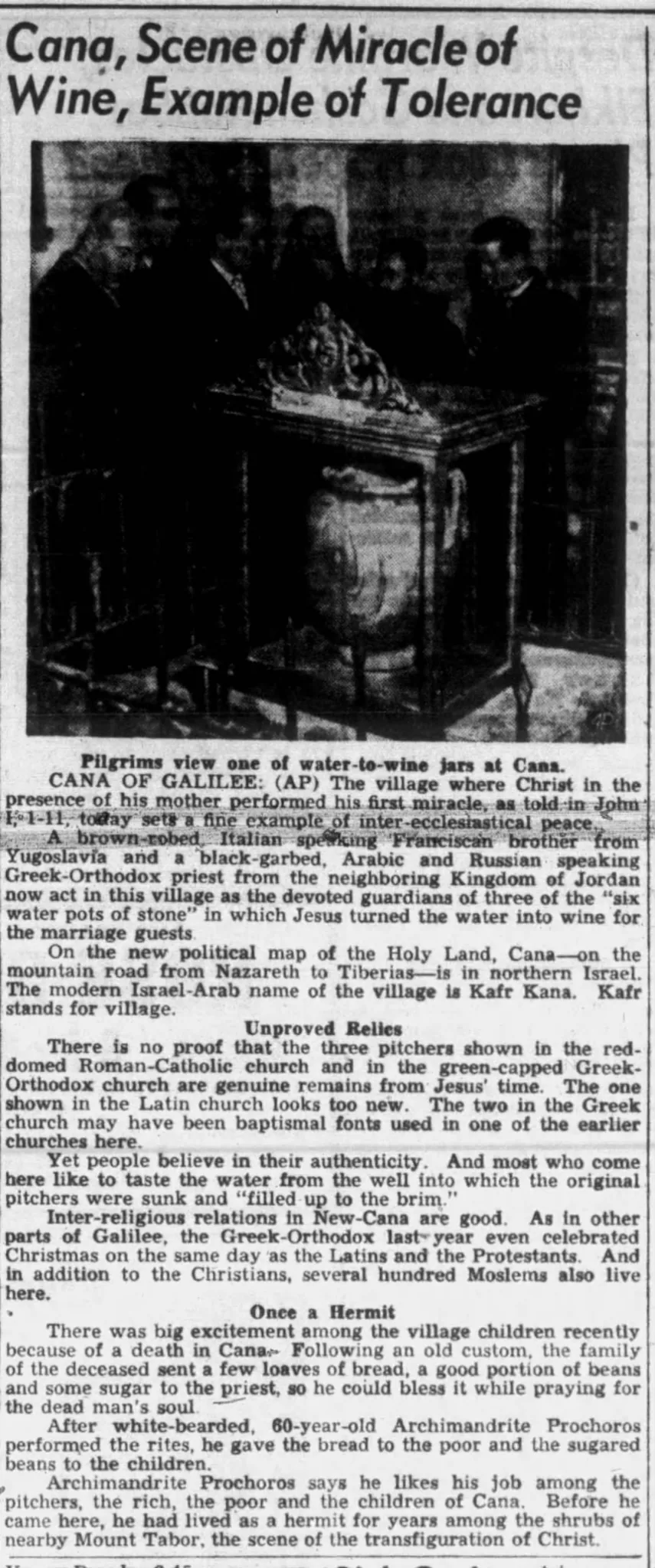
A brown-robed, Italian speaking Franciscan brother from Yugoslavia and a black-garbed, Arabic and Russian speaking Greek-Orthodox priest from the neighboring Kingdom of Jordan now act in this village as the devoted guardians of three of the "six water pots of stone" in which Jesus turned the water into wine for the marriage guests.
On the new political map of the Holy Land, Cana—on the mountain road from Nazareth to Tiberias—is in northern Israel. The modern Israel-Arab name of the village is Kafr Kana. Kafr stands for village.
Unproved Relics There is no proof that the three pitchers shown in the red-domed Roman-Catholic church and in the green-capped Greek-Orthodox church are genuine remains from Jesus' time. The one shown in the Latin church looks too new. The two in the Greek church may have been baptismal fonts used in one of the earlier churches here. Yet people believe in their authenticity.
And most who come here like to taste the water from the well into which the original pitchers were sunk and "filled up to the brim." Inter-religious relations in New-Cana are good. As in other parts of Galilee, the Greek-Orthodox last year even celebrated Christmas on the same day as the Latins and the Protestants.
And in addition to the Christians, several hundred Moslems also live here. Once a Hermit There was big excitement among the village children recently because of a death in Cana. Following an old custom, the family of the deceased sent a few loaves of bread, a good portion of beans and some sugar to the priest, so he could bless it while praying for the dead man's soul.
After white-bearded, 60-year-old Archimandrite Prochoros performed the rites, he gave the bread to the poor and the sugared beans to the children. Archimandrite Prochoros says he likes his job among the pitchers, the rich, the poor and the children of Cana.
Before he came here, he had lived as a hermit for years among the shrubs of nearby Mount Tabor, the scene of the transfiguration of Christ.
How this transcription was made
Date and publication rest on the collector's slide label; no masthead, folio or printed dateline appears on this clipping.
Context added by this archive
MARIA'S FLAGGED CLIPPING. Clipped article with photograph; no masthead, no folio, no printed date, so the date is label-only. The item carries an (AP) credit inside the dateline but no byline. There is no deck; 'Unproved Relics' and 'Once a Hermit' are crossheads inside the story.
Photo caption, set above the dateline in bold: 'Pilgrims view one of water-to-wine jars at Cana.' EDITOR'S NOTE MATERIAL — EXACTLY WHAT THE PAPER CALLED THE PLACE AND ITS PEOPLE, AND WHAT IT LEFT OUT.
Words the paper uses for the PLACE: 'Cana of Galilee' (dateline), 'The village', 'this village', 'Cana', 'New-Cana', 'the Holy Land' ('the new political map of the Holy Land'), 'northern Israel', 'Galilee', 'other parts of Galilee', 'the mountain road from Nazareth to Tiberias', 'nearby Mount Tabor', 'the neighboring Kingdom of Jordan', and once, as a translated label: 'The modern Israel-Arab name of the village is Kafr Kana.
Kafr stands for village.' Words the paper uses for the PEOPLE: 'the village children', 'the children of Cana', 'the rich, the poor', 'the family of the deceased', 'the Christians', 'several hundred Moslems', 'the Latins', 'the Protestants', 'the Greek-Orthodox', 'pilgrims', 'people', 'most who come here', and for individuals by nationality or office only — 'Italian speaking Franciscan brother from Yugoslavia', 'Arabic and Russian speaking Greek-Orthodox priest', 'Archimandrite Prochoros'.
WHAT IS ABSENT: the words 'Palestine' and 'Palestinian' appear nowhere in the clipping. No inhabitant of Kafr Kana is named. No inhabitant is quoted; the only person quoted indirectly is the priest, and he is reported, not quoted.
The 'several hundred Moslems' who live there have no names, no ages, no speech and no history before 1948; they appear in a subordinate clause, 'And in addition to the Christians, several hundred Moslems also live here.' The Arabic name of the village is given once and only as a modern label for a Christian site, glossed with 'Kafr stands for village' — the Arabic is treated as an etymological curiosity rather than as what the people there call their home.
The village's status is reported only as a line on 'the new political map': Kafr Kana is a Palestinian village in Galilee whose inhabitants, Muslim and Christian, became citizens of Israel under military government in 1948, three years before this was printed, and the clipping says nothing of that.
The 'example of tolerance' in the headline is tolerance between European and Levantine churches, not between the state and the villagers. FOR MARIA'S NOTE: Kafr Kana should not be confused with Kafr Qasim, the village of the 29 October 1956 massacre already represented in the archive by the 1956-58 Commons uploads.
Different village, different district, different event; the similarity of the names is a real risk for a reader skimming the collection, and the note should say so.
Cite this clipping
"Cana, Scene of Miracle of Wine, Example of Tolerance," The Elkhart Truth, 14 April 1951. Covering Palestine archive, CP-1951-017. https://coveringpalestine.org/archive/cp-1951-017
More from The Elkhart Truth
- Palestinian wants to set record straightThe Elkhart Truth · 10 May 1988
More from the 1950s
- Arabs Take Action on Refugee IssuesThe New York Times · 6 February 1951
- 9 Killed in Blast Of Arab's HouseDuluth News-Tribune · 8 February 1951
- Arabs Blame Jews In BlastKnoxville Journal · 9 February 1951
- Israeli-Arab Tension MountsMorning World · 9 February 1951
- Israeli-Arab Border Tension IncreasesWorcester Telegram · 9 February 1951
- Palestine Refugees Will Be ResettledThe News and Advance · 24 March 1951
- All 215 clippings from the 1950s →
Last updated 2 November 2026
This record is part of Covering Palestine, an archive of American newspaper clippings about Palestinians, 1724 to 2023. Researched and assembled by Maria Robles.
The clipping belongs to the newspaper that printed it, or to the news agency that supplied the copy. It is reproduced here for research, criticism and commentary. A city here is where the newspaper was published, not where the story came from, and on most records it was taken from the masthead.
Something wrong here, or something you know about this clipping? The archive is still being built and corrections are wanted: maria@rozumstudio.com, quoting CP-1951-017.
Everything printed in 1951 · Printed on this day · See it in the archive reel · Full text of every clipping · Dataset