Newport Daily News · Newport, Rhode Island · 23 November 1955
CP-1955-005
The Background Of Palestine’s Tangled Story
The World Today
By James Marlow, Associated Press
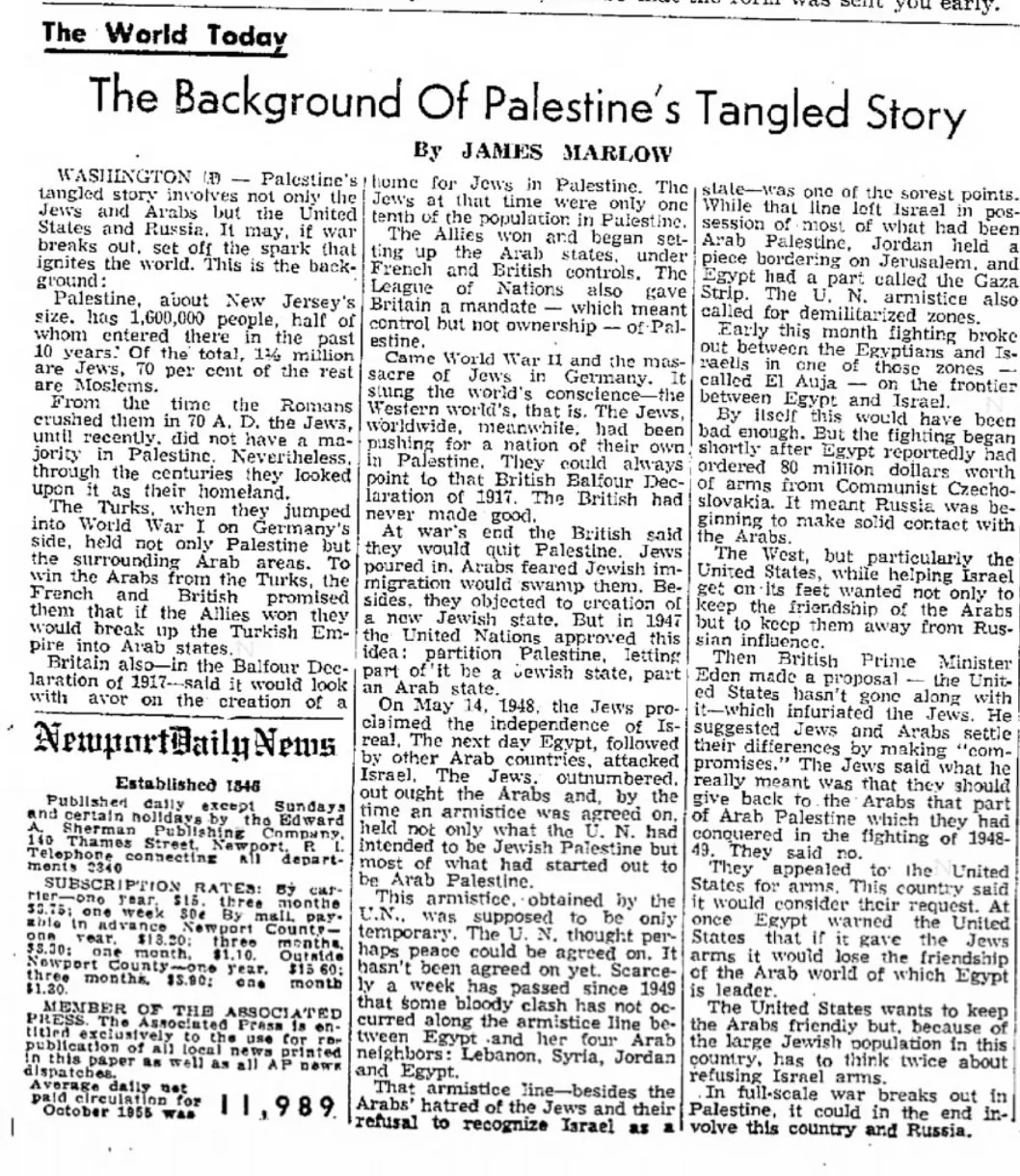
Transcribed from the clipping
“WASHINGTON (AP) — Palestine’s tangled story involves not only the Jews and Arabs but the United States and Russia. It may, if war breaks out, set off the spark that ignites the world. This is the background: Palestine, about New Jersey’s size, has 1,600,000 people, half of whom entered there in the past 10 years.
Of the total, 1¼ million are Jews, 70 per cent of the rest are Moslems. From the time the Romans crushed them in 70 A.D. the Jews, until recently, did not have a majority in Palestine. Nevertheless, through the centuries they looked upon it as their homeland.
The Turks, when they jumped into World War I on Germany’s side, held not only Palestine but the surrounding Arab areas. To win the Arabs from the Turks, the French and British promised them that if the Allies won they would break up the Turkish Empire into Arab states.
Britain also—in the Balfour Declaration of 1917—said it would look with favor on the creation of a home for Jews in Palestine. The Jews at that time were only one tenth of the population in Palestine. The Allies won and began setting up the Arab states, under French and British controls.
The League of Nations also gave Britain a mandate — which meant control but not ownership — of Palestine. Came World War II and the massacre of Jews in Germany. It stung the world’s conscience—the Western world’s, that is. The Jews, worldwide, meanwhile, had been pushing for a nation of their own in Palestine.
They could always point to that British Balfour Declaration of 1917. The British had never made good. At war’s end the British said they would quit Palestine. Jews poured in. Arabs feared Jewish immigration would swamp them. Besides, they objected to creation of a new Jewish state.
But in 1947 the United Nations approved this idea: partition Palestine, letting part of it be a Jewish state, part an Arab state. On May 14, 1948, the Jews proclaimed the independence of Isreal. The next day Egypt, followed by other Arab countries, attacked Israel. The Jews, outnumbered, out ought the Arabs and, by the time an armistice was agreed on, held not only what the U.
N. had intended to be Jewish Palestine but most of what had started out to be Arab Palestine. This armistice, obtained by the U.N., was supposed to be only temporary. The U. N. thought perhaps peace could be agreed on. It hasn’t been agreed on yet.
Scarcely a week has passed since 1949 that some bloody clash has not occurred along the armistice line between Egypt and her four Arab neighbors: Lebanon, Syria, Jordan and Egypt. That armistice line—besides the Arabs’ hatred of the Jews and their refusal to recognize Israel as a state—was one of the sorest points.
While that line left Israel in possession of most of what had been Arab Palestine, Jordan held a piece bordering on Jerusalem, and Egypt had a part called the Gaza Strip. The U. N. armistice also called for demilitarized zones.
Early this month fighting broke out between the Egyptians and Israelis in one of those zones — called El Auja — on the frontier between Egypt and Israel. By itself this would have been bad enough. But the fighting began shortly after Egypt reportedly had ordered 80 million dollars worth of arms from Communist Czechoslovakia.
It meant Russia was beginning to make solid contact with the Arabs. The West, but particularly the United States, while helping Israel get on its feet, wanted not only to keep the friendship of the Arabs but to keep them away from Russian influence.
Then British Prime Minister Eden made a proposal — the United States hasn’t gone along with it—which infuriated the Jews. He suggested Jews and Arabs settle their differences by making ‘compromises.’
The Jews said what he really meant was that they should give back to the Arabs that part of Arab Palestine which they had conquered in the fighting of 1948-49. They said no. They appealed to the United States for arms. This country said it would consider their request.
At once Egypt warned the United States that if it gave the Jews arms it would lose the friendship of the Arab world of which Egypt is leader. The United States wants to keep the Arabs friendly but, because of the large Jewish population in this country, has to think twice about refusing Israel arms.
If full-scale war breaks out in Palestine, it could in the end involve this country and Russia.”
Context added by this archive
Rhode Island’s first appearance in this archive, and it opens on a count: 1,600,000 people in a place about the size of New Jersey, half of whom entered there in the past 10 years.
The column is a briefing for Americans on how the place got that way, and it says the British had never made good on Balfour and that the armistice left Israel holding most of what had been meant to be the Arab state. The last sentence of the piece is about the United States and Russia rather than about anyone living there.
Cite this item
"The Background Of Palestine’s Tangled Story," Newport Daily News, 23 November 1955. Covering Palestine archive, CP-1955-005. https://coveringpalestine.org/archive/cp-1955-005
More from the 1950s
- Who Owns Palestine?Sacramento Union · 3 January 1955
- What’s Happening In GazaSouthern Illinoisan · 10 March 1955
- Gaza Strip—Evening Star · 13 March 1955
- Arabs, Jewish Immigrants Now Live, Work Side by Side In Jaffa, IsraelThe Herald News · 25 November 1955
- Calls Palestine Deal All WrongThe Courier-Journal · 5 January 1954
- Anti-British Influence At New High As Palestinians Take Lead In JordanAsheville Citizen-Times · 6 January 1954
- All 77 clippings from the 1950s →
This record is part of Covering Palestine, an archive of American and Anglophone newspaper clippings about Palestinians, 1799 to 2023. Researched and assembled by Maria Robles.
The clipping belongs to the newspaper that printed it, or to the news agency that supplied the copy. It is reproduced here for research, criticism and commentary. The city is derived from the masthead, not read off the clipping.
Something wrong here, or something you know about this clipping? The archive is still being built and corrections are wanted: maria@rozumstudio.com, quoting CP-1955-005.
See it in the archive reel · Full text of every clipping · Dataset