Newport Daily News · Newport, Rhode Island · 31 July 1958
CP-1958-009
U.N. Ration Cards Worth Only $1.50 Give Palestine Arab Refugees Hope
Associated Press
Transcribed from the clipping
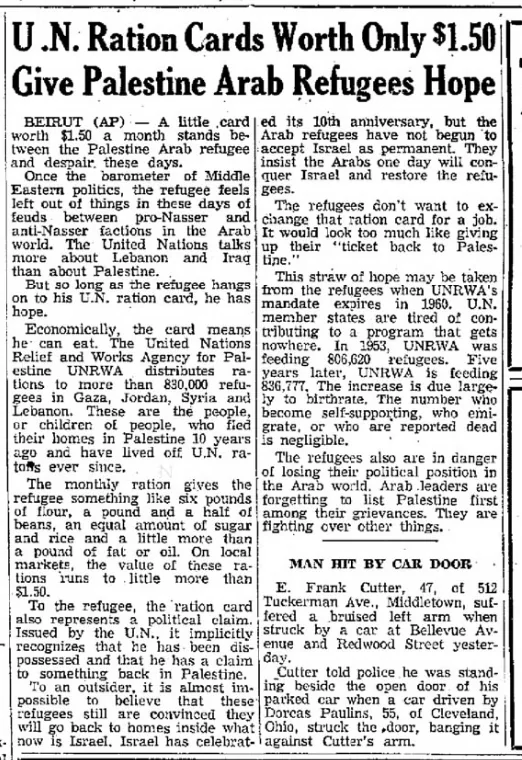
“BEIRUT (AP) — A little card worth $1.50 a month stands between the Palestine Arab refugee and despair, these days. Once the barometer of Middle Eastern politics, the refugee feels left out of things in these days of feuds between pro-Nasser and anti-Nasser factions in the Arab world. The United Nations talks more about Lebanon and Iraq than about Palestine.
But so long as the refugee hangs on to his U.N. ration card, he has hope. Economically, the card means he can eat. The United Nations Relief and Works Agency for Palestine UNRWA distributes rations to more than 830,000 refugees in Gaza, Jordan, Syria and Lebanon.
These are the people, or children of people, who fled their homes in Palestine 10 years ago and have lived off U.N. rations ever since. The monthly ration gives the refugee something like six pounds of flour, a pound and a half of beans, an equal amount of sugar and rice and a little more than a pound of fat or oil.
On local markets, the value of these rations runs to little more than $1.50. To the refugee, the ration card also represents a political claim. Issued by the U.N., it implicitly recognizes that he has been dispossessed and that he has a claim to something back in Palestine.
To an outsider, it is almost impossible to believe that these refugees still are convinced they will go back to homes inside what now is Israel. Israel has celebrated its 10th anniversary, but the Arab refugees have not begun to accept Israel as permanent. They insist the Arabs one day will conquer Israel and restore the refugees.
The refugees don’t want to exchange that ration card for a job. It would look too much like giving up their ‘ticket back to Palestine.’ This straw of hope may be taken from the refugees when UNRWA’s mandate expires in 1960. U.N. member states are tired of contributing to a program that gets nowhere. In 1953, UNRWA was feeding 806,620 refugees.
Five years later, UNRWA is feeding 836,777. The increase is due largely to birthrate. The number who become self-supporting, who emigrate, or who are reported dead is negligible. The refugees also are in danger of losing their political position in the Arab world. Arab leaders are forgetting to list Palestine first among their grievances.
They are fighting over other things.”
Context added by this archive
The ration card read as a political document rather than as food. The news agency says so outright: issued by the United Nations, it implicitly recognizes that he has been dispossessed and that he has a claim to something back in Palestine, which is why the refugees will not exchange it for a job.
Two counts five years apart are printed together — 806,620 in 1953 and 836,777 in 1958 — with the increase attributed to birthrate. Beside it on the page, a Middletown man is hit by a car door.
Cite this item
"U.N. Ration Cards Worth Only $1.50 Give Palestine Arab Refugees Hope," Newport Daily News, 31 July 1958. Covering Palestine archive, CP-1958-009. https://coveringpalestine.org/archive/cp-1958-009
More from Newport Daily News
- The Background Of Palestine’s Tangled StoryNewport Daily News · 23 November 1955
More from the 1950s
- “Palestinian” PatriotsWisconsin Jewish Chronicle · 21 February 1958
- Palestinians Due More Voice In Gaza RuleThe Evening Sun · 11 March 1958
- Gaza Palestinians Get Voice In Gov’t.The Herald Press · 12 March 1958
- Needs of Palestinian Arab Refugees Are Ignored by the UN and the WorldJackson Citizen Patriot · 10 May 1958
- Palestinian Arabs Still Expect to Regain HomesHerald News · 31 July 1958
- Refugees Pin All Hopes on NasserWashington Daily News · 5 August 1958
- All 79 clippings from the 1950s →
This record is part of Covering Palestine, an archive of American and Anglophone newspaper clippings about Palestinians, 1799 to 2023. Researched and assembled by Maria Robles.
The clipping belongs to the newspaper that printed it, or to the news agency that supplied the copy. It is reproduced here for research, criticism and commentary. The city is derived from the masthead, not read off the clipping.
Something wrong here, or something you know about this clipping? The archive is still being built and corrections are wanted: maria@rozumstudio.com, quoting CP-1958-009.
See it in the archive reel · Full text of every clipping · Dataset