The New York Times · New York, New York · 2 November 1960
CP-1960-015
Touring Nabatean Cities in the Negev
By ROBERT D. KAPLAN
Transcribed from the clipping
A half-hour by car south of Beersheba in the Negev is a cubist landscape of jagged peaks and long plateau walls studded with Bedouin encampments. Through this desert — brown except for a lavender mantle of wildflowers in the spring — Moses and the Israelites wandered 33 centuries ago.
In the third century B.C., another group of nomads, the Nabateans, passed this way seeking a settled existence. By the time of Jesus they had built flourishing cities whose remains remarkably evoke the daily life of that period. The Nabateans were a tribal people who came from Arabia and who adopted the Aramaic language.
Long before modern-day kibbutzniks they created a water-collection system that made it possible for them to live in the desert.
Though less visually spectacular than the Nabatean capital of Petra in Jordan, their three ancient cities in the Negev — Oboda (now called Avdat), Mampsis (Mamshit) and Subeita (Shivta) — offer considerably more in the way of actual remains.
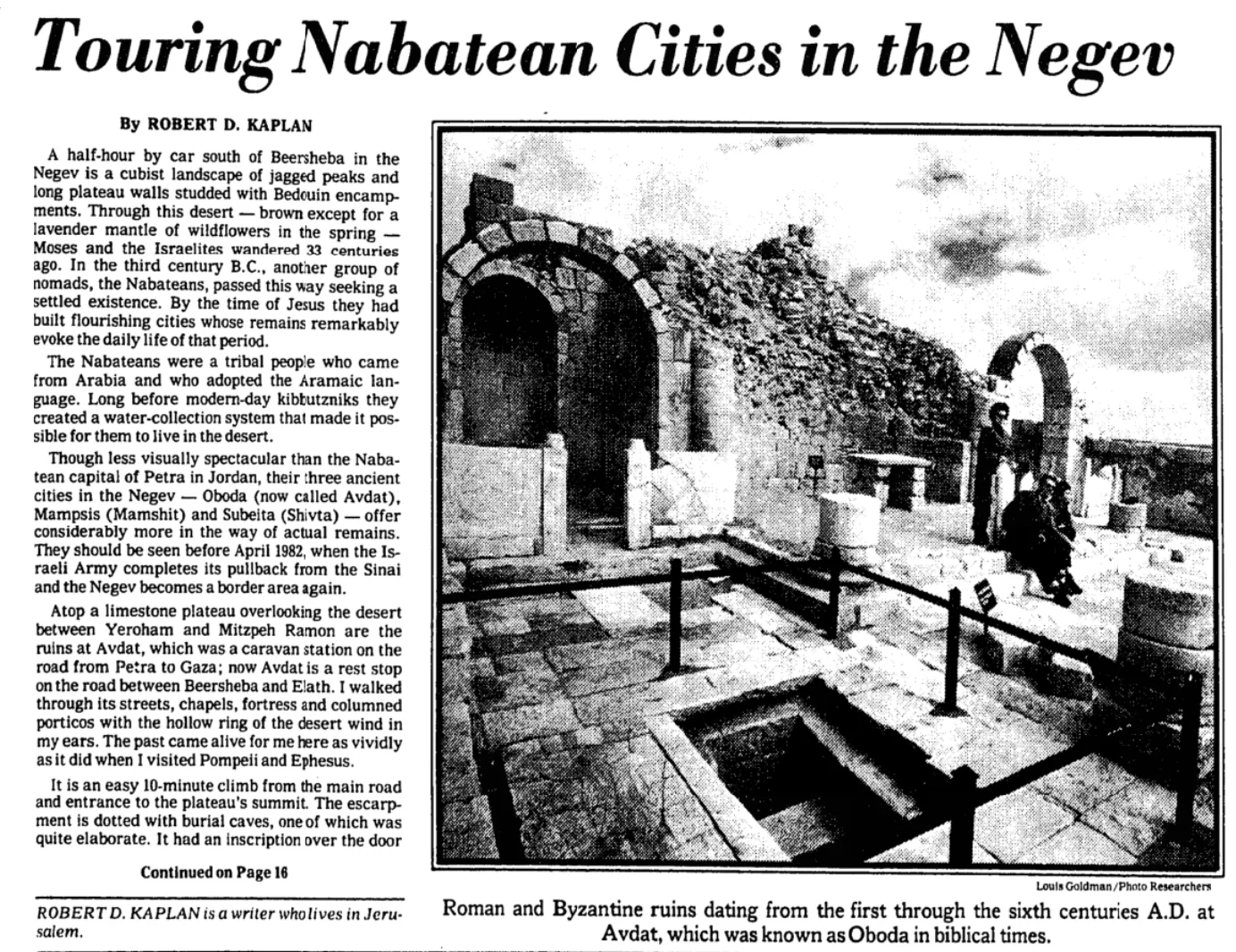
They should be seen before April 1982, when the Israeli Army completes its pullback from the Sinai and the Negev becomes a border area again. Atop a limestone plateau overlooking the desert between Yeroham and Mitzpeh Ramon are the ruins at Avdat, which was a caravan station on the road from Petra to Gaza; now Avdat is a rest stop on the road between Beersheba and Elath.
I walked through its streets, chapels, fortress and columned porticos with the hollow ring of the desert wind in my ears. The past came alive for me here as vividly as it did when I visited Pompeii and Ephesus. It is an easy 10-minute climb from the main road and entrance to the plateau’s summit.
The escarpment is dotted with burial caves, one of which was quite elaborate.
How this transcription was made
Read from the scan by a machine looking at the image of the page, not by optical character recognition and not by a person. The clipping carries no masthead or date line, so its date and newspaper rest on the record it arrived with, not on anything visible in the scan.
Context added by this archive
Date check: No masthead or folio line is on this clipping, so nothing on the page states a date. BUT THE TEXT ITSELF RULES OUT 1960: the third paragraph reads “They should be seen before April 1982, when the Israeli Army completes its pullback from the Sinai and the Negev becomes a border area again.”
The final Sinai withdrawal under the Camp David accords took place in April 1982, so this piece was written in or shortly before that period — roughly 1981 — not on 1960-11-02. The modern photo-typeset body face and the Photo Researchers picture credit agree with an early-1980s setting.
Cite this clipping
"Touring Nabatean Cities in the Negev," The New York Times, 2 November 1960. Covering Palestine archive, CP-1960-015. https://coveringpalestine.org/archive/cp-1960-015
More from The New York Times
- The Maine Colony in PalestineThe New York Times · 12 November 1866
- Jewish Colonization in PalestineThe New York Times · 9 December 1883
- Jewish State in Palestine OpposedThe New York Times · 9 July 1897
- ZIONIST CONGRESS IN BASELThe New York Times · 31 August 1897
- ROME FEARS THE ZIONISTSThe New York Times · 12 September 1897
- PROGRESS OF ZIONISMThe New York Times · 16 December 1901
- 852 more from this paper in the full text →
More from the 1960s
- Gaza Strip Refugees Are Fed, Clothed, HousedHerald Statesman · 6 January 1960
- Marry, Wait to Die Lament of 240,000 Gaza RefugeesPress and Sun Bulletin · 6 January 1960
- Gaza Strip Refugee Says Young Merely Wed, Old DieThe Patriot Ledger · 7 January 1960
- An Arab Voice of ReasonThe New York Times · 19 January 1960
- Uncertainty, Fear Mark City's MoodMonroe Morning World · 5 February 1960
- Jordan Rejects Palestine BidThe New York Times · 8 March 1960
- All 227 clippings from the 1960s →
Last updated 2 November 2026
This record is part of Covering Palestine, an archive of American newspaper clippings about Palestinians, 1724 to 2023. Researched and assembled by Maria Robles.
The clipping belongs to the newspaper that printed it, or to the news agency that supplied the copy. It is reproduced here for research, criticism and commentary. A city here is where the newspaper was published, not where the story came from, and on most records it was taken from the masthead.
Something wrong here, or something you know about this clipping? The archive is still being built and corrections are wanted: maria@rozumstudio.com, quoting CP-1960-015.
Everything printed in 1960 · Printed on this day · See it in the archive reel · Full text of every clipping · Dataset