The New York Times · 5 October 1970
CP-1970-023
A Palestinian Solution
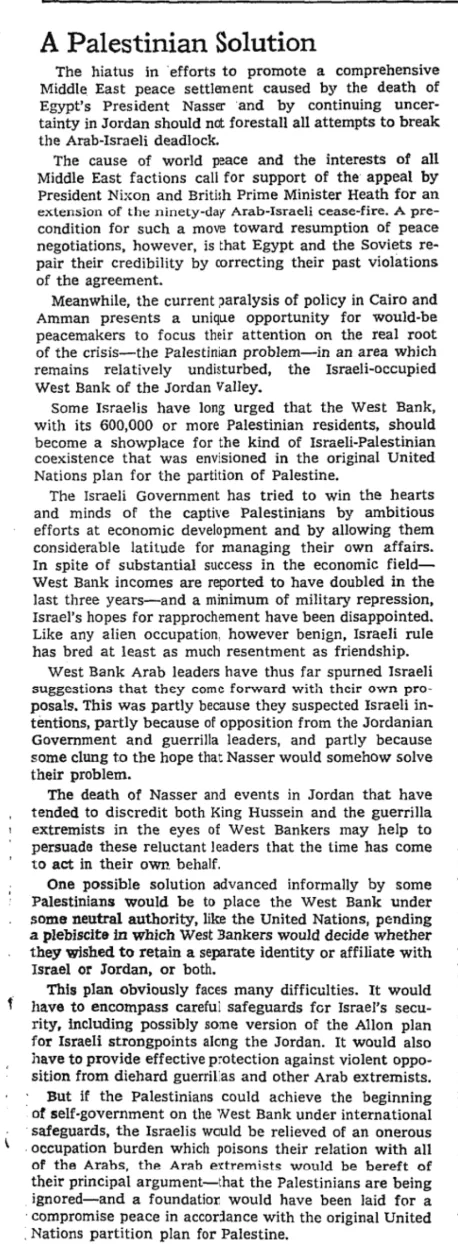
Transcribed from the clipping
The hiatus in efforts to promote a comprehensive Middle East peace settlement caused by the death of Egypt’s President Nasser and by continuing uncertainty in Jordan should not forestall all attempts to break the Arab-Israeli deadlock.
The cause of world peace and the interests of all Middle East factions call for support of the appeal by President Nixon and British Prime Minister Heath for an extension of the ninety-day Arab-Israeli cease-fire.
A precondition for such a move toward resumption of peace negotiations, however, is that Egypt and the Soviets repair their credibility by correcting their past violations of the agreement.
Meanwhile, the current paralysis of policy in Cairo and Amman presents a unique opportunity for would-be peacemakers to focus their attention on the real root of the crisis—the Palestinian problem—in an area which remains relatively undisturbed, the Israeli-occupied West Bank of the Jordan Valley.
Some Israelis have long urged that the West Bank, with its 600,000 or more Palestinian residents, should become a showplace for the kind of Israeli-Palestinian coexistence that was envisioned in the original United Nations plan for the partition of Palestine.
The Israeli Government has tried to win the hearts and minds of the captive Palestinians by ambitious efforts at economic development and by allowing them considerable latitude for managing their own affairs.
In spite of substantial success in the economic field—West Bank incomes are reported to have doubled in the last three years—and a minimum of military repression, Israel’s hopes for rapprochement have been disappointed. Like any alien occupation, however benign, Israeli rule has bred at least as much resentment as friendship.
West Bank Arab leaders have thus far spurned Israeli suggestions that they come forward with their own proposals. This was partly because they suspected Israeli intentions, partly because of opposition from the Jordanian Government and guerrilla leaders, and partly because some clung to the hope that Nasser would somehow solve their problem.
The death of Nasser and events in Jordan that have tended to discredit both King Hussein and the guerrilla extremists in the eyes of West Bankers may help to persuade these reluctant leaders that the time has come to act in their own behalf.
Cite this clipping
"A Palestinian Solution," The New York Times, 5 October 1970. Covering Palestine archive, CP-1970-023. https://coveringpalestine.org/archive/cp-1970-023
More from The New York Times
- The Maine Colony in PalestineThe New York Times · 12 November 1866
- Jewish Colonization in PalestineThe New York Times · 9 December 1883
- Jewish State in Palestine OpposedThe New York Times · 9 July 1897
- ZIONIST CONGRESS IN BASELThe New York Times · 31 August 1897
- ROME FEARS THE ZIONISTSThe New York Times · 12 September 1897
- PROGRESS OF ZIONISMThe New York Times · 16 December 1901
- 852 more from this paper in the full text →
More from the 1970s
- Arab RefugeesThe News · 7 January 1970
- Israel to Settle 1,000 Jews In Arab Town of HebronThe New York Times · 26 March 1970
- ISRAELIS REPORT KILLING 21 ARABSThe New York Times · 5 May 1970
- Black Panthers Hit Jews, Zionism and Racism as SameWisconsin Jewish Chronicle · 8 May 1970
- Palestinians Want State, Refugee FundsThe Decatur Review · 9 June 1970
- Jewish Museum Bars Pamphlets By Artist GroupThe New York Times · 18 June 1970
- All 338 clippings from the 1970s →
Last updated 2 November 2026
This record is part of Covering Palestine, an archive of American newspaper clippings about Palestinians, 1724 to 2023. Researched and assembled by Maria Robles.
The clipping belongs to the newspaper that printed it, or to the news agency that supplied the copy. It is reproduced here for research, criticism and commentary. A city here is where the newspaper was published, not where the story came from, and on most records it was taken from the masthead.
Something wrong here, or something you know about this clipping? The archive is still being built and corrections are wanted: maria@rozumstudio.com, quoting CP-1970-023.
Everything printed in 1970 · Printed on this day · See it in the archive reel · Full text of every clipping · Dataset