The New York Times · 14 September 1970
CP-1970-024
Hijacking Mastermind Is No. 2 in the Popular Front
By John M. Lee
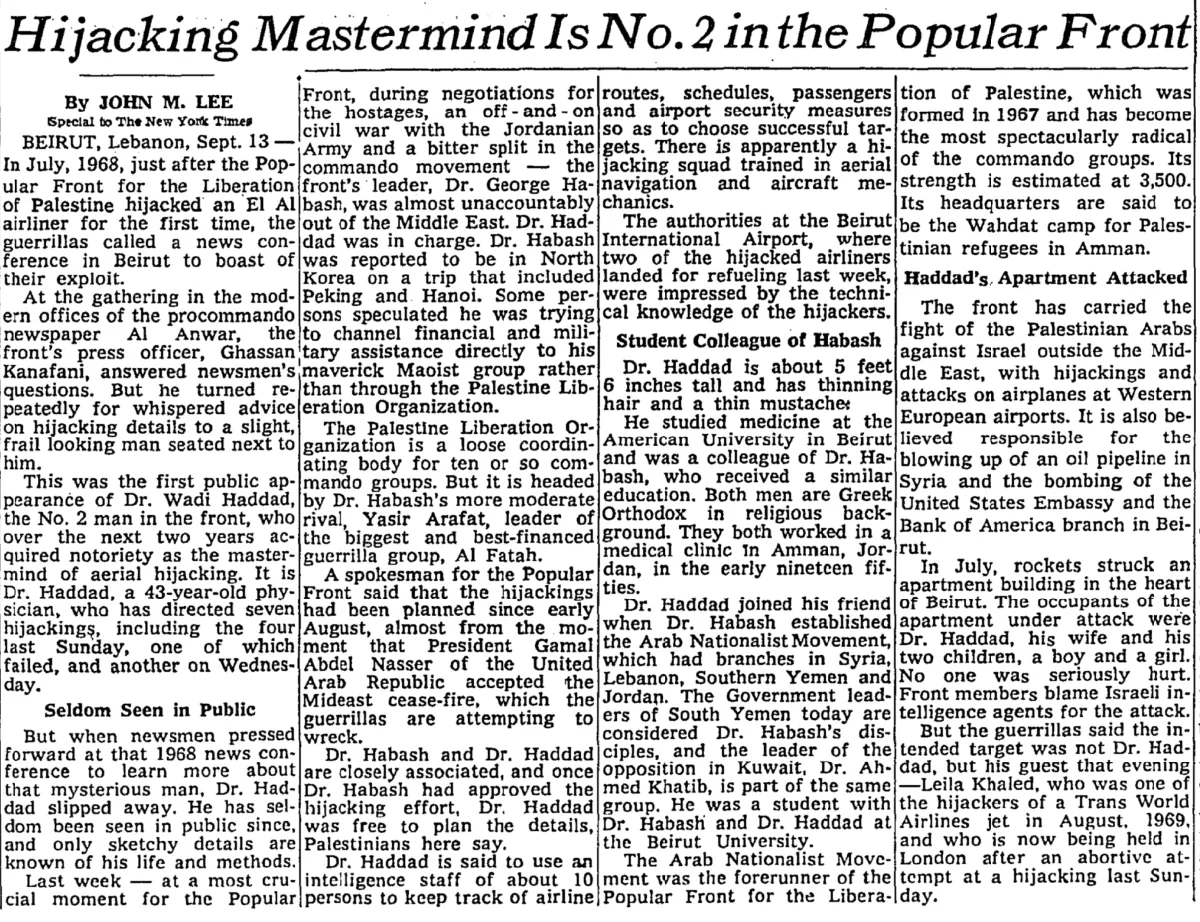
Transcribed from the clipping
BEIRUT, Lebanon, Sept. 13 — In July, 1968, just after the Popular Front for the Liberation of Palestine hijacked an El Al airliner for the first time, the guerrillas called a news conference in Beirut to boast of their exploit.
At the gathering in the modern offices of the procommando newspaper Al Anwar, the front’s press officer, Ghassan Kanafani, answered newsmen’s questions. But he turned repeatedly for whispered advice on hijacking details to a slight, frail looking man seated next to him. This was the first public appearance of Dr. Wadi Haddad, the No.
2 man in the front, who over the next two years acquired notoriety as the mastermind of aerial hijacking. It is Dr. Haddad, a 43-year-old physician, who has directed seven hijackings, including the four last Sunday, one of which failed, and another on Wednesday.
Seldom Seen in Public But when newsmen pressed forward at that 1968 news conference to learn more about that mysterious man, Dr. Haddad slipped away. He has seldom been seen in public since, and only sketchy details are known of his life and methods.
Last week — at a most crucial moment for the Popular Front, during negotiations for the hostages, an off-and-on civil war with the Jordanian Army and a bitter split in the commando movement — the front’s leader, Dr. George Habash, was almost unaccountably out of the Middle East. Dr. Haddad was in charge. Dr.
Habash was reported to be in North Korea on a trip that included Peking and Hanoi. Some persons speculated he was trying to channel financial and military assistance directly to his maverick Maoist group rather than through the Palestine Liberation Organization. The Palestine Liberation Organization is a loose coordinating body for ten or so commando groups.
But it is headed by Dr. Habash’s more moderate rival, Yasir Arafat, leader of the biggest and best-financed guerrilla group, Al Fatah.
A spokesman for the Popular Front said that the hijackings had been planned since early August, almost from the moment that President Gamal Abdel Nasser of the United Arab Republic accepted the Mideast cease-fire, which the guerrillas are attempting to wreck. Dr. Habash and Dr. Haddad are closely associated, and once Dr. Habash had approved the hijacking effort, Dr.
Haddad was free to plan the details, Palestinians here say. Dr. Haddad is said to use an intelligence staff of about 10 persons to keep track of airline routes, schedules, passengers and airport security measures so as to choose successful targets. There is apparently a hijacking squad trained in aerial navigation and aircraft mechanics.
The authorities at the Beirut International Airport, where two of the hijacked airliners landed for refueling last week, were impressed by the technical knowledge of the hijackers. Student Colleague of Habash Dr. Haddad is about 5 feet 6 inches tall and has thinning hair and a thin mustache. He studied medicine at the American University in Beirut and was a colleague of Dr.
Habash, who received a similar education. Both men are Greek Orthodox in religious background. They both worked in a medical clinic in Amman, Jordan, in the early nineteen fifties. Dr. Haddad joined his friend when Dr. Habash established the Arab Nationalist Movement, which had branches in Syria, Lebanon, Southern Yemen and Jordan.
The Government leaders of South Yemen today are considered Dr. Habash’s disciples, and the leader of the opposition in Kuwait, Dr. Ahmed Khatib, is part of the same group. He was a student with Dr. Habash and Dr. Haddad at the Beirut University.
The Arab Nationalist Movement was the forerunner of the Popular Front for the Liberation of Palestine, which was formed in 1967 and has become the most spectacularly radical of the commando groups. Its strength is estimated at 3,500. Its headquarters are said to be the Wahdat camp for Palestinian refugees in Amman.
Haddad’s Apartment Attacked The front has carried the fight of the Palestinian Arabs against Israel outside the Middle East, with hijackings and attacks on airplanes at Western European airports. It is also believed responsible for the blowing up of an oil pipeline in Syria and the bombing of the United States Embassy and the Bank of America branch in Beirut.
In July, rockets struck an apartment building in the heart of Beirut. The occupants of the apartment under attack were Dr. Haddad, his wife and his two children, a boy and a girl. No one was seriously hurt. Front members blame Israeli intelligence agents for the attack. But the guerrillas said the intended target was not Dr.
Haddad, but his guest that evening — Leila Khaled, who was one of the hijackers of a Trans World Airlines jet in August, 1969, and who is now being held in London after an abortive attempt at a hijacking last Sunday.
Cite this clipping
"Hijacking Mastermind Is No. 2 in the Popular Front," The New York Times, 14 September 1970. Covering Palestine archive, CP-1970-024. https://coveringpalestine.org/archive/cp-1970-024
More from The New York Times
- The Maine Colony in PalestineThe New York Times · 12 November 1866
- Jewish Colonization in PalestineThe New York Times · 9 December 1883
- Jewish State in Palestine OpposedThe New York Times · 9 July 1897
- ZIONIST CONGRESS IN BASELThe New York Times · 31 August 1897
- ROME FEARS THE ZIONISTSThe New York Times · 12 September 1897
- PROGRESS OF ZIONISMThe New York Times · 16 December 1901
- 852 more from this paper in the full text →
More from the 1970s
- Arab RefugeesThe News · 7 January 1970
- Israel to Settle 1,000 Jews In Arab Town of HebronThe New York Times · 26 March 1970
- ISRAELIS REPORT KILLING 21 ARABSThe New York Times · 5 May 1970
- Black Panthers Hit Jews, Zionism and Racism as SameWisconsin Jewish Chronicle · 8 May 1970
- Palestinians Want State, Refugee FundsThe Decatur Review · 9 June 1970
- Jewish Museum Bars Pamphlets By Artist GroupThe New York Times · 18 June 1970
- All 338 clippings from the 1970s →
Last updated 2 November 2026
This record is part of Covering Palestine, an archive of American newspaper clippings about Palestinians, 1724 to 2023. Researched and assembled by Maria Robles.
The clipping belongs to the newspaper that printed it, or to the news agency that supplied the copy. It is reproduced here for research, criticism and commentary. A city here is where the newspaper was published, not where the story came from, and on most records it was taken from the masthead.
Something wrong here, or something you know about this clipping? The archive is still being built and corrections are wanted: maria@rozumstudio.com, quoting CP-1970-024.
Everything printed in 1970 · Printed on this day · See it in the archive reel · Full text of every clipping · Dataset