The New York Times · 25 December 1970
CP-1970-028
Christmas Scene in Bethlehem Spans the Centuries
By PETER GROSE
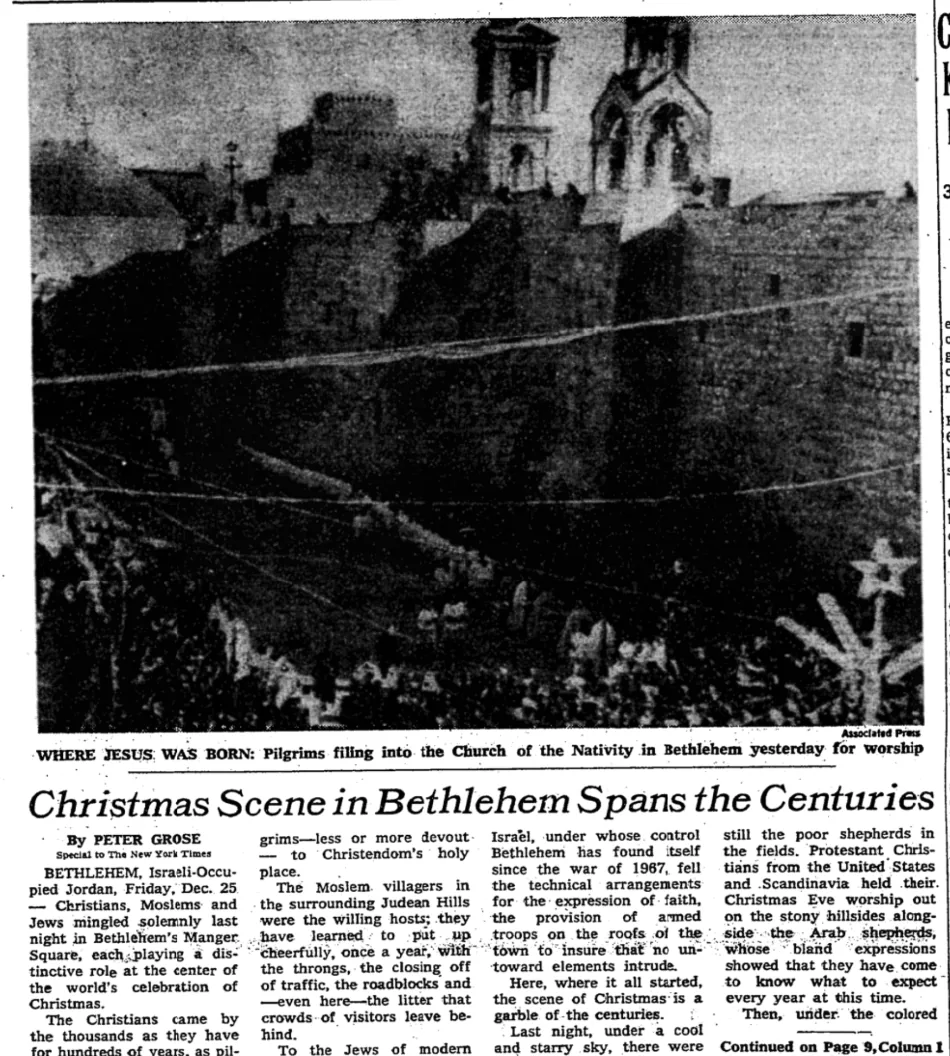
Transcribed from the clipping
BETHLEHEM, Israeli-Occupied Jordan, Friday, Dec. 25 — Christians, Moslems and Jews mingled solemnly last night in Bethlehem’s Manger Square, each playing a distinctive role at the center of the world’s celebration of Christmas. The Christians came by the thousands as they have for hundreds of years, as pilgrims—less or more devout—to Christendom’s holy place.
The Moslem villagers in the surrounding Judean Hills were the willing hosts; they have learned to put up cheerfully, once a year, with the throngs, the closing off of traffic, the roadblocks and—even here—the litter that crowds of visitors leave behind.
To the Jews of modern Israel, under whose control Bethlehem has found itself since the war of 1967, fell the technical arrangements for the expression of faith, the provision of armed troops on the roofs of the town to insure that no untoward elements intrude. Here, where it all started, the scene of Christmas is a garble of the centuries.
… [JUMP OF THE MATCHED ARTICLE — this is the part that merges into CP-1970-028:] BETHLEHEM SCENE SPANS CENTURIES Continued From Page 1, Col 4 lights and loudspeakers of downtown Bethlehem, there were clusters of youths from a dozen countries, their bedrolls laid out on the stone pavement, their guitars gently harmonizing with the carols and hymns from the amplified organ of the church over the manger revered as the one where Jesus was born.
Here the Roman Catholic and Eastern Orthodox churches are in control. The midnight mass is theirs, but with the important understanding that one representative each of the Eastern Orthodox and Armenian churches stand on the southern side of the main iron door of the basilica of the Nativity as the Latin, or Roman Catholic, patriarch enters.
Other Groups Participate Moreover, for half an hour yesterday afternoon, before the arrival of the Latin patriarch, Msgr. James Joseph Beltritti, the Armenians were authorized to ring the bells and the Eastern Orthodox placed their icon in the Grotto of the Nativity, removing it promptly when their worship was concluded and the Latin patriarch arrived at 1:30.
The Eastern Orthodox Church celebrates Christmas on Jan 7, the Armenian Church on Jan. 19, all because of different calendars that have evolved since the beginning of the Christian era. The intricate arrangements of the various Christian denominations have their uneasy focus at the celebration of the holy days — Christmas in Bethlehem and Easter in Jerusalem.
As the Israelis discovered in 1967, when they found themselves supervising these arrangements as the political authorities on the spot, the rivalries and prerogatives are complex. The head of the Christian Division of the Israeli Ministry of Religious Affairs, Saul P. Colbi, has written: “True, the rights and privileges of the communities had been defined in 1852.
But to master the subtle intricacies, one must acquire a thorough knowledge of the de facto situation prevailing in the shrines from a perusal of the main precedents set and decisions promulgated by the governments which successively ruled the Holy Land.”
Below the basilica, down a flight of curving stone steps, a stream of the curious and the devout passed to see the Grotto of the Nativity, the cave that medieval Biblical translators turned into a stable. “Hic de Virgine Maria Jesus Christ natus est,” the inscription reads. “Here the Virgin Mary gave birth to Jesus Christ.”
The grotto was open to all pilgrims who came; the pontifical high mass could be joined only by those who had received tickets from the local church authorities.
All outside in Manger Square, however, could observe the process of worship on a two-story-high screen erected on the side of a hotel to give closed-circuit television coverage of the high altar. [END OF THE MATCHED ARTICLE. Below is a SEPARATE item printed on the same clipping, with its own head and dateline.
Not part of CP-1970-028.] Grenade Hurled Near Bethlehem BETHLEHEM, Friday, Dec. 25 (AP)—A hand grenade apparently thrown by an Arab guerrilla, exploded last night on the outskirts of Bethlehem, Israeli security agents said. No one was injured, they reported.
They said that the grenade had been hurled at an Israeli civilian car but had missed. [A further item begins below a rule at the foot of the scan. Only the first two words of its headline are on the page and the second is cut by the crop: “Crosses A…”. Nothing of its body is on the scan.]
How this transcription was made
Transcribed from a scan of the printed page. The page carries no masthead or folio, but the dateline dates itself: it reads 'BETHLEHEM, Israeli-Occupied Jordan, Friday, Dec. 25', and 25 December 1970 was a Friday, with the photograph caption referring to 'yesterday'. The newspaper is identified from the printed credit line 'Special to The New York Times' under the byline. The dateline's 'Israeli-Occupied Jordan', three and a half years after the 1967 war, is the page's own wording and has been transcribed exactly. The article is marked 'Continued on Page 9, Column 1', so this is a front page, but no page number is printed on the scan, and the clipping is cut at the right edge where a second article's headline is partly visible. The caption's bold all-capitals lead-in is part of the caption as printed. Read from crops magnified to between eleven and twelve times page scale. The other part of this article was added on 2 November 2026 from a second clipping (m003_2.png).
Cite this clipping
"Christmas Scene in Bethlehem Spans the Centuries," The New York Times, 25 December 1970. Covering Palestine archive, CP-1970-028. https://coveringpalestine.org/archive/cp-1970-028
More from The New York Times
- The Maine Colony in PalestineThe New York Times · 12 November 1866
- Jewish Colonization in PalestineThe New York Times · 9 December 1883
- Jewish State in Palestine OpposedThe New York Times · 9 July 1897
- ZIONIST CONGRESS IN BASELThe New York Times · 31 August 1897
- ROME FEARS THE ZIONISTSThe New York Times · 12 September 1897
- PROGRESS OF ZIONISMThe New York Times · 16 December 1901
- 852 more from this paper in the full text →
More from the 1970s
- Arab RefugeesThe News · 7 January 1970
- Israel to Settle 1,000 Jews In Arab Town of HebronThe New York Times · 26 March 1970
- ISRAELIS REPORT KILLING 21 ARABSThe New York Times · 5 May 1970
- Black Panthers Hit Jews, Zionism and Racism as SameWisconsin Jewish Chronicle · 8 May 1970
- Palestinians Want State, Refugee FundsThe Decatur Review · 9 June 1970
- Jewish Museum Bars Pamphlets By Artist GroupThe New York Times · 18 June 1970
- All 338 clippings from the 1970s →
Last updated 2 November 2026
This record is part of Covering Palestine, an archive of American newspaper clippings about Palestinians, 1724 to 2023. Researched and assembled by Maria Robles.
The clipping belongs to the newspaper that printed it, or to the news agency that supplied the copy. It is reproduced here for research, criticism and commentary. A city here is where the newspaper was published, not where the story came from, and on most records it was taken from the masthead.
Something wrong here, or something you know about this clipping? The archive is still being built and corrections are wanted: maria@rozumstudio.com, quoting CP-1970-028.
Everything printed in 1970 · Printed on this day · See it in the archive reel · Full text of every clipping · Dataset