The New York Times · 10 July 1972
CP-1972-030
Arafat Says Killing of Guerrilla Heralds New Blows at Israel
Special to The New York Times
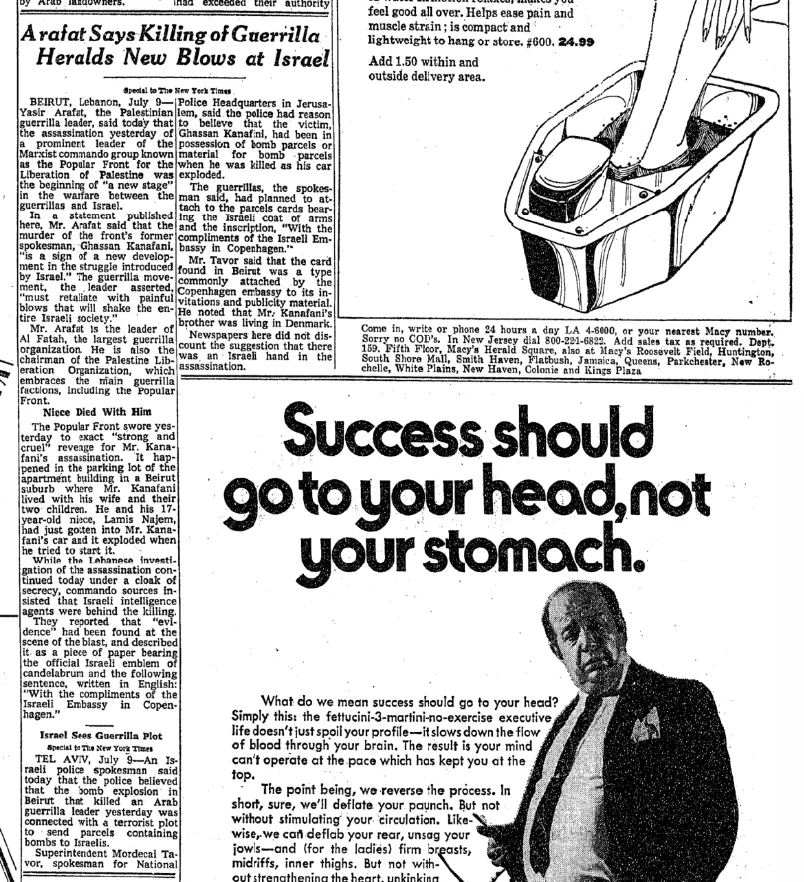
Transcribed from the clipping
BEIRUT, Lebanon, July 9 — Yasir Arafat, the Palestinian guerrilla leader, said today that the assassination yesterday of a prominent leader of the Marxist commando group known as the Popular Front for the Liberation of Palestine was the beginning of “a new stage” in the warfare between the guerrillas and Israel. In a statement published here, Mr.
Arafat said that the murder of the front’s former spokesman, Ghassan Kanafani, “is a sign of a new development in the struggle introduced by Israel.” The guerrilla movement, the leader asserted, “must retaliate with painful blows that will shake the entire Israeli society.” Mr. Arafat is the leader of Al Fatah, the largest guerrilla organization.
He is also the chairman of the Palestine Liberation Organization, which embraces the main guerrilla factions, including the Popular Front. Niece Died With Him The Popular Front swore yesterday to exact “strong and cruel” revenge for Mr. Kanafani’s assassination. It happened in the parking lot of the apartment building in a Beirut suburb where Mr.
Kanafani lived with his wife and their two children. He and his 17-year-old niece, Lamis Najem, had just gotten into Mr. Kanafani’s car and it exploded when he tried to start it. While the Lebanese investigation of the assassination continued today under a cloak of secrecy, commando sources insisted that Israeli intelligence agents were behind the killing.
They reported that “evidence” had been found at the scene of the blast, and described it as a piece of paper bearing the official Israeli emblem of candelabrum and the following sentence, written in English: “With the compliments of the Israeli Embassy in Copenhagen.”
Israel Sees Guerrilla Plot TEL AVIV, July 9 — An Israeli police spokesman said today that the police believed that the bomb explosion in Beirut that killed an Arab guerrilla leader yesterday was connected with a terrorist plot to send parcels containing bombs to Israelis.
Superintendent Mordecai Tavor, spokesman for National Police Headquarters in Jerusalem, said the police had reason to believe that the victim, Ghassan Kanafini, had been in possession of bomb parcels or material for bomb parcels when he was killed as his car exploded.
The guerrillas, the spokesman said, had planned to attach to the parcels cards bearing the Israeli coat of arms and the inscription, “With the compliments of the Israeli Embassy in Copenhagen.” Mr. Tavor said that the card found in Beirut was a type commonly attached by the Copenhagen embassy to its invitations and publicity material. He noted that Mr.
Kanafani’s brother was living in Denmark. Newspapers here did not discount the suggestion that there was an Israeli hand in the assassination.
Cite this clipping
"Arafat Says Killing of Guerrilla Heralds New Blows at Israel," The New York Times, 10 July 1972. Covering Palestine archive, CP-1972-030. https://coveringpalestine.org/archive/cp-1972-030
More from The New York Times
- The Maine Colony in PalestineThe New York Times · 12 November 1866
- Jewish Colonization in PalestineThe New York Times · 9 December 1883
- Jewish State in Palestine OpposedThe New York Times · 9 July 1897
- ZIONIST CONGRESS IN BASELThe New York Times · 31 August 1897
- ROME FEARS THE ZIONISTSThe New York Times · 12 September 1897
- PROGRESS OF ZIONISMThe New York Times · 16 December 1901
- 852 more from this paper in the full text →
More from the 1970s
- Beirut Moves Against Guerrillas To Quell Israeli RaidsThe Times · 29 February 1972
- Giant Step for Arab WomenThe New York Times · 29 February 1972
- Israeli Raid Forces Beirut To Face Up To Guerrilla ProblemColumbia Record · 3 March 1972
- Israel to Discipline Officers In Bedouins’ DisplacementThe New York Times · 27 March 1972
- Artist Seeking Mideast TogethernessThe Daily Progress · 3 May 1972
- Israel cites POW torture; Palestinians ask statehoodThe Morning Call · 10 June 1972
- All 338 clippings from the 1970s →
Last updated 2 November 2026
This record is part of Covering Palestine, an archive of American newspaper clippings about Palestinians, 1724 to 2023. Researched and assembled by Maria Robles.
The clipping belongs to the newspaper that printed it, or to the news agency that supplied the copy. It is reproduced here for research, criticism and commentary. A city here is where the newspaper was published, not where the story came from, and on most records it was taken from the masthead.
Something wrong here, or something you know about this clipping? The archive is still being built and corrections are wanted: maria@rozumstudio.com, quoting CP-1972-030.
Everything printed in 1972 · Printed on this day · See it in the archive reel · Full text of every clipping · Dataset