Longview Daily News · 11 May 1973
CP-1973-034
Death threats not chasing Palestinians from ‘jobs’
By Gavin Young, The London Observer
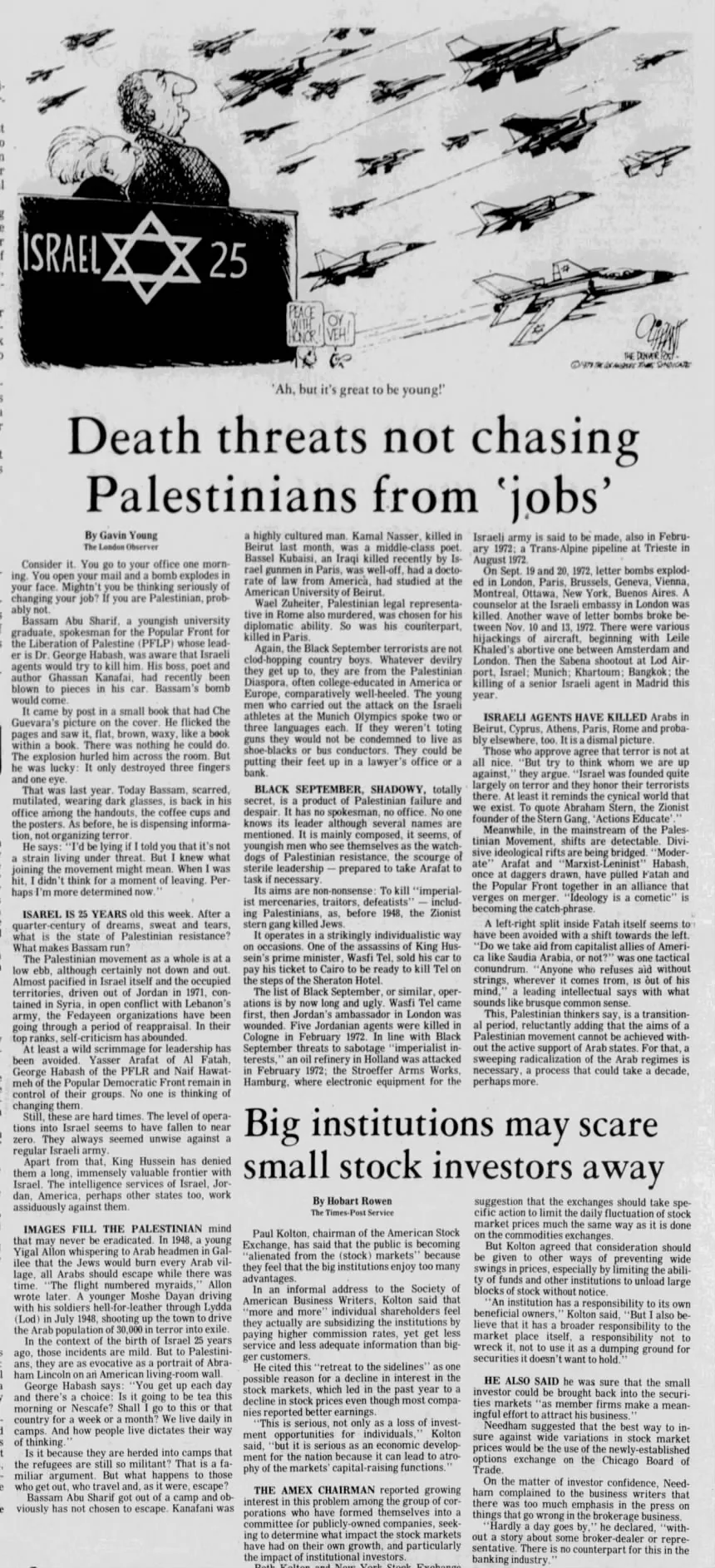
Transcribed from the clipping
Consider it. You go to your office one morning. You open your mail and a bomb explodes in your face. Mightn’t you be thinking seriously of changing your job? If you are Palestinian, probably not. Bassam Abu Sharif, a youngish university graduate, spokesman for the Popular Front for the Liberation of Palestine (PFLP) whose leader is Dr.
George Habash, was aware that Israeli agents would try to kill him. His boss, poet and author Ghassan Kanafai, had recently been blown to pieces in his car. Bassam’s bomb would come. It came by post in a small book that had Che Guevara’s picture on the cover. He flicked the pages and saw it, flat, brown, waxy, like a book within a book.
There was nothing he could do. The explosion hurled him across the room. But he was lucky: It only destroyed three fingers and one eye. That was last year. Today Bassam, scarred, mutilated, wearing dark glasses, is back in his office among the handouts, the coffee cups and the posters. As before, he is dispensing information, not organizing terror.
He says: “I’d be lying if I told you that it’s not a strain living under threat. But I knew what joining the movement might mean. When I was hit, I didn’t think for a moment of leaving. Perhaps I’m more determined now.” ISAREL IS 25 YEARS old this week.
After a quarter-century of dreams, sweat and tears, what is the state of Palestinian resistance? What makes Bassam run? The Palestinian movement as a whole is at a low ebb, although certainly not down and out.
Almost pacified in Israel itself and the occupied territories, driven out of Jordan in 1971, contained in Syria, in open conflict with Lebanon’s army, the Fedayeen organizations have been going through a period of reappraisal. In their top ranks, self-criticism has abounded. At least a wild scrimmage for leadership has been avoided.
Yasser Arafat of Al Fatah, George Habash of the PFLR and Naif Hawatmeh of the Popular Democratic Front remain in control of their groups. No one is thinking of changing them. Still, these are hard times. The level of operations into Israel seems to have fallen to near zero. They always seemed unwise against a regular Israeli army.
Apart from that, King Hussein has denied them a long, immensely valuable frontier with Israel. The intelligence services of Israel, Jordan, America, perhaps other states too, work assiduously against them. IMAGES FILL THE PALESTINIAN mind that may never be eradicated.
In 1948, a young Yigal Allon whispering to Arab headmen in Galilee that the Jews would burn every Arab village, all Arabs should escape while there was time. “The flight numbered myraids,” Allon wrote later.
A younger Moshe Dayan driving with his soldiers hell-for-leather through Lydda (Lod) in July 1948, shooting up the town to drive the Arab population of 30,000 in terror into exile. In the context of the birth of Israel 25 years ago, those incidents are mild. But to Palestinians, they are as evocative as a portrait of Abraham Lincoln on an American living-room wall.
George Habash says: “You get up each day and there’s a choice: Is it going to be tea this morning or Nescafe? Shall I go to this or that country for a week or a month? We live daily in camps. And how people live dictates their way of thinking.”
How this transcription was made
Read from the scan Maria supplied on 17 November 2026, at magnification, band by band. NO MASTHEAD, FOLIO OR DATE LINE ON THIS CLIPPING. The scan is an opinion page — a syndicated cartoon across the top, this article below it, and a second article, "Big institutions may scare small stock investors away" by Hobart Rowen of The Times-Post Service, filling the lower half — but the page carries no nameplate, page number or date. The internal time-marker is firm enough to bracket the week and no more: the article says twice that Israel is 25 years old "this week" and that Kamal Nasser was "killed in Beirut last month" (the Beirut raid was 10 April 1973). Israel's 25th anniversary by the Hebrew calendar fell on 7 May 1973. The label date 1973-05-11 sits in that week. The year is nowhere printed on the page. label_uncertain IS SET TRUE ON THIS ENTRY IN THE INPUT, and nothing on the page resolves it. Paper and date both rest on the slide label. The page is consistent with a daily of about 11 May 1973 but names neither itself nor Longview nor any date. This is the one in the batch I would least want published with a confident citation. CROSSHEADING MISPRINT, AS PRINTED: "ISAREL IS 25 YEARS old this week". Israel is transposed to Isarel in the bold lead-in. Checked at 6x. It stays. The same paragraph is where the piece's thesis sits, so this is a line that will be quoted and the misprint should travel with it. A SECOND MISPRINT IN THE SAME COLUMN: "George Habash of the PFLR" — PFLR for PFLP, four lines after the piece has already spelt out "Popular Front for the Liberation of Palestine (PFLP)" correctly. Both stay as set. THE PAPER SPELLS KANAFANI TWO WAYS ON THE SAME PAGE. Column one: "His boss, poet and author Ghassan Kanafai, had recently been blown to pieces in his car." Column one again, at its foot: "Kanafani was" — and column two continues "a highly cultured man." Kanafai in the first instance, Kanafani in the second. Both checked at 6x. Neither is corrected. A THIRD MISPRINT, INSIDE A QUOTATION: Yigal Allon is quoted as writing "The flight numbered myraids" — myraids for myriads. It is inside quotation marks, so the error is now attributed to Allon by this paper. Transcribed as printed and flagged here so the archive does not propagate it as his spelling. COLUMN ORDER ESTABLISHED FROM THE SENSE, NOT THE LAYOUT. Three columns, left to right. Column one ends mid-sentence at "Kanafani was" and column two opens "a highly cultured man." Column two ends "...the Stroeffer Arms Works, Hamburg, where electronic equipment for the" and column three opens "Israeli army is said to be made". Both joins read continuously. FLAG FOR THE CONSORTIUM BRIEF, THOUGH NOT AN AMERICAN CAMPUS. The piece turns on education, repeatedly. Bassam Abu Sharif is introduced as "a youngish university graduate". Bassel Kubaisi "had a doctorate of law from America, had studied at the American University of Beirut". And the Black September paragraph: "they are from the Palestinian Diaspora, often college-educated in America or Europe, comparatively well-heeled." A 1973 American daily is telling its readers that the Palestinians in the news went to university, and several of them in the United States. THE EXCERPT RUNS LONGER THAN THE USUAL 2,000 CHARACTERS, to about 3,200, because the three quotable passages worth recording — Abu Sharif's, Allon's and Habash's — are spread across the whole of column one and a quote cannot be recorded unless it stands in the excerpt. It ends at a complete sentence, the close of the Habash quotation, at the foot of column one. Columns two and three are summarised in these queries rather than transcribed. THE CARTOON IS NOT THIS ARTICLE'S. Above the headline sits a syndicated editorial cartoon — Israeli jets in formation over an "ISRAEL 25" anniversary platform, with two small figures at the foot holding placards reading "PEACE WITH HONOR" and "OY VEH!" — signed and credited in the plate to THE DENVER POST and the Los Angeles Times Syndicate. Its caption, the only line of type under it, reads ‘Ah, but it’s great to be young!’ I have put that caption in photo_caption, labelled, because the clipping carries no photograph and the caption is the only cut-line on the page; but it belongs to the cartoon, not to Gavin Young's article, and should not be filed as an illustration of it. The placard lettering inside the drawing is lettering inside an image and is not transcribed as text. People named in columns two and three, outside the excerpt, are listed under people and marked as such in their roles: Kamal Nasser, Bassel Kubaisi, Wael Zuheiter, Wasfi Tel, Leile Khaled (so spelt) and Abraham Stern. Note that the page calls Kubaisi "an Iraqi", not a Palestinian.
Cite this clipping
"Death threats not chasing Palestinians from ‘jobs’," Longview Daily News, 11 May 1973. Covering Palestine archive, CP-1973-034. https://coveringpalestine.org/archive/cp-1973-034
More from Longview Daily News
- Americans disagree with U.N. on Zionism as racismLongview Daily News · 15 December 1975
- Israel, PLO sign historic peace planLongview Daily News · 13 September 1993
More from the 1970s
- French Plan Protection For Israeli(newspaper unidentified) · 10 January 1973
- Paris Police Plan Special Security Measures for Meir(newspaper unidentified) · 10 January 1973
- Mrs. Meir's Safety StudiedLos Angeles Times · 11 January 1973
- Cases of senseless murder and wanton destructionWisconsin Jewish Chronicle · 19 January 1973
- Palestinian Runs : Arab Newspaper In E. JerusalemDuluth News-Tribune · 4 February 1973
- Israeli Arabs and Jews unite for right of villagers to returnDaily World · 23 February 1973
- All 353 clippings from the 1970s →
Last updated 17 November 2026
This record is part of Covering Palestine, an archive of American newspaper clippings about Palestinians, 1724 to 2023. Researched and assembled by Maria Robles.
The clipping belongs to the newspaper that printed it, or to the news agency that supplied the copy. It is reproduced here for research, criticism and commentary. A city here is where the newspaper was published, not where the story came from, and on most records it was taken from the masthead.
Something wrong here, or something you know about this clipping? The archive is still being built and corrections are wanted: maria@rozumstudio.com, quoting CP-1973-034.
Everything printed in 1973 · Printed on this day · See it in the archive reel · Full text of every clipping · Dataset