The Miami Herald · 14 August 1976
CP-1976-036
Buildings Burn and Corpses Rot In What Remains of Tal Zaatar
By JOE ALEX MORRIS Jr.
Transcribed from the clipping
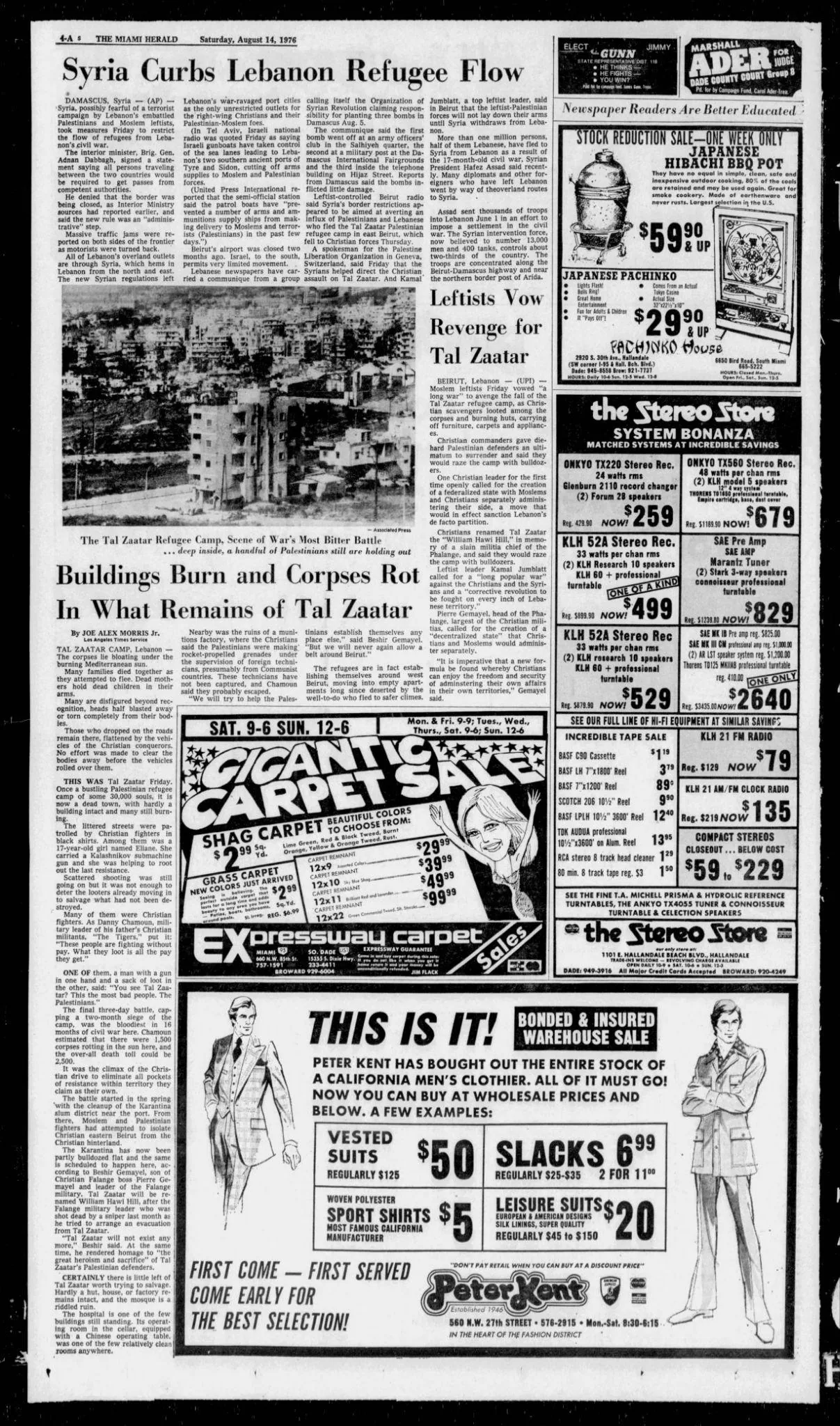
TAL ZAATAR CAMP, Lebanon — The corpses lie bloating under the burning Mediterranean sun. Many families died together as they attempted to flee. Dead mothers hold dead children in their arms. Many are disfigured beyond recognition, heads half blasted away or torn completely from their bodies.
Those who dropped on the roads remain there, flattened by the vehicles of the Christian conquerors. No effort was made to clear the bodies away before the vehicles rolled over them. THIS WAS Tal Zaatar Friday. Once a bustling Palestinian refugee camp of some 30,000 souls, it is now a dead town, with hardly a building intact and many still burning.
The littered streets were patrolled by Christian fighters in black shirts. Among them was a 17-year-old girl named Eliane. She carried a Kalashnikov submachine gun and she was helping to root out the last resistance. Scattered shooting was still going on but it was not enough to deter the looters already moving in to salvage what had not been destroyed.
Many of them were Christian fighters. As Danny Chamoun, military leader of his father’s Christian militants, “The Tigers,” put it: “These people are fighting without pay. What they loot is all the pay they get.” ONE OF them, a man with a gun in one hand and a sack of loot in the other, said: “You see Tal Zaatar? This the most bad people.
The Palestinians.” The final three-day battle, capping a two-month siege of the camp, was the bloodiest in 16 months of civil war here. Chamoun estimated that there were 1,500 corpses rotting in the sun here, and the over-all death toll could be 2,500.
It was the climax of the Christian drive to eliminate all pockets of resistance within territory they claim as their own. The battle started in the spring with the cleanup of the Karantina slum district near the port. From there, Moslem and Palestinian fighters had attempted to isolate Christian eastern Beirut from the Christian hinterland.
The Karantina has now been partly bulldozed flat and the same is scheduled to happen here, according to Beshir Gemayel, son of Christian Falange boss Pierre Gemayel and leader of the Falange military. Tal Zaatar will be renamed William Hawi Hill, after the Falange military leader who was shot dead by a sniper last month as he tried to arrange an evacuation from Tal Zaatar.
“Tal Zaatar will not exist any more,” Beshir said. At the same time, he rendered homage to “the great heroism and sacrifice” of Tal Zaatar’s Palestinian defenders. CERTAINLY there is little left of Tal Zaatar worth trying to salvage. Hardly a hut, house, or factory remains intact, and the mosque is a riddled ruin.
The hospital is one of the few buildings still standing. Its operating room in the cellar, equipped with a Chinese operating table, was one of the few relatively clean rooms anywhere.
Nearby was the ruins of a munitions factory, where the Christians said the Palestinians were making rocket-propelled grenades under the supervision of foreign technicians, presumably from Communist countries. These technicians have not been captured, and Chamoun said they probably escaped.
“We will try to help the Palestinians establish themselves any place else,” said Beshir Gemayel. “But we will never again allow a belt around Beirut.” The refugees are in fact establishing themselves around west Beirut, moving into empty apartments long since deserted by the well-to-do who fled to safer climes.
Cite this clipping
"Buildings Burn and Corpses Rot In What Remains of Tal Zaatar," The Miami Herald, 14 August 1976, p. 4-A. Covering Palestine archive, CP-1976-036. https://coveringpalestine.org/archive/cp-1976-036
More from The Miami Herald
- Irgun Takes Arab City In Night BattleThe Miami Herald · 5 May 1948
- Arabs Learn ABCs With the Hatred Left OutThe Miami Herald · 7 September 1967
- Debate Rages on Arab Refugee ProblemThe Miami Herald · 7 October 1967
- Downing Airliner Also TerrorismThe Miami Herald · 14 March 1973
- The PalestiniansThe Miami Herald · 29 May 1977
- Israel steps up its claims on Occupied West Bank landThe Miami Herald · 11 February 1981
- 18 more from this paper in the full text →
More from the 1970s
- Palestinians and Leftist Factions Open an Offensive in BeirutThe New York Times · 8 January 1976
- Equation Of Zionism With Racism Shocked CleaverPaducah Sun · 13 January 1976
- Arab prisoner manages to retain political attitudesMidland Reporter Telegram · 29 January 1976
- Drive to liberate Palestine intensifiesChicago Tribune · 29 February 1976
- Zionism and RacismHonolulu Star-Bulletin · 12 March 1976
- Plight of four schoolgirls illustrates frustration of West Bank occupationBellingham Herald · 17 March 1976
- All 338 clippings from the 1970s →
The same copy, in 1 other paper
Their text and this one are nearly identical. Found by comparing transcriptions, not by reading them side by side, so this establishes that the text overlaps and not that these papers ran the same dispatch. How this was done.
Last updated 2 November 2026
This record is part of Covering Palestine, an archive of American newspaper clippings about Palestinians, 1724 to 2023. Researched and assembled by Maria Robles.
The clipping belongs to the newspaper that printed it, or to the news agency that supplied the copy. It is reproduced here for research, criticism and commentary. A city here is where the newspaper was published, not where the story came from, and on most records it was taken from the masthead.
Something wrong here, or something you know about this clipping? The archive is still being built and corrections are wanted: maria@rozumstudio.com, quoting CP-1976-036.
Everything printed in 1976 · Printed on this day · See it in the archive reel · Full text of every clipping · Dataset