The Miami Herald · Miami, Florida · 29 May 1977
CP-1977-008
The Palestinians
Will Thousands of Refugees Ever Have Their Homeland Again?
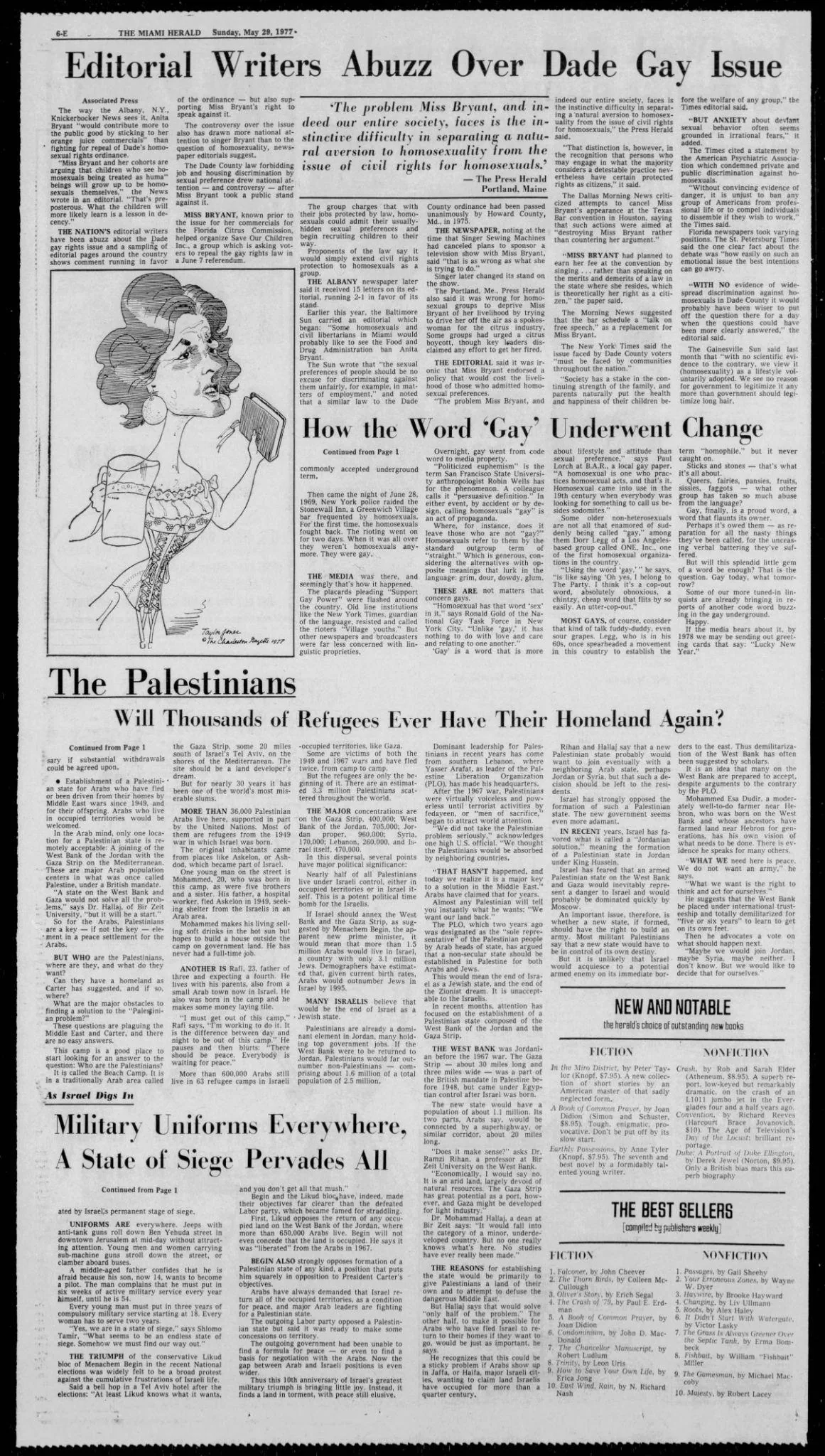
Transcribed from the clipping
“More than 600,000 Arabs still live in 63 refugee camps in Israeli-occupied territories, like Gaza… But who are the Palestinians, where are they, and what do they want? Can they have a homeland as Carter has suggested, and if so, where?
What are the major obstacles to finding a solution to the ‘Palestinian problem’?… This camp is a good place to start looking for an answer… It is called the Beach Camp. It is in a traditionally Arab area called the Gaza Strip, some 20 miles south of Israel’s Tel Aviv, on the shores of the Mediterranean.
The site should be a land developer’s dream. But for nearly 30 years it has been one of the world’s most miserable slums. More than 36,000 Palestinian Arabs live here, supported in part by the United Nations… One young man on the street is Mohammed, 20, who was born in this camp, as were five brothers and a sister.
His father, a hospital worker, fled Askelon in 1949, seeking shelter from the Israelis in an Arab area. Mohammed makes his living selling soft drinks in the hot sun but hopes to build a house outside the camp on government land. He has never had a full-time job. Another is Rafi, 23, father of three and expecting a fourth.
He lives with his parents, also from a small Arab town now in Israel. He also was born in the camp and he makes some money laying tile. ‘I must get out of this camp,’ Rafi says. ‘I’m working to do it. It is the difference between day and night to be out of this camp.’ He pauses and then blurts: ‘There should be peace.
Everybody is waiting for peace.’… There are an estimated 3.3 million Palestinians scattered throughout the world… Nearly half of all Palestinians live under Israeli control, either in occupied territories or in Israel itself. This is a potent political time bomb for the Israelis… ‘Does it make sense?’ asks Dr.
Ramzi Rihan, a professor at Bir Zeit University on the West Bank. ‘Economically, I would say no. It is an arid land, largely devoid of natural resources. The Gaza Strip has great potential as a port, however, and Gaza might be developed for light industry.’ Dr. Mohammad Hallaj says: ‘It would fall into the category of a minor, underdeveloped country.
But no one really knows what’s here. No studies have ever really been made.’… ‘We did not take the Palestinian problem seriously,’ acknowledges one high U.S. official. ‘We thought the Palestinians would be absorbed by neighboring countries.’
That hasn’t happened, and today we realize it is a major key to a solution in the Middle East.
Arabs have claimed that for years. Almost any Palestinian will tell you instantly what he wants: ‘We want our land back.’… Mohammed Esa Dudir, a moderately well-to-do farmer near Hebron, who was born on the West Bank and whose ancestors have farmed land near Hebron for generations, has no vision of what needs to be done.
‘What we need here is peace. We do not want an army,’ he says. ‘What we want is the right to think and act for ourselves.’ He suggests that the West Bank be placed under international trusteeship and totally demilitarized for ‘five or six years’ to learn to get on its own feet. Then he advocates a vote on what should happen next.
‘Maybe we would join Jordan, maybe Syria, maybe neither. I don’t know. But we would like to decide that for ourselves.’”
Context added by this archive
Five Palestinians named and quoted: two men born in the Beach Camp in Gaza who have never had steady work, two professors at Birzeit, and a farmer near Hebron who wants a demilitarised trusteeship and then a vote. The farmer’s answer is the longest in the piece and the least quoted anywhere since.
The feature shares its page with a column on the Anita Bryant campaign in Dade County, an essay on how the word gay changed, and the week’s bestseller list.
Cite this clipping
"The Palestinians," The Miami Herald, 29 May 1977, p. 1. Covering Palestine archive, CP-1977-008. https://coveringpalestine.org/archive/cp-1977-008
More from The Miami Herald
- Irgun Takes Arab City In Night BattleThe Miami Herald · 5 May 1948
- Arabs Learn ABCs With the Hatred Left OutThe Miami Herald · 7 September 1967
- Debate Rages on Arab Refugee ProblemThe Miami Herald · 7 October 1967
- Downing Airliner Also TerrorismThe Miami Herald · 14 March 1973
- Buildings Burn and Corpses Rot In What Remains of Tal ZaatarThe Miami Herald · 14 August 1976
- Israel steps up its claims on Occupied West Bank landThe Miami Herald · 11 February 1981
- 19 more from this paper in the full text →
More from the 1970s
- Beersheba, Once Scorned by Israelis, Is Booming Amid the DesertThe New York Times · 29 January 1977
- Thousands Pay Respects To Palestinian LeaderThe New York Times · 9 February 1977
- U.N. Agency Says Israel Tortures and PillagesThe New York Times · 16 February 1977
- Carter Publicly Endorses Palestinian ‘Homeland’Poughkeepsie Journal · 18 March 1977
- Arafat Praises Carter's StandPress of Atlantic City · 18 March 1977
- Jimmy Carter shakes hands with a Palestinian andHouston Chronicle · 20 March 1977
- All 353 clippings from the 1970s →
In these collections
Last updated 17 November 2026
This record is part of Covering Palestine, an archive of American newspaper clippings about Palestinians, 1724 to 2023. Researched and assembled by Maria Robles.
The clipping belongs to the newspaper that printed it, or to the news agency that supplied the copy. It is reproduced here for research, criticism and commentary. A city here is where the newspaper was published, not where the story came from, and on most records it was taken from the masthead.
Something wrong here, or something you know about this clipping? The archive is still being built and corrections are wanted: maria@rozumstudio.com, quoting CP-1977-008.
Everything printed in 1977 · Printed on this day · See it in the archive reel · Full text of every clipping · Dataset