The New York Times · 3 October 1976
CP-1976-040
Controversial Jewish Settlement at Hebron Illustrates the Challenges Israel Faces in Occupied Arab Lands
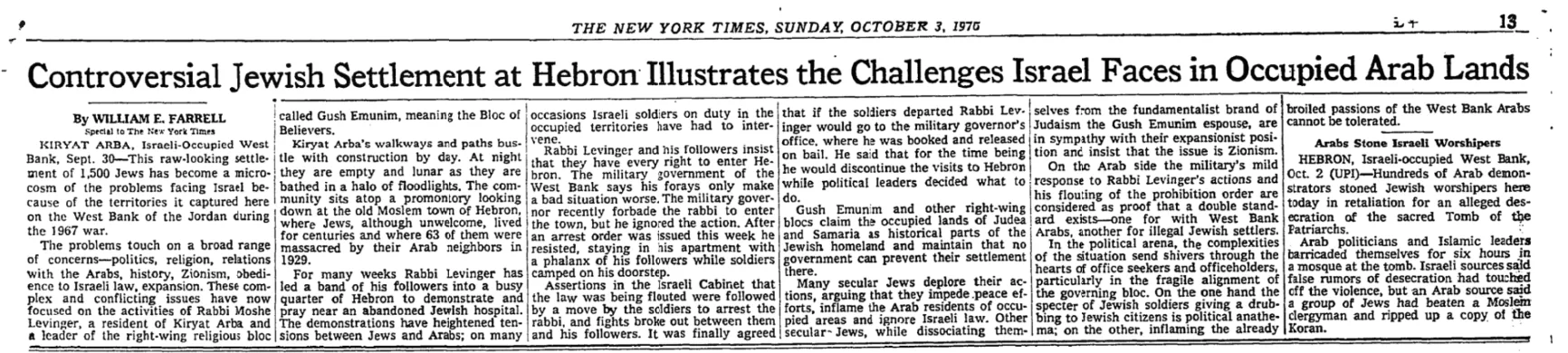
Transcribed from the clipping
KIRYAT ARBA, Israeli-Occupied West Bank, Sept. 30—This raw-looking settlement of 1,500 Jews has become a microcosm of the problems facing Israel because of the territories it captured here on the West Bank of the Jordan during the 1967 war.
The problems touch on a broad range of concerns—politics, religion, relations with the Arabs, history, Zionism, obedience to Israeli law, expansion. These complex and conflicting issues have now focused on the activities of Rabbi Moshe Levinger, a resident of Kiryat Arba and a leader of the right-wing religious bloc called Gush Emunim, meaning the Bloc of Believers.
Kiryat Arba’s walkways and paths bustle with construction by day. At night they are empty and lunar as they are bathed in a halo of floodlights. The community sits atop a promontory looking down at the old Moslem town of Hebron, where Jews, although unwelcome, lived for centuries and where 63 of them were massacred by their Arab neighbors in 1929.
For many weeks Rabbi Levinger has led a band of his followers into a busy quarter of Hebron to demonstrate and pray near an abandoned Jewish hospital. The demonstrations have heightened tensions between Jews and Arabs; on many occasions Israeli soldiers on duty in the occupied territories have had to intervene.
Rabbi Levinger and his followers insist that they have every right to enter Hebron. The military government of the West Bank says his forays only make a bad situation worse. The military governor recently forbade the rabbi to enter the town, but he ignored the action.
After an arrest order was issued this week he resisted, staying in his apartment with a phalanx of his followers while soldiers camped on his doorstep. Assertions in the Israeli Cabinet that the law was being flouted were followed by a move by the soldiers to arrest the rabbi, and fights broke out between him and his followers.
It was finally agreed that if the soldiers departed Rabbi Levinger would go to the military governor’s office, where he was booked and released on bail. He said that for the time being he would discontinue the visits to Hebron while political leaders decided what to do.
Gush Emunim and other right-wing blocs claim the occupied lands of Judea and Samaria as historical parts of the Jewish homeland and maintain that no government can prevent their settlement there. Many secular Jews deplore their actions, arguing that they impede peace efforts, inflame the Arab residents of occupied areas and ignore Israeli law.
Other secular Jews, while dissociating themselves from the fundamentalist brand of Judaism the Gush Emunim espouse, are in sympathy with their expansionist position and insist that the issue is Zionism.
Cite this clipping
"Controversial Jewish Settlement at Hebron Illustrates the Challenges Israel Faces in Occupied Arab Lands," The New York Times, 3 October 1976, p. 13. Covering Palestine archive, CP-1976-040. https://coveringpalestine.org/archive/cp-1976-040
More from The New York Times
- The Maine Colony in PalestineThe New York Times · 12 November 1866
- Jewish Colonization in PalestineThe New York Times · 9 December 1883
- Jewish State in Palestine OpposedThe New York Times · 9 July 1897
- ZIONIST CONGRESS IN BASELThe New York Times · 31 August 1897
- ROME FEARS THE ZIONISTSThe New York Times · 12 September 1897
- PROGRESS OF ZIONISMThe New York Times · 16 December 1901
- 852 more from this paper in the full text →
More from the 1970s
- Palestinians and Leftist Factions Open an Offensive in BeirutThe New York Times · 8 January 1976
- Equation Of Zionism With Racism Shocked CleaverPaducah Sun · 13 January 1976
- Arab prisoner manages to retain political attitudesMidland Reporter Telegram · 29 January 1976
- Drive to liberate Palestine intensifiesChicago Tribune · 29 February 1976
- Zionism and RacismHonolulu Star-Bulletin · 12 March 1976
- Plight of four schoolgirls illustrates frustration of West Bank occupationBellingham Herald · 17 March 1976
- All 338 clippings from the 1970s →
Last updated 2 November 2026
This record is part of Covering Palestine, an archive of American newspaper clippings about Palestinians, 1724 to 2023. Researched and assembled by Maria Robles.
The clipping belongs to the newspaper that printed it, or to the news agency that supplied the copy. It is reproduced here for research, criticism and commentary. A city here is where the newspaper was published, not where the story came from, and on most records it was taken from the masthead.
Something wrong here, or something you know about this clipping? The archive is still being built and corrections are wanted: maria@rozumstudio.com, quoting CP-1976-040.
Everything printed in 1976 · Printed on this day · See it in the archive reel · Full text of every clipping · Dataset