The New York Times · 4 October 1976
CP-1976-047
Arabs and Israelis Clash on West Bank
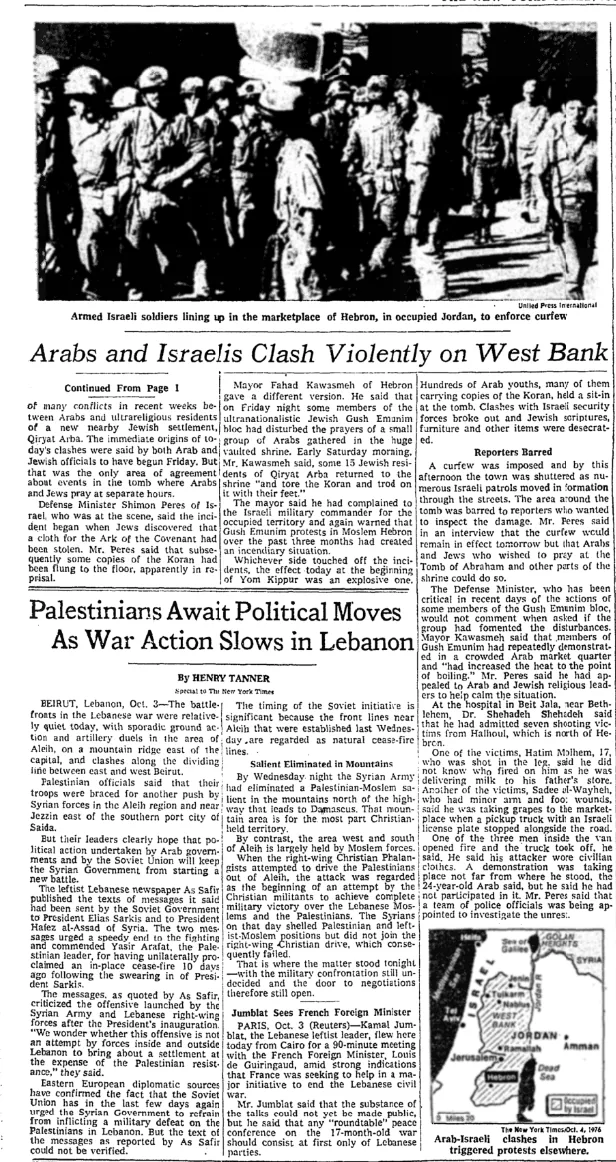
Transcribed from the clipping
ARABS AND ISRAELIS CLASH ON WEST BANK Two Sides Accuse Each Other of Desecrating Artifacts By WILLIAM E. FARRELL Special to The New York Times HEBRON, Occupied West Bank, Oct.
3—Rioting and violent clashes erupted here today between Arab youths and Israeli security forces after Moslems and Jews accused one another of desecrating Moslem and Jewish artifacts at a shrine sacred to both faiths.
The charges and countercharges of vandalism in the Tomb of the Patriarchs here also triggered rock-throwing protests in a number of other Arab West Bank towns occupied by Israel, including Nablus, Tulkarm, Jenin and Ramallah.
About 60 arrests were made during a melee at the shrine here and up to 55 Arabs were reported to have been injured in fights with Israeli security forces. Six Arab youths and an Arab girl of 14, all of them from the nearby village of Halhoul, were shot. Two of them were reported to be in critical condition in a hospital in the town of Beit Jala.
One of the injured youths said he had been shot by a civilian. This tense town has been the scene Continued on Page 3, Column 1 … of many conflicts in recent weeks between Arabs and ultrareligious residents of a new nearby Jewish settlement, Qiryat Arba. The immediate origins of today’s clashes were said by both Arab and Jewish officials to have begun Friday.
But that was the only area of agreement about events in the tomb where Arabs and Jews pray at separate hours. Defense Minister Shimon Peres of Israel, who was at the scene, said the incident began when Jews discovered that a cloth for the Ark of the Covenant had been stolen. Mr.
Peres said that subsequently some copies of the Koran had been flung to the floor, apparently in reprisal. Mayor Fahad Kawasmeh of Hebron gave a different version. He said that on Friday night some members of the ultranationalistic Jewish Gush Emunim bloc had disturbed the prayers of a small group of Arabs gathered in the huge vaulted shrine. Early Saturday morning, Mr.
Kawasmeh said, some 15 Jewish residents of Qiryat Arba returned to the shrine “and tore the Koran and trod on it with their feet.” The mayor said he had complained to the Israeli military commander for the occupied territory and again warned that Gush Emunim protests in Moslem Hebron over the past three months had created an incendiary situation.
Whichever side touched off the incidents, the effect today at the beginning of Yom Kippur was an explosive one. Hundreds of Arab youths, many of them carrying copies of the Koran, held a sit-in at the tomb. Clashes with Israeli security forces broke out and Jewish scriptures, furniture and other items were desecrated.
Reporters Barred A curfew was imposed and by this afternoon the town was shuttered as numerous Israeli patrols moved in formation through the streets. The area around the tomb was barred to reporters who wanted to inspect the damage. Mr.
Peres said in an interview that the curfew would remain in effect tomorrow but that Arabs and Jews who wished to pray at the Tomb of Abraham and other parts of the shrine could do so. The Defense Minister, who has been critical in recent days of the actions of some members of the Gush Emunim bloc, would not comment when asked if the group had fomented the disturbances.
Mayor Kawasmeh said that members of Gush Emunim had repeatedly demonstrated in a crowded Arab market quarter and “had increased the heat to the point of boiling.” Mr. Peres said he had appealed to Arab and Jewish religious leaders to help calm the situation. At the hospital in Beit Jala, near Bethlehem, Dr.
Shehadeh Shehadeh said that he had admitted seven shooting victims from Halhoul, which is north of Hebron. One of the victims, Hatim Molhem, 17, who was shot in the leg, said he did not know who fired on him as he was delivering milk to his father’s store.
Another of the victims, Sadee al-Wayheh, who had minor arm and foot wounds, said he was taking grapes to the marketplace when a pickup truck with an Israeli license plate stopped alongside the road. One of the three men inside the van opened fire and the truck took off, he said. He said his attacker wore civilian clothes.
A demonstration was taking place not far from where he stood, the 24-year-old Arab said, but he said he had not participated in it. Mr. Peres said that a team of police officials was being appointed to investigate the unrest.
How this transcription was made
Transcribed from the slide scan by a reader working off magnified crops, not by optical character recognition. The date and the newspaper are both printed on the clipping, in the credit at the foot of the locator map, which reads “The New York Times/Oct. 4, 1976”, and the newspaper again in the credit line “Special to The New York Times” under the lower article’s byline. 4 October 1976 was a Monday, and the article says the clashes fell “today at the beginning of Yom Kippur”, which began at sundown on 3 October 1976. The clipping carries two articles. The record transcribes the jump of “Arabs and Israelis Clash Violently on West Bank”, headed “Continued From Page 1”, which is why the excerpt begins mid-sentence and no byline is recorded; the other, “Palestinians Await Political Moves As War Action Slows in Lebanon” by Henry Tanner, datelined Beirut, is complete on the clipping and is not transcribed. The caption printed with the photograph calls Hebron “occupied Jordan”, which is the paper’s usage in 1976 and is kept. The other part of this article was added on 2 November 2026 from a second clipping (m014_2.png). Headline corrected on 2 November 2026 from the opening of the article, which the archive did not hold until now: the record read “Arabs and Israelis Clash Violently on West Bank”, which is the jump slug, not the headline the paper set.
Cite this clipping
"Arabs and Israelis Clash on West Bank," The New York Times, 4 October 1976. Covering Palestine archive, CP-1976-047. https://coveringpalestine.org/archive/cp-1976-047
More from The New York Times
- The Maine Colony in PalestineThe New York Times · 12 November 1866
- Jewish Colonization in PalestineThe New York Times · 9 December 1883
- Jewish State in Palestine OpposedThe New York Times · 9 July 1897
- ZIONIST CONGRESS IN BASELThe New York Times · 31 August 1897
- ROME FEARS THE ZIONISTSThe New York Times · 12 September 1897
- PROGRESS OF ZIONISMThe New York Times · 16 December 1901
- 852 more from this paper in the full text →
More from the 1970s
- Palestinians and Leftist Factions Open an Offensive in BeirutThe New York Times · 8 January 1976
- Equation Of Zionism With Racism Shocked CleaverPaducah Sun · 13 January 1976
- Arab prisoner manages to retain political attitudesMidland Reporter Telegram · 29 January 1976
- Drive to liberate Palestine intensifiesChicago Tribune · 29 February 1976
- Zionism and RacismHonolulu Star-Bulletin · 12 March 1976
- Plight of four schoolgirls illustrates frustration of West Bank occupationBellingham Herald · 17 March 1976
- All 338 clippings from the 1970s →
Last updated 2 November 2026
This record is part of Covering Palestine, an archive of American newspaper clippings about Palestinians, 1724 to 2023. Researched and assembled by Maria Robles.
The clipping belongs to the newspaper that printed it, or to the news agency that supplied the copy. It is reproduced here for research, criticism and commentary. A city here is where the newspaper was published, not where the story came from, and on most records it was taken from the masthead.
Something wrong here, or something you know about this clipping? The archive is still being built and corrections are wanted: maria@rozumstudio.com, quoting CP-1976-047.
Everything printed in 1976 · Printed on this day · See it in the archive reel · Full text of every clipping · Dataset