The New York Times · 22 April 1976
CP-1976-041
Israeli Arabs’ Status
By Atallah Mansour
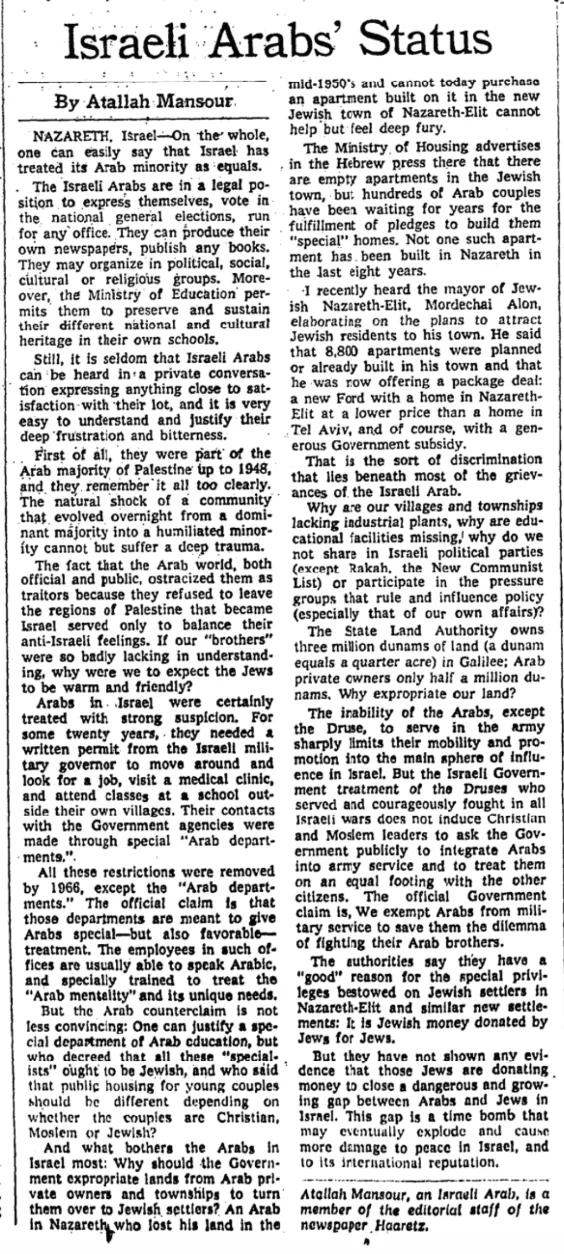
Transcribed from the clipping
NAZARETH, Israel — On the whole, one can easily say that Israel has treated its Arab minority as equals. The Israeli Arabs are in a legal position to express themselves, vote in the national general elections, run for any office. They can produce their own newspapers, publish any books. They may organize in political, social, cultural or religious groups.
Moreover, the Ministry of Education permits them to preserve and sustain their different national and cultural heritage in their own schools. Still, it is seldom that Israeli Arabs can be heard in a private conversation expressing anything close to satisfaction with their lot, and it is very easy to understand and justify their deep frustration and bitterness.
First of all, they were part of the Arab majority of Palestine up to 1948, and they remember it all too clearly. The natural shock of a community that evolved overnight from a dominant majority into a humiliated minority cannot but suffer a deep trauma.
The fact that the Arab world, both official and public, ostracized them as traitors because they refused to leave the regions of Palestine that became Israel served only to balance their anti-Israeli feelings. If our “brothers” were so badly lacking in understanding, why were we to expect the Jews to be warm and friendly?
Arabs in Israel were certainly treated with strong suspicion. For some twenty years, they needed a written permit from the Israeli military governor to move around and look for a job, visit a medical clinic, and attend classes at a school outside their own villages. Their contacts with the Government agencies were made through special “Arab departments.”
All these restrictions were removed by 1966, except the “Arab departments.” The official claim is that those departments are meant to give Arabs special — but also favorable — treatment. The employees in such offices are usually able to speak Arabic, and specially trained to treat the “Arab mentality” and its unique needs.
But the Arab counterclaim is not less convincing: One can justify a special department of Arab education, but who decreed that all these “specialists” ought to be Jewish, and who said that public housing for young couples should be different depending on whether the couples are Christian, Moslem or Jewish?
And what bothers the Arabs in Israel most: Why should the Government expropriate lands from Arab private owners and townships to turn them over to Jewish settlers? An Arab in Nazareth who lost his land in the mid-1950’s and cannot today purchase an apartment built on it in the new Jewish town of Nazareth-Elit cannot help but feel deep fury.
The Ministry of Housing advertises in the Hebrew press there that there are empty apartments in the Jewish town, but hundreds of Arab couples have been waiting for years for the fulfillment of pledges to build them “special” homes. Not one such apartment has been built in Nazareth in the last eight years.
I recently heard the mayor of Jewish Nazareth-Elit, Mordechai Alon, elaborating on the plans to attract Jewish residents to his town.
He said that 8,800 apartments were planned or already built in his town and that he was now offering a package deal: a new Ford with a home in Nazareth-Elit at a lower price than a home in Tel Aviv, and of course, with a generous Government subsidy. That is the sort of discrimination that lies beneath most of the grievances of the Israeli Arab.
Why are our villages and townships lacking industrial plants, why are educational facilities missing, why do we not share in Israeli political parties (except Rakah, the New Communist List) or participate in the pressure groups that rule and influence policy (especially that of our own affairs)?
The State Land Authority owns three million dunams of land (a dunam equals a quarter acre) in Galilee; Arab private owners only half a million dunams. Why expropriate our land? The inability of the Arabs, except the Druse, to serve in the army sharply limits their mobility and promotion into the main sphere of influence in Israel.
But the Israeli Government treatment of the Druses who served and courageously fought in all Israeli wars does not induce Christian and Moslem leaders to ask the Government publicly to integrate Arabs into army service and to treat them on an equal footing with the other citizens.
The official Government claim is, We exempt Arabs from military service to save them the dilemma of fighting their Arab brothers. The authorities say they have a “good” reason for the special privileges bestowed on Jewish settlers in Nazareth-Elit and similar new settlements: It is Jewish money donated by Jews for Jews.
But they have not shown any evidence that those Jews are donating money to close a dangerous and growing gap between Arabs and Jews in Israel. This gap is a time bomb that may eventually explode and cause more damage to peace in Israel, and to its international reputation.
Cite this clipping
"Israeli Arabs’ Status," The New York Times, 22 April 1976. Covering Palestine archive, CP-1976-041. https://coveringpalestine.org/archive/cp-1976-041
More from The New York Times
- The Maine Colony in PalestineThe New York Times · 12 November 1866
- Jewish Colonization in PalestineThe New York Times · 9 December 1883
- Jewish State in Palestine OpposedThe New York Times · 9 July 1897
- ZIONIST CONGRESS IN BASELThe New York Times · 31 August 1897
- ROME FEARS THE ZIONISTSThe New York Times · 12 September 1897
- PROGRESS OF ZIONISMThe New York Times · 16 December 1901
- 852 more from this paper in the full text →
More from the 1970s
- Palestinians and Leftist Factions Open an Offensive in BeirutThe New York Times · 8 January 1976
- Equation Of Zionism With Racism Shocked CleaverPaducah Sun · 13 January 1976
- Arab prisoner manages to retain political attitudesMidland Reporter Telegram · 29 January 1976
- Drive to liberate Palestine intensifiesChicago Tribune · 29 February 1976
- Zionism and RacismHonolulu Star-Bulletin · 12 March 1976
- Plight of four schoolgirls illustrates frustration of West Bank occupationBellingham Herald · 17 March 1976
- All 338 clippings from the 1970s →
Last updated 2 November 2026
This record is part of Covering Palestine, an archive of American newspaper clippings about Palestinians, 1724 to 2023. Researched and assembled by Maria Robles.
The clipping belongs to the newspaper that printed it, or to the news agency that supplied the copy. It is reproduced here for research, criticism and commentary. A city here is where the newspaper was published, not where the story came from, and on most records it was taken from the masthead.
Something wrong here, or something you know about this clipping? The archive is still being built and corrections are wanted: maria@rozumstudio.com, quoting CP-1976-041.
Everything printed in 1976 · Printed on this day · See it in the archive reel · Full text of every clipping · Dataset