The New York Times · 19 March 1978
CP-1978-022
Invasion Focuses Attention on Censorship in Israel
By DEIRDRE CARMODY
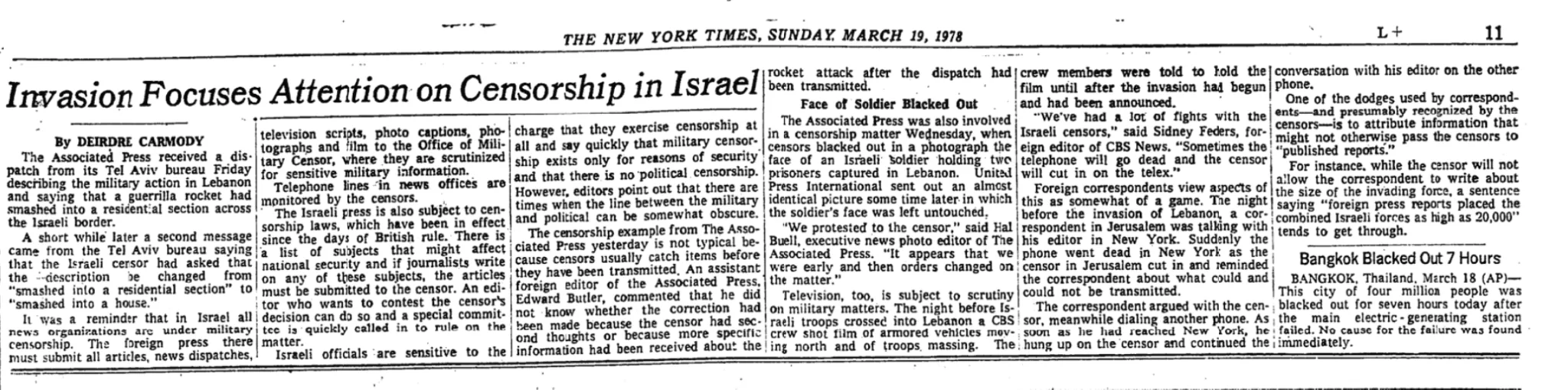
Transcribed from the clipping
The Associated Press received a dispatch from its Tel Aviv bureau Friday describing the military action in Lebanon and saying that a guerrilla rocket had smashed into a residential section across the Israeli border.
A short while later a second message came from the Tel Aviv bureau saying that the Israeli censor had asked that the description be changed from “smashed into a residential section” to “smashed into a house.” It was a reminder that in Israel all news organizations are under military censorship.
The foreign press there must submit all articles, news dispatches, television scripts, photo captions, photographs and film to the Office of Military Censor, where they are scrutinized for sensitive military information. Telephone lines in news offices are monitored by the censors.
The Israeli press is also subject to censorship laws, which have been in effect since the days of British rule. There is a list of subjects that might affect national security and if journalists write on any of these subjects, the articles must be submitted to the censor.
An editor who wants to contest the censor's decision can do so and a special committee is quickly called in to rule on the matter. Israeli officials are sensitive to the charge that they exercise censorship at all and say quickly that military censorship exists only for reasons of security and that there is no political censorship.
However, editors point out that there are times when the line between the military and political can be somewhat obscure. The censorship example from The Associated Press yesterday is not typical because censors usually catch items before they have been transmitted.
An assistant foreign editor of the Associated Press, Edward Butler, commented that he did not know whether the correction had been made because the censor had second thoughts or because more specific information had been received about the rocket attack after the dispatch had been transmitted.
Face of Soldier Blacked Out The Associated Press was also involved in a censorship matter Wednesday, when censors blacked out in a photograph the face of an Israeli soldier holding two prisoners captured in Lebanon. United Press International sent out an almost identical picture some time later in which the soldier's face was left untouched.
“We protested to the censor,” said Hal Buell, executive news photo editor of The Associated Press. “It appears that we were early and then orders changed on the matter.” Television, too, is subject to scrutiny on military matters. The night before Israeli troops crossed into Lebanon a CBS crew shot film of armored vehicles moving north and of troops massing.
The crew members were told to hold the film until after the invasion had begun and had been announced. “We've had a lot of fights with the Israeli censors,” said Sidney Feders, foreign editor of CBS News. “Sometimes the telephone will go dead and the censor will cut in on the telex.” Foreign correspondents view aspects of this as somewhat of a game.
The night before the invasion of Lebanon, a correspondent in Jerusalem was talking with his editor in New York. Suddenly the phone went dead in New York as the censor in Jerusalem cut in and reminded the correspondent about what could and could not be transmitted. The correspondent argued with the censor, meanwhile dialing another phone.
As soon as he had reached New York, he hung up on the censor and continued the conversation with his editor on the other phone. One of the dodges used by correspondents — and presumably recognized by the censors — is to attribute information that might not otherwise pass the censors to “published reports.”
For instance, while the censor will not allow the correspondent to write about the size of the invading force, a sentence saying “foreign press reports placed the combined Israeli forces as high as 20,000” tends to get through.
How this transcription was made
One scan of a horizontal strip of page 11 (edition mark L+), read at 8x-11x across seven columns. Masthead strip reads THE NEW YORK TIMES, SUNDAY, MARCH 19, 1978. The whole article is transcribed; "Face of Soldier Blacked Out" is a subhead within it, reproduced in place. The column at far right also carries a separate short item, "Bangkok Blacked Out 7 Hours" (BANGKOK, Thailand, March 18 (AP)), about an electrical failure; it is unrelated and not part of this record.
Cite this clipping
"Invasion Focuses Attention on Censorship in Israel," The New York Times, 19 March 1978, p. 11. Covering Palestine archive, CP-1978-022. https://coveringpalestine.org/archive/cp-1978-022
More from The New York Times
- The Maine Colony in PalestineThe New York Times · 12 November 1866
- Jewish Colonization in PalestineThe New York Times · 9 December 1883
- Jewish State in Palestine OpposedThe New York Times · 9 July 1897
- ZIONIST CONGRESS IN BASELThe New York Times · 31 August 1897
- ROME FEARS THE ZIONISTSThe New York Times · 12 September 1897
- PROGRESS OF ZIONISMThe New York Times · 16 December 1901
- 852 more from this paper in the full text →
More from the 1970s
- PLO ridicules Carter's Palestine standWest Bend News · 4 January 1978
- U.S. Woman Starts Israel Prison TermHuntsville Times · 10 January 1978
- American Gets Five Year Term As Spy for ArabsThe Missoulian · 10 January 1978
- American Woman Jailed In Israel as Spy for Arabs(newspaper unidentified) · 10 January 1978
- Woman begins sentence for aiding Arabs(newspaper unidentified) · 10 January 1978
- 3 Israeli Settlements On West Bank ApprovedLos Angeles Herald Examiner · 11 January 1978
- All 338 clippings from the 1970s →
Last updated 2 November 2026
This record is part of Covering Palestine, an archive of American newspaper clippings about Palestinians, 1724 to 2023. Researched and assembled by Maria Robles.
The clipping belongs to the newspaper that printed it, or to the news agency that supplied the copy. It is reproduced here for research, criticism and commentary. A city here is where the newspaper was published, not where the story came from, and on most records it was taken from the masthead.
Something wrong here, or something you know about this clipping? The archive is still being built and corrections are wanted: maria@rozumstudio.com, quoting CP-1978-022.
Everything printed in 1978 · Printed on this day · See it in the archive reel · Full text of every clipping · Dataset