The Sun · Baltimore, Maryland · 15 October 1980
CP-1980-005
Palestinians Claim Cultural Oppression
Larry Thorson, Associated Press Writer, Ramallah
Transcribed from the clipping
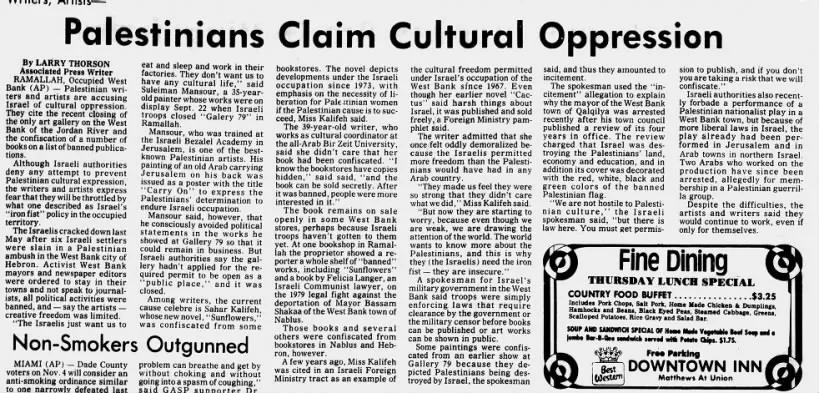
RAMALLAH, Occupied West Bank (AP) — Palestinian writers and artists are accusing Israel of cultural oppression.
They cite the recent closing of the only art gallery on the West Bank, the confiscation of a number of books on a list of banned publications… “Carry On” to express the Palestinians’ determination to endure Israeli occupation, said Suleiman Mansour, a 35-year-old painter whose works were on display Sept.
22 when Israeli troops closed “Gallery 79” in Ramallah. Mansour, who was trained at the Israeli Bezalel Academy in Jerusalem, is one of the best-known Palestinian artists.
His painting of an old Arab carrying Jerusalem on his back was issued as a poster with the title “Carry On”… Mansour said, however, that he consciously avoided political statements in the works he showed at Gallery 79 so that it could remain in business… The book remains on sale openly in some West Bank stores, perhaps because Israeli troops haven’t gotten to them yet.
At one bookshop in Ramallah the proprietor showed a reporter a whole shelf of “banned” works, including “Sunflowers” and a book by Felicia Langer, an Israeli Communist lawyer, on the 1979 legal fight against the deportation of Mayor Bassam Shakaa of the West Bank town of Nablus… A few years ago, Miss Kalifeh was cited in an Israeli Foreign Ministry pamphlet as an example of the cultural freedom permitted under Israel’s occupation of the West Bank since 1967.
Even though her earlier novel “Cactus” said harsh things about Israel, it was published and sold freely, a Foreign Ministry pamphlet said.
The writer admitted that she once felt oddly demoralized because the Israelis permitted more freedom than the Palestinians would have had in any Arab country. “They made us feel they were so strong that they didn’t care what we did,” Miss Kalifeh said.
“But now they are starting to worry, because even though we are weak, we are drawing the attention of the world. The world wants to know more about the Palestinians, and this is why they (the Israelis) need the iron fist — they are insecure.”
Context added by this archive
Suleiman Mansour at 35, three years after the Pasadena show and eight before he stands outside Ketziot prison. The writer Sahar Khalifeh, printed here as Miss Kalifeh, describes being cited in an Israeli government pamphlet as proof of the freedom she was being permitted, and says the permission ended when the world started paying attention.
Cite this clipping
"Palestinians Claim Cultural Oppression," The Sun, 15 October 1980, p. 1. Covering Palestine archive, CP-1980-005. https://coveringpalestine.org/archive/cp-1980-005
More from The Sun
- The Return Of The Jews And Their Lawful Right To PalestineThe Sun · 1 September 1918
- Terror Still Stalks Residents Of Gaza Strip As Political Murders Increase In NumberThe Sun · 1 August 1971
- Mideast war begins againThe Sun · 8 October 1973
- Hussein Asks Nixon Palestine BackingThe Sun · 8 October 1973
- Israeli soldier denies being at Sabra campThe Sun · 24 November 1982
- Bloody crossroads at center of debateThe Sun · 4 October 2000
- 1 more from this paper in the full text →
More from the 1980s
- The View From the West BankThe New York Times · 20 January 1980
- Is Zionism Racism?Wichita Eagle · 27 January 1980
- UN papers on Zionism challenge Israel itselfMiami News · 29 January 1980
- No Compromise At Kiryat ArbaSarasota Herald-Tribune · 12 February 1980
- Palestinians in Gaza: Hostages to a DreamThe New York Times · 19 February 1980
- Israeli Censorship Strikes A Discordant, Insistent NoteThe New York Times · 2 March 1980
- All 571 clippings from the 1980s →
In these collections
Last updated 17 November 2026
This record is part of Covering Palestine, an archive of American newspaper clippings about Palestinians, 1724 to 2023. Researched and assembled by Maria Robles.
The clipping belongs to the newspaper that printed it, or to the news agency that supplied the copy. It is reproduced here for research, criticism and commentary. A city here is where the newspaper was published, not where the story came from, and on most records it was taken from the masthead.
Something wrong here, or something you know about this clipping? The archive is still being built and corrections are wanted: maria@rozumstudio.com, quoting CP-1980-005.
Everything printed in 1980 · Printed on this day · See it in the archive reel · Full text of every clipping · Dataset