Kingsport Times-News · 29 June 1981
CP-1981-023
Soviets linked to Palestinian terrorism
By JOHN MACLEAN and JONATHAN BRODER, Chicago Tribune
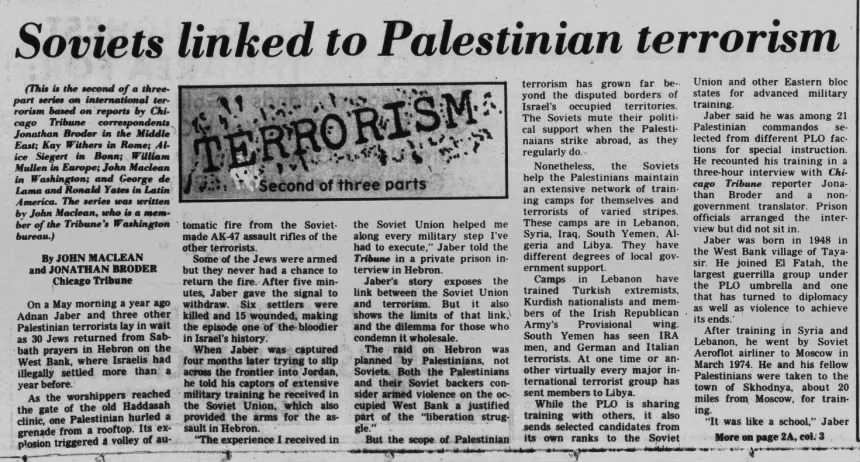
Transcribed from the clipping
On a May morning a year ago Adnan Jaber and three other Palestinian terrorists lay in wait as 30 Jews returned from Sabbath prayers in Hebron on the West Bank, where Israelis had illegally settled more than a year before. As the worshippers reached the gate of the old Haddasah clinic, one Palestinian hurled a grenade from a rooftop.
Its explosion triggered a volley of automatic fire from the Soviet-made AK-47 assault rifles of the other terrorists. Some of the Jews were armed but they never had a chance to return the fire. After five minutes, Jaber gave the signal to withdraw. Six settlers were killed and 15 wounded, making the episode one of the bloodier in Israel’s history.
When Jaber was captured four months later trying to slip across the frontier into Jordan, he told his captors of extensive military training he received in the Soviet Union, which also provided the arms for the assault in Hebron.
“The experience I received in the Soviet Union helped me along every military step I’ve had to execute,” Jaber told the Tribune in a private prison interview in Hebron. Jaber’s story exposes the link between the Soviet Union and terrorism. But it also shows the limits of that link, and the dilemma for those who condemn it wholesale.
… [THIS IS THE JUMP OF CP-1981-023, NOT CP-1980-026.] Terrorism Continued from page 1 said. “We studied six classes every day from eight in the morning until four in the afternoon. We learned theory in the classrooms and then went into the field to practice what we had learned.” The course aimed to prepare the Palestinians as platoon commanders.
Jaber said the emphasis was on conventional military techniques rather than individual acts of terror. He found this cause for complaint. “We prefer to go to Vietnam where the training is more contemporary for our kind of guerrilla war,” he said. “The Russian training is based on lessons from World War II.”
But the training was professional nonetheless, he said. During his six-month course instructors remained “detached and professional” and never attempted to foment anti-Israeli feelings. Upon return to Lebanon, Jaber commanded a platoon in the 1975-76 civil war.
Then in 1979 he received orders from PLO military operations commander Abu Jihad to infiltrate into Hebron and await orders. He did, remaining underground 15 months. In April 1980, immediately following the assassination of a top PLO official in Cyprus, Jaber received orders from Jihad to attack Jewish settlers in Hebron.
“Perhaps Abu Jihad wanted revenge and to prove he had a presence in Hebron,” Jaber said. But in Jaber’s view the Israeli settlements drive was reason enough to attack. “This is a war that both sides are fighting, not just us,” he said. “We don’t fight because we like killing. The Palestinian people are being strangled.
We must fight for our cause.” Jaber expressed no remorse for the attack, in which four women were wounded. He said some of the Israelis were armed and an ambush was necessary to success. He did say he was “sorry the situation between the Jews and Palestinians has had to reach this point.” The Palestinian cause long has attracted the Soviets.
In 1970 the Soviet press for the first time referred to Arab terrorist activities as a “liberation struggle” and supported a machinegun attack on an El Al plane at a Zurich airport. A major military aid relationship did not begin until after the 1973 Middle East war.
The Soviets found their main Middle East connection with Egypt broken in the aftermath of that conflict, when the Egyptians turned to the West as a result of U.S. diplomacy. The Palestinians then gave the Soviets a toehold in the region.
The relationship grew until the late 1970s when Palestinian officials openly acknowledged the extensive military and political ties that had grown. “Our boys go to the Soviet Union, they go to the socialist countries,” said Zehdi Labib Terzi, PLO representative at the United Nations, in a 1979 interview with the Public Broadcasting Service.
“They go for training, their education. Oh, yes, we’re getting our direct consignments to the PLO — machine guns, explosives and all that.
“The Soviet Union, and all the rest of the socialist countries, just like the rest of the world, almost, they give us the full support — diplomatic, moral, educational and also they open their military academies to some of our freedom fighters.”
And earlier this year, Muhammed ash-Sha’ir, the PLO’s representative in Moscow, boasted that hundreds of PLO officers have graudated from Soviet military academies and that 2,000 Palestinians currently are undergoing training in the Soviet Union. His statement was reported by several news agencies.
“The relations between the PLO and the Soviet Union are at their best and both sides maintain close ties on matters of policy,” ash-Sha’ir told a Beirut audience in a lecture Feb. 17. He said the PLO and Soviet Union signed an agreement in 1980 when Yasir Arafat visited Moscow calling for coordination on problems of mutual concern.
“A high level Palestinian goes to Moscow whenever a problem arises in order to coordinate a joint stand with the Soviets,” ash-Sha’ir said. PLO leaders also make no secret of their support and cooperation with terrorist groups throughout the world.
“As a revolution we take an interest in problems of liberation all over the world,” said Mag’d Abu Sharar, a member of the PLO Central Committee, in an interview with a Kuwait newspaper in January. “We exchange information and know-how with factions of all liberation forces in the world. We are not dissociated from the forces of world revolution.
Rather we are an integral part thereof.” Cooperation between Palestinians and other groups has become pervasive. Confessed terrorists often say they got Eastern bloc weapons from the PLO in return for favors such as stockpiling arms for the PLO or attacking American and Israeli installations.
One member of Italy’s Red Brigades told police, “The Palestinians are just as anxious as ourselves to undermine Italy’s stability.” In this hemisphere, the PLO helped train the Sandinista guerrillas who overthrew Anastasio Somoza in Nicaragua. In return, the Sandinista government pledged full support for the PLO.
“The cause of the PLO is that of the Sandinistas,” Interior Minister Thomas Borge said in welcoming Yasir Arafat to Nicaragua shortly after Somoza’s overthrow. With the support of the Soviet Union, the PLO has been more successful at making terror than at making peace.
Like the Soviets, the Palestinians ippear to have created a creature over which they lack control. When Arafat sought in 1979 to dampen the PLO’s revolutionary rhetoric in a bid to make the group more acceptable to Europeans, he was defeated by rejectionists within Fatah who used as their main weapon Arafat’s own words.
Meeting last summer in Damascus, Fatah called for the overthrow of Israel by armed force, although Arafat sough to soften the statement. The words adopted were his own from many years before calling for “the liquidation of the Zionist entity politically, culturally and militarily.”
The Israelis believe the Soviets also tried to thwart the peace bid in 1979 because it was carried out independently of them. Israeli government officials said the Soviets actively built ties with more radical elements within the PLO to undermine Arafat. The PLO received world attention by terrorism. Now it has found the way to peace blocked by terrorism.
Tomorrow: The Cuban terror connection. [The rest of the clipping is other material and is NOT part of this article: a second banner, “Murder”, over a continuation about the Harrison murders at Longs Bend (“Continued from page 1”, quoting a man named Baird and a man named Ray); a separate item “Gunman killed in FBI building”, ATLANTA (UPI); and display advertising — KINGSPORT FUN FEST, KINGSPORT OPTICAL, and a gold-buying advertisement.]
How this transcription was made
Read from the scan by a machine looking at the image of the page, not by optical character recognition and not by a person. The clipping carries no masthead or date line, so its date and newspaper rest on the record it arrived with, not on anything visible in the scan. The other part of this article was added on 2 November 2026 from a second clipping (m007_2.png).
Context added by this archive
Date check: No masthead and no page date line survive on this clipping — it is trimmed to the headline, the italic series note, the “TERRORISM / Second of three parts” art and five text columns, with “More on page 2A, col. 3” at the foot. Nothing on the clipping confirms either the date or the paper, so 1981-06-29 could not be checked.
Cite this clipping
"Soviets linked to Palestinian terrorism," Kingsport Times-News, 29 June 1981. Covering Palestine archive, CP-1981-023. https://coveringpalestine.org/archive/cp-1981-023
More from Kingsport Times-News
- Israel calls up reservists; Palestinians brace for attacksKingsport Times-News · 10 May 2002
- Israeli airstrike kills three Palestinians in Gaza StripKingsport Times-News · 29 February 2004
- Denying existence of Palestinian people leaves little hope for peaceKingsport Times-News · 24 March 2023
More from the 1980s
- Bedouin Member of the Israeli Parliament Is Shot to Death in JerusalemThe New York Times · 13 January 1981
- West Bank to have new Jewish outpostsThe Register-Guard · 26 January 1981
- Begin Gets Parliamentary OK For 3 West Bank SettlementsThe Town Talk · 27 January 1981
- Palestinian doctor sentenced as Soviet spySan Antonio Express News · 1 February 1981
- Israel seizes land to add to settlementThe Baltimore Sun · 9 February 1981
- Israel steps up its claims on Occupied West Bank landThe Miami Herald · 11 February 1981
- All 527 clippings from the 1980s →
Last updated 2 November 2026
This record is part of Covering Palestine, an archive of American newspaper clippings about Palestinians, 1724 to 2023. Researched and assembled by Maria Robles.
The clipping belongs to the newspaper that printed it, or to the news agency that supplied the copy. It is reproduced here for research, criticism and commentary. A city here is where the newspaper was published, not where the story came from, and on most records it was taken from the masthead.
Something wrong here, or something you know about this clipping? The archive is still being built and corrections are wanted: maria@rozumstudio.com, quoting CP-1981-023.
Everything printed in 1981 · Printed on this day · See it in the archive reel · Full text of every clipping · Dataset