The New York Times · New York, New York · 30 March 1982
CP-1982-055
Israel Tightens Control Over Arab Newspapers
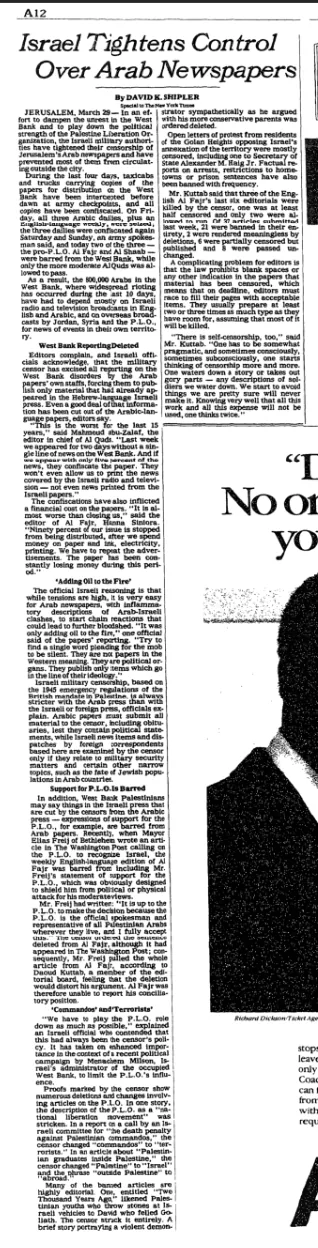
Shown from the top. The whole column — 3.9 times taller than it is wide — is in the enlargement.
Transcribed from the clipping
JERUSALEM, March 29 — In an effort to dampen the unrest in the West Bank and to play down the political strength of the Palestine Liberation Organization, the Israeli military authorities have tightened their censorship of Jerusalem’s Arab newspapers and have prevented most of them from circulating outside the city.
During the last four days, taxicabs and trucks carrying copies of the papers for distribution on the West Bank have been intercepted before dawn at army checkpoints, and all copies have been confiscated.
On Friday, all three Arabic dailies, plus an English-language weekly, were seized; the three dailies were confiscated again Saturday and Sunday, an army spokesman said, and today two of the three — the pro-P.L.O. Al Fajr and Al Shaab — were barred from the West Bank, while only the more moderate Al Quds was allowed to pass.
As a result, the 800,000 Arabs in the West Bank, where widespread rioting has occurred during the last 10 days, have had to depend mostly on Israeli radio and television broadcasts in English and Arabic, and on overseas broadcasts by Jordan, Syria and the P.L.O. for news of events in their own territory.
Editors complain, and Israeli officials acknowledge, that the military censor has excised all reporting on the West Bank disorders by the Arab papers’ own staffs, forcing them to publish only material that had already appeared in the Hebrew-language Israeli press. Even a good deal of that information has been cut out of the Arabic-language papers, editors say.
“This is the worst for the last 15 years,” said Mahmoud abu-Zalaf, the editor in chief of Al Quds. “Last week we appeared for two days without a single line of news on the West Bank. And if we appear with only five percent of the news, they confiscate the paper.
They won’t even allow us to print the news covered by the Israeli radio and television — not even news printed from the Israeli papers.” The confiscations have also inflicted a financial cost on the papers. “It is almost worse than closing us,” said the editor of Al Fajr, Hanna Siniora.
“Ninety percent of our issue is stopped from being distributed, after we spend money on paper and ink, electricity, printing. We have to repeat the advertisements. The paper has been constantly losing money during this period.”
How this transcription was made
Read from the scan by a machine looking at the image of the page, not by optical character recognition and not by a person. The clipping carries no masthead and no dated folio line, so the date recorded here could not be checked against anything printed on the page. Nothing on the page contradicts it.
Cite this clipping
"Israel Tightens Control Over Arab Newspapers," The New York Times, 30 March 1982, p. A12. Covering Palestine archive, CP-1982-055. https://coveringpalestine.org/archive/cp-1982-055
More from The New York Times
- The Maine Colony in PalestineThe New York Times · 12 November 1866
- Jewish Colonization in PalestineThe New York Times · 9 December 1883
- Jewish State in Palestine OpposedThe New York Times · 9 July 1897
- ZIONIST CONGRESS IN BASELThe New York Times · 31 August 1897
- ROME FEARS THE ZIONISTSThe New York Times · 12 September 1897
- PROGRESS OF ZIONISMThe New York Times · 16 December 1901
- 852 more from this paper in the full text →
More from the 1980s
- Even Israelis protest West Bank university shutdownThe Evening Sun · 11 January 1982
- Israel renews charge against PalestiniansThe Baltimore Sun · 3 March 1982
- Israelis Survive Storm Over Bedouin Baby’s DeathThe New York Times · 9 March 1982
- art review/Childhood reflectionsNewsday · 12 March 1982
- Looking the Other WayThe New York Times · 15 March 1982
- Begin will stay on despite voteStamford Advocate · 24 March 1982
- All 527 clippings from the 1980s →
Last updated 2 November 2026
This record is part of Covering Palestine, an archive of American newspaper clippings about Palestinians, 1724 to 2023. Researched and assembled by Maria Robles.
The clipping belongs to the newspaper that printed it, or to the news agency that supplied the copy. It is reproduced here for research, criticism and commentary. A city here is where the newspaper was published, not where the story came from, and on most records it was taken from the masthead.
Something wrong here, or something you know about this clipping? The archive is still being built and corrections are wanted: maria@rozumstudio.com, quoting CP-1982-055.
Everything printed in 1982 · Printed on this day · See it in the archive reel · Full text of every clipping · Dataset