The New York Times · 24 July 1986
CP-1986-025
In the Achille Lauro Trial, Justice and Palestinians Lost
By Walter Reich
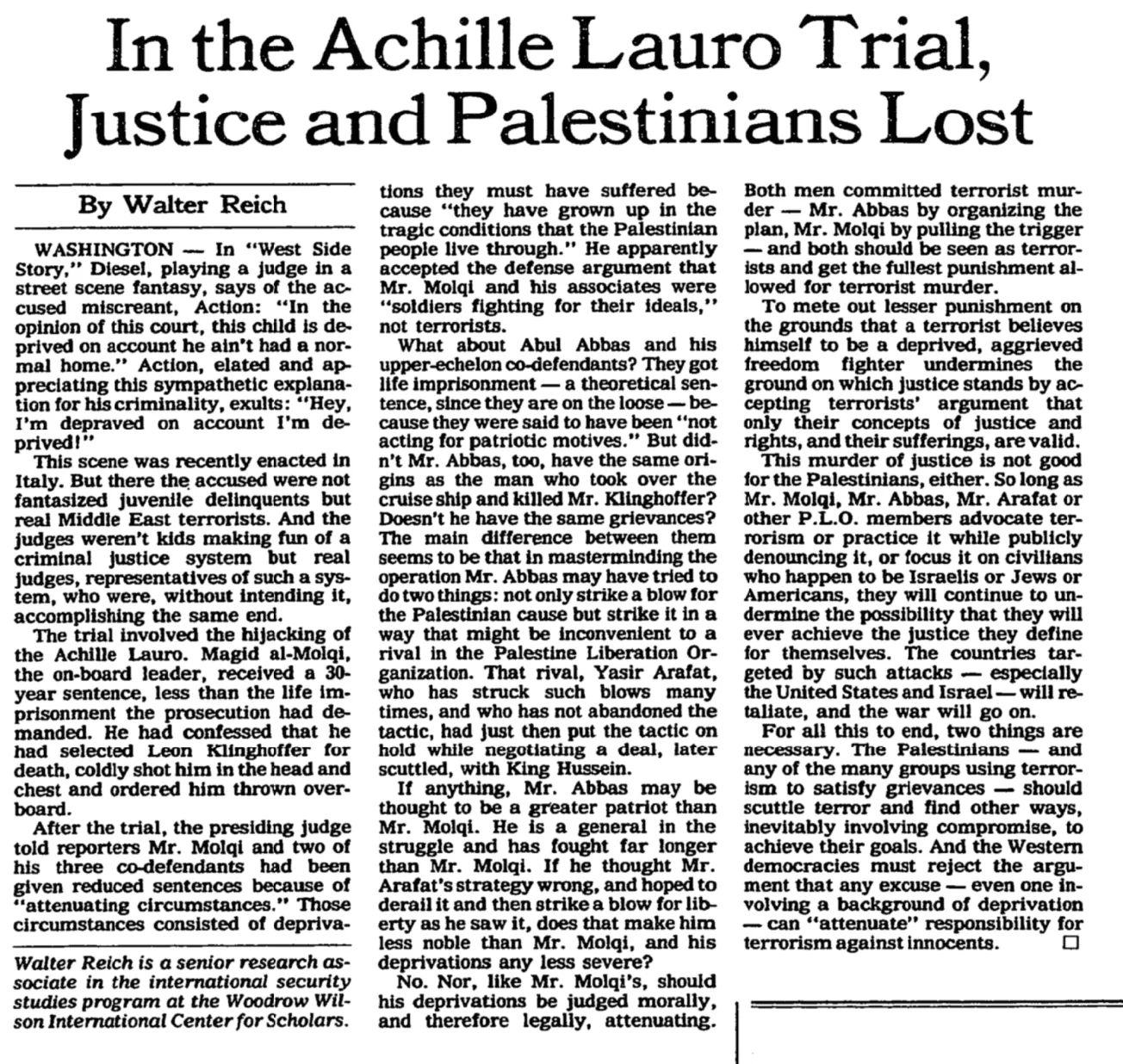
Transcribed from the clipping
WASHINGTON — In “West Side Story,” Diesel, playing a judge in a street scene fantasy, says of the accused miscreant, Action: “In the opinion of this court, this child is deprived on account he ain’t had a normal home.”
Action, elated and appreciating this sympathetic explanation for his criminality, exults: “Hey, I’m depraved on account I’m deprived!” This scene was recently enacted in Italy. But there the accused were not fantasized juvenile delinquents but real Middle East terrorists.
And the judges weren’t kids making fun of a criminal justice system but real judges, representatives of such a system, who were, without intending it, accomplishing the same end. The trial involved the hijacking of the Achille Lauro. Magid al-Molqi, the on-board leader, received a 30-year sentence, less than the life imprisonment the prosecution had demanded.
He had confessed that he had selected Leon Klinghoffer for death, coldly shot him in the head and chest and ordered him thrown overboard. After the trial, the presiding judge told reporters Mr. Molqi and two of his three co-defendants had been given reduced sentences because of “attenuating circumstances.”
Those circumstances consisted of deprivations they must have suffered because “they have grown up in the tragic conditions that the Palestinian people live through.” He apparently accepted the defense argument that Mr. Molqi and his associates were “soldiers fighting for their ideals,” not terrorists.
What about Abul Abbas and his upper-echelon co-defendants? They got life imprisonment — a theoretical sentence, since they are on the loose — because they were said to have been “not acting for patriotic motives.” But didn’t Mr. Abbas, too, have the same origins as the man who took over the cruise ship and killed Mr. Klinghoffer?
Doesn’t he have the same grievances? The main difference between them seems to be that in masterminding the operation Mr. Abbas may have tried to do two things: not only strike a blow for the Palestinian cause but strike it in a way that might be inconvenient to a rival in the Palestine Liberation Organization.
That rival, Yasir Arafat, who has struck such blows many times, and who has not abandoned the tactic, had just then put the tactic on hold while negotiating a deal, later scuttled, with King Hussein. If anything, Mr. Abbas may be thought to be a greater patriot than Mr. Molqi. He is a general in the struggle and has fought far longer than Mr. Molqi. If he thought Mr.
Arafat’s strategy wrong, and hoped to derail it and then strike a blow for liberty as he saw it, does that make him less noble than Mr. Molqi, and his deprivations any less severe? No. Nor, like Mr. Molqi’s, should his deprivations be judged morally, and therefore legally, attenuating. Both men committed terrorist murder — Mr.
Abbas by organizing the plan, Mr. Molqi by pulling the trigger — and both should be seen as terrorists and get the fullest punishment allowed for terrorist murder.
To mete out lesser punishment on the grounds that a terrorist believes himself to be a deprived, aggrieved freedom fighter undermines the ground on which justice stands by accepting terrorists’ argument that only their concepts of justice and rights, and their sufferings, are valid. This murder of justice is not good for the Palestinians, either. So long as Mr.
Molqi, Mr. Abbas, Mr. Arafat or other P.L.O. members advocate terrorism or practice it while publicly denouncing it, or focus it on civilians who happen to be Israelis or Jews or Americans, they will continue to undermine the possibility that they will ever achieve the justice they define for themselves.
The countries targeted by such attacks — especially the United States and Israel — will retaliate, and the war will go on. For all this to end, two things are necessary. The Palestinians — and any of the many groups using terrorism to satisfy grievances — should scuttle terror and find other ways, inevitably involving compromise, to achieve their goals.
And the Western democracies must reject the argument that any excuse — even one involving a background of deprivation — can “attenuate” responsibility for terrorism against innocents. Walter Reich is a senior research associate in the international security studies program at the Woodrow Wilson International Center for Scholars.
Cite this clipping
"In the Achille Lauro Trial, Justice and Palestinians Lost," The New York Times, 24 July 1986. Covering Palestine archive, CP-1986-025. https://coveringpalestine.org/archive/cp-1986-025
More from The New York Times
- The Maine Colony in PalestineThe New York Times · 12 November 1866
- Jewish Colonization in PalestineThe New York Times · 9 December 1883
- Jewish State in Palestine OpposedThe New York Times · 9 July 1897
- ZIONIST CONGRESS IN BASELThe New York Times · 31 August 1897
- ROME FEARS THE ZIONISTSThe New York Times · 12 September 1897
- PROGRESS OF ZIONISMThe New York Times · 16 December 1901
- 852 more from this paper in the full text →
More from the 1980s
- In West Bank, Israeli Policies to Improve the ‘Quality of Life’ Get Mixed ReviewsThe New York Times · 5 January 1986
- Marilyn Klinghoffer Dies at 58; Wife of Victim of Ship HijackersThe New York Times · 10 February 1986
- Jews Are Not Helped by Rewriting HistorySt. Louis Jewish Light · 5 March 1986
- F.B.I. Chief Doubts Anti-Arab Terrorists Caused Capital FireThe New York Times · 15 March 1986
- Views on terrorism differThe Daily Ledger · 18 April 1986
- Italians Say Abbas Masterminded Ship HijackingThe New York Times · 11 June 1986
- All 527 clippings from the 1980s →
Last updated 2 November 2026
This record is part of Covering Palestine, an archive of American newspaper clippings about Palestinians, 1724 to 2023. Researched and assembled by Maria Robles.
The clipping belongs to the newspaper that printed it, or to the news agency that supplied the copy. It is reproduced here for research, criticism and commentary. A city here is where the newspaper was published, not where the story came from, and on most records it was taken from the masthead.
Something wrong here, or something you know about this clipping? The archive is still being built and corrections are wanted: maria@rozumstudio.com, quoting CP-1986-025.
Everything printed in 1986 · Printed on this day · See it in the archive reel · Full text of every clipping · Dataset