The New York Times · New York, New York · 17 December 1987
CP-1987-019
The Worst Option
Transcribed from the clipping
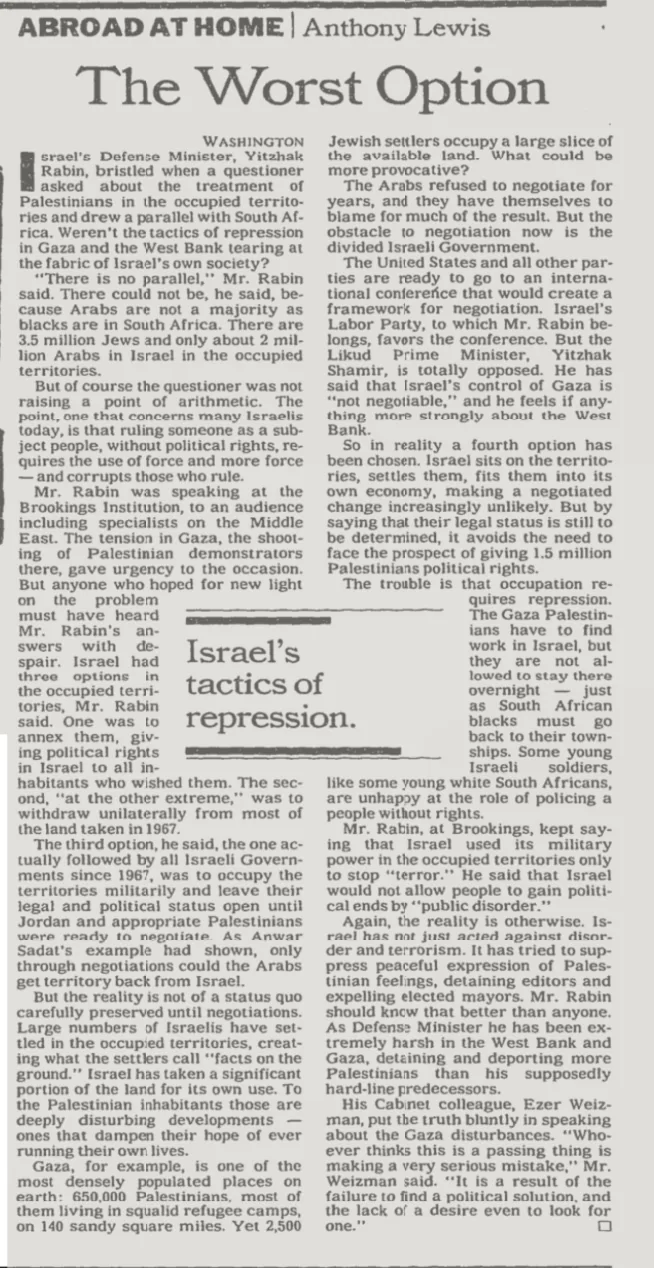
WASHINGTON Israel’s Defense Minister, Yitzhak Rabin, bristled when a questioner asked about the treatment of Palestinians in the occupied territories and drew a parallel with South Africa. Weren’t the tactics of repression in Gaza and the West Bank tearing at the fabric of Israel’s own society? “There is no parallel,” Mr. Rabin said.
There could not be, he said, because Arabs are not a majority as blacks are in South Africa. There are 3.5 million Jews and only about 2 million Arabs in Israel and the occupied territories. But of course the questioner was not raising a point of arithmetic.
The point, one that concerns many Israelis today, is that ruling someone as a subject people, without political rights, requires the use of force and more force — and corrupts those who rule. Mr. Rabin was speaking at the Brookings Institution, to an audience including specialists on the Middle East.
The tension in Gaza, the shooting of Palestinian demonstrators there, gave urgency to the occasion. But anyone who hoped for new light on the problem must have heard Mr. Rabin’s answers with despair. Israel had three options in the occupied territories, Mr. Rabin said. One was to annex them, giving political rights in Israel to all inhabitants who wished them.
The second, “at the other extreme,” was to withdraw unilaterally from most of the land taken in 1967. The third option, he said, the one actually followed by all Israeli Governments since 1967, was to occupy the territories militarily and leave their legal and political status open until Jordan and appropriate Palestinians were ready to negotiate.
As Anwar Sadat’s example had shown, only through negotiations could the Arabs get territory back from Israel. But the reality is not of a status quo carefully preserved until negotiations. Large numbers of Israelis have settled in the occupied territories, creating what the settlers call “facts on the ground.”
Israel has taken a significant portion of the land for its own use. To the Palestinian inhabitants those are deeply disturbing developments — ones that dampen their hope of ever running their own lives. Gaza, for example, is one of the most densely populated places on earth: 650,000 Palestinians, most of them living in squalid refugee camps, on 140 sandy square miles.
Yet 2,500 Jewish settlers occupy a large slice of the available land. What could be more provocative?
How this transcription was made
Transcribed by optical character recognition and read back against the scan by hand.
Cite this clipping
"The Worst Option," The New York Times, 17 December 1987. Covering Palestine archive, CP-1987-019. https://coveringpalestine.org/archive/cp-1987-019
More from The New York Times
- The Maine Colony in PalestineThe New York Times · 12 November 1866
- Jewish Colonization in PalestineThe New York Times · 9 December 1883
- Jewish State in Palestine OpposedThe New York Times · 9 July 1897
- ZIONIST CONGRESS IN BASELThe New York Times · 31 August 1897
- ROME FEARS THE ZIONISTSThe New York Times · 12 September 1897
- PROGRESS OF ZIONISMThe New York Times · 16 December 1901
- 852 more from this paper in the full text →
More from the 1980s
- Palestinians Under Israel: Bitter PoliticsThe New York Times · 12 January 1987
- Are jailed Palestinians terrorists or scapegoats?Los Angeles Herald Examiner · 15 February 1987
- Last 3 Arabs are freed in case of terrorist groupLos Angeles Herald Examiner · 19 February 1987
- Accused PLO members freedLos Angeles Times · 19 February 1987
- Jordanians tell of INS ‘nightmare’Los Angeles Herald Examiner · 26 February 1987
- Uneasy in ZionThe New York Times · 1 March 1987
- All 571 clippings from the 1980s →
Last updated 17 November 2026
This record is part of Covering Palestine, an archive of American newspaper clippings about Palestinians, 1724 to 2023. Researched and assembled by Maria Robles.
The clipping belongs to the newspaper that printed it, or to the news agency that supplied the copy. It is reproduced here for research, criticism and commentary. A city here is where the newspaper was published, not where the story came from, and on most records it was taken from the masthead.
Something wrong here, or something you know about this clipping? The archive is still being built and corrections are wanted: maria@rozumstudio.com, quoting CP-1987-019.
Everything printed in 1987 · Printed on this day · See it in the archive reel · Full text of every clipping · Dataset