Santa Barbara News-Press · 22 May 1987
CP-1987-071
U.S. judge passes in Arab case
McCarthy-era law targeted by ACLU
By Judy Farah
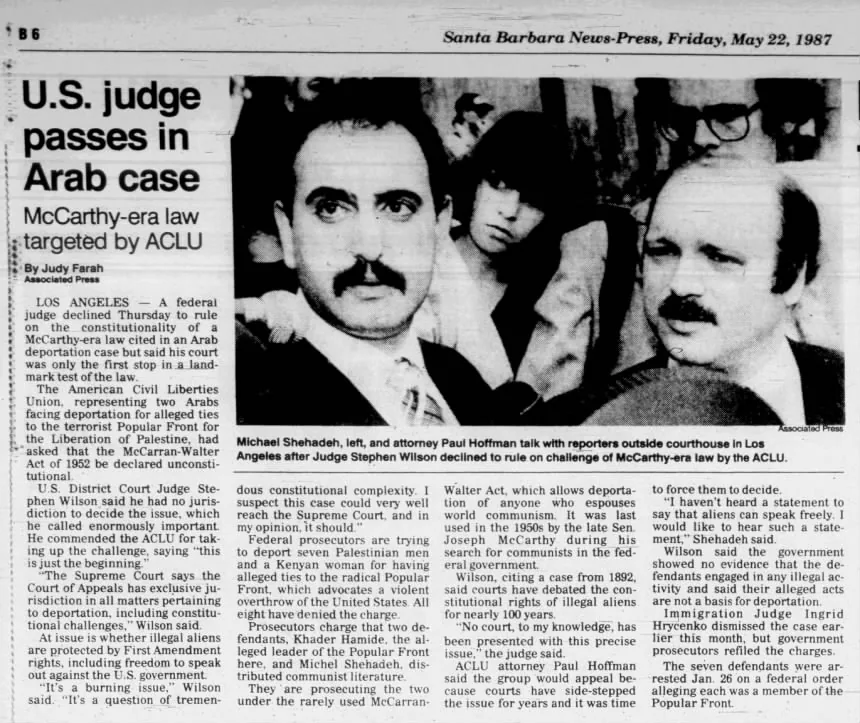
Transcribed from the clipping
LOS ANGELES — A federal judge declined Thursday to rule on the constitutionality of a McCarthy-era law cited in an Arab deportation case but said his court was only the first stop in a landmark test of the law.
The American Civil Liberties Union, representing two Arabs facing deportation for alleged ties to the terrorist Popular Front for the Liberation of Palestine, had asked that the McCarran-Walter Act of 1952 be declared unconstitutional. U.S. District Court Judge Stephen Wilson said he had no jurisdiction to decide the issue, which he called enormously important.
He commended the ACLU for taking up the challenge, saying “this is just the beginning.” “The Supreme Court says the Court of Appeals has exclusive jurisdiction in all matters pertaining to deportation, including constitutional challenges,” Wilson said.
At issue is whether illegal aliens are protected by First Amendment rights, including freedom to speak out against the U.S. government. “It's a burning issue,” Wilson said. “It's a question of tremendous constitutional complexity. I suspect this case could very well reach the Supreme Court, and in my opinion, it should.”
Federal prosecutors are trying to deport seven Palestinian men and a Kenyan woman for having alleged ties to the radical Popular Front, which advocates a violent overthrow of the United States. All eight have denied the charge.
Prosecutors charge that two defendants, Khader Hamide, the alleged leader of the Popular Front here, and Michel Shehadeh, distributed communist literature. They are prosecuting the two under the rarely used McCarran-Walter Act, which allows deportation of anyone who espouses world communism. It was last used in the 1950s by the late Sen.
Joseph McCarthy during his search for communists in the federal government. Wilson, citing a case from 1892, said courts have debated the constitutional rights of illegal aliens for nearly 100 years. “No court, to my knowledge, has been presented with this precise issue,” the judge said.
ACLU attorney Paul Hoffman said the group would appeal because courts have side-stepped the issue for years and it was time to force them to decide. “I haven't heard a statement to say that aliens can speak freely. I would like to hear such a statement,” Shehadeh said.
How this transcription was made
Read from the scan Maria supplied on 17 November 2026, at magnification, band by band. RUNNING HEAD PRESENT AND IT MATCHES ON BOTH COUNTS: "B 6" at the left, "Santa Barbara News-Press, Friday, May 22, 1987" at the right. The paper's name is set exactly as `pub` holds it, hyphen and all, and 22 May 1987 was a Friday. `pub` and `date` are both confirmed by the page. This and la048 are the only two clippings in the batch where that is true. THE PAGE CONTRADICTS ITSELF ON SHEHADEH'S FORENAME, within a few inches. The photo caption reads "Michael Shehadeh, left"; the body text, two columns away, reads "and Michel Shehadeh, distributed communist literature". Both magnified and checked. I have transcribed each as printed — MICHAEL in `photo_caption`, MICHEL in `excerpt`. Across the batch: Michel in la040, la043, la046, la048, la049, la050, la051, la052 and in this story's body; Michael in la045 and in this story's caption. The caption and the body were almost certainly set by different hands. This is an ASSOCIATED PRESS story, bylined Judy Farah — the only AP item in the batch. la049, la050 and la051 are UPI; la042's photograph is Times staff. For the consortium's purposes that means the 11–22 May stretch of this case is documented through two competing wires plus local staff coverage. `dek` holds "McCarthy-era law targeted by ACLU", set in a smaller bold face directly beneath the three-line headline and above the byline. It is a genuine deck, not a kicker. On the Kenyan: this page sets "a Kenyan woman", correctly, where la052 — dated the same day — sets "a Kenyon woman". She is not named here at all. COUNT PROBLEM in the last paragraph, transcribed as printed: "The seven defendants were arrested Jan. 26 on a federal order alleging each was a member of the Popular Front." SEVEN, where the story's own earlier paragraph says "seven Palestinian men and a Kenyan woman" and "All eight have denied the charge". The eighth, Bashar Amer, was arrested in February, so "seven arrested Jan. 26" may be right on its own terms; but the sentence says "the seven defendants" as though that were the whole set. The procedural picture this story adds, and it is the clearest statement of it in the batch: Judge Wilson held that he had NO JURISDICTION, because "The Supreme Court says the Court of Appeals has exclusive jurisdiction in all matters pertaining to deportation, including constitutional challenges" — so the constitutional question goes up, not down. He also said the government showed no evidence the defendants engaged in any illegal activity and that their alleged acts are not a basis for deportation. And he confirmed the sequence after la049/la050: "Immigration Judge Ingrid Hrycenko dismissed the case earlier this month, but government prosecutors refiled the charges.". NEW NAME: ACLU attorney PAUL HOFFMAN, who appears both in the caption and in the body and who says the group will appeal. He is the "civil rights organization" la052 left unnamed. The excerpt runs to about 2,400 characters, over the usual 1,000–2,000. I extended it deliberately to reach Michel Shehadeh's own words at the foot of the last column, which are the only quotation from a defendant on the page and the sharpest Palestinian line in the batch. Cutting at 2,000 would have ended on the ACLU attorney and left the defendant silent. Wilson's remark "this is just the beginning" is set inside the paper's own sentence, so it is a fragment rather than a sentence of its own and is not in `quotes`. Los Angeles particulars: the federal courthouse in Los Angeles (the photograph is taken outside it); U.S. District Court; the Court of Appeals as the forum the judge points the ACLU toward. No campus is named.
Cite this clipping
"U.S. judge passes in Arab case," Santa Barbara News-Press, 22 May 1987, p. B 6. Covering Palestine archive, CP-1987-071. https://coveringpalestine.org/archive/cp-1987-071
More from Santa Barbara News-Press
- Problem of Refugees in PalestineSanta Barbara News-Press · 12 June 1949
- The Palestinian Refugees…Santa Barbara News-Press · 18 June 1967
- Zionism, racism: Another viewpointSanta Barbara News-Press · 11 December 1975
- Gazans lose a rare pleasure: the zooSanta Barbara News-Press · 22 May 2004
- Israeli leader warns of 'iron fist'; Hamas remains defiantSanta Barbara News-Press · 13 January 2009
- Palestinian push for statehood jeopardizes U.S. aidSanta Barbara News-Press · 20 September 2011
- 4 more from this paper in the full text →
More from the 1980s
- Palestinians Under Israel: Bitter PoliticsThe New York Times · 12 January 1987
- Are jailed Palestinians terrorists or scapegoats?Los Angeles Herald Examiner · 15 February 1987
- Last 3 Arabs are freed in case of terrorist groupLos Angeles Herald Examiner · 19 February 1987
- Accused PLO members freedLos Angeles Times · 19 February 1987
- Jordanians tell of INS ‘nightmare’Los Angeles Herald Examiner · 26 February 1987
- Uneasy in ZionThe New York Times · 1 March 1987
- All 571 clippings from the 1980s →
Last updated 17 November 2026
This record is part of Covering Palestine, an archive of American newspaper clippings about Palestinians, 1724 to 2023. Researched and assembled by Maria Robles.
The clipping belongs to the newspaper that printed it, or to the news agency that supplied the copy. It is reproduced here for research, criticism and commentary. A city here is where the newspaper was published, not where the story came from, and on most records it was taken from the masthead.
Something wrong here, or something you know about this clipping? The archive is still being built and corrections are wanted: maria@rozumstudio.com, quoting CP-1987-071.
Everything printed in 1987 · Printed on this day · See it in the archive reel · Full text of every clipping · Dataset