The Patriot Ledger · Quincy, Massachusetts · 16 April 1988
CP-1988-044
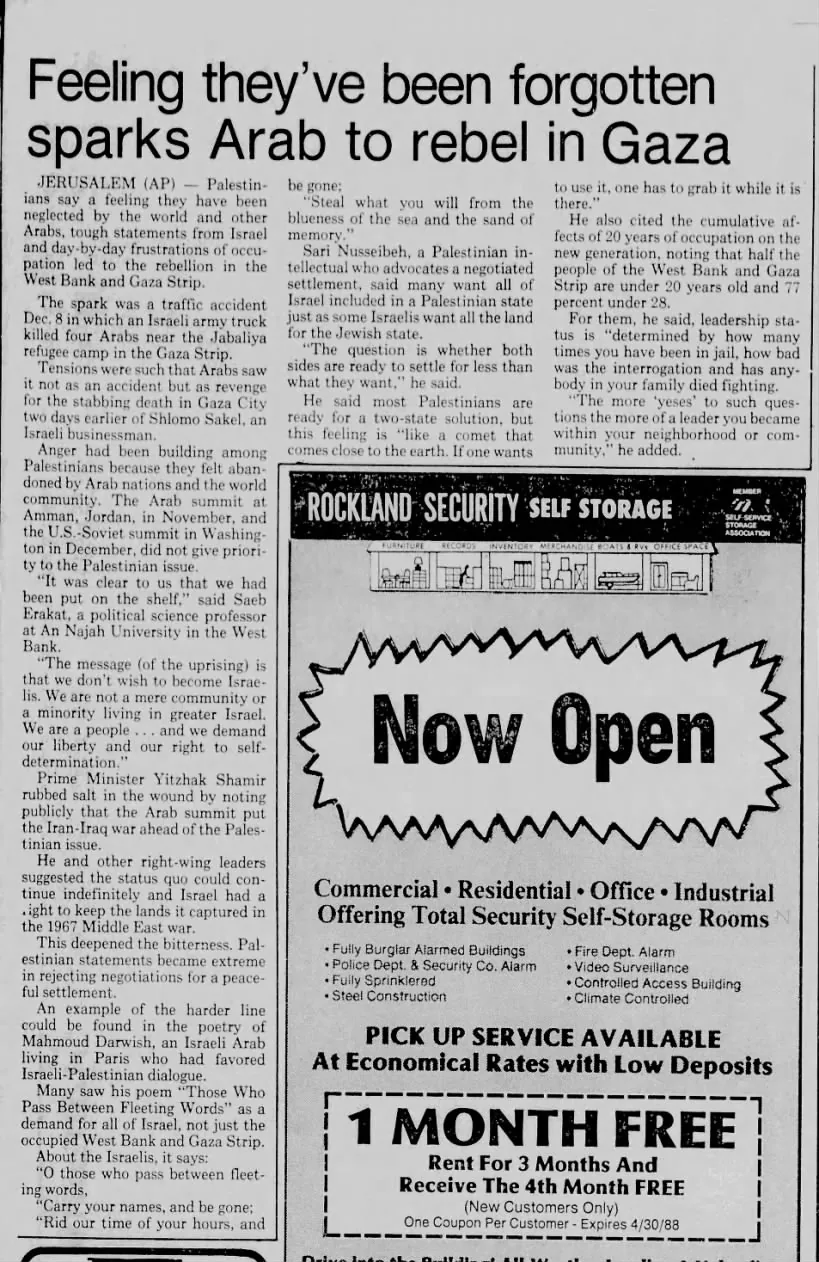
Feeling they’ve been forgotten sparks Arab to rebel in Gaza
The Associated Press, Jerusalem
Transcribed from the clipping
“JERUSALEM (AP) — Palestinians say a feeling they have been neglected by the world and other Arabs, statements from Israel and day-by-day frustrations of occupation led to the rebellion in the West Bank and Gaza Strip. The spark was a traffic accident Dec. 8 in which an Israeli army truck killed four Arabs near the Jabaliya refugee camp in the Gaza Strip… Anger had been building among Palestinians because they felt abandoned by Arab nations and the world community… ‘It was clear to us that we had been put on the shelf,’ said Saeb Erakat, a political science professor at An Najah University in the West Bank. ‘The message (of the uprising) is that we don’t wish to become Israelis. We are not a mere community or a minority living in greater Israel. We are a people… and we demand our liberty and our right to self-determination.’ Prime Minister Yitzhak Shamir rubbed salt in the wound by noting publicly that the Arab summit put the Iran-Iraq war ahead of the Palestinian issue… An example of the harder line could be found in the poetry of Mahmoud Darwish, an Israeli Arab living in Paris who had favored Israeli-Palestinian dialogue. Many saw his poem ‘Those Who Pass Between Fleeting Words’ as a demand for all of Israel, not just the occupied West Bank and Gaza Strip. About the Israelis, it says: ‘O those who pass between fleeting words, Carry your names, and be gone; Rid our time of your hours, and be gone; Steal what you will from the blueness of the sea and the sand of memory.’ Sari Nusseibeh, a Palestinian intellectual who advocates a negotiated settlement, said many want all of Israel included in a Palestinian state just as some Israelis want all the land for the Jewish state. ‘The question is whether both sides are ready to settle for less than what they want,’ he said. He said most Palestinians are ready for a two-state solution, but this feeling is ‘like a comet that comes close to the earth. If one wants to use it, one has to grab it while it is there.’ He also cited the cumulative affects of 20 years of occupation on the new generation, noting that half the people of the West Bank and Gaza Strip are under 20 years old and 77 percent are under 28. For them, he said, leadership status is ‘determined by how many times you have been in jail, how bad was the interrogation and has anybody in your family died fighting.’ ‘The more “yeses” to such questions the more of a leader you became within your neighborhood or community,’ he added.”
Context added by this archive
The poem itself, printed in an American paper in April 1988 and read as a demand for all of Israel. Twenty years later this archive holds four obituaries of its author in which Adel Usta, a specialist on his work, says the poem was misunderstood and mistranslated, and in which Yitzhak Shamir is reported reading it aloud in the Knesset as proof that Palestinians would not live alongside Jews. Darwish is described here as an Israeli Arab living in Paris. Saeb Erakat appears as a political science professor, years before he became the chief negotiator. The page carries a self-storage advertisement: Now Open, one month free.
Cite this item
"Feeling they’ve been forgotten sparks Arab to rebel in Gaza," The Patriot Ledger, 16 April 1988. Covering Palestine archive, CP-1988-044. https://coveringpalestine.org/archive/cp-1988-044
Elsewhere in the archive
- Alliance between Palestinians, Israelis and American Jews offers hopeThe Patriot Ledger · 14 June 2017 · the same newspaper
- Gaza Strip: the forgotten stepchildNorthwest Herald · 4 January 1988 · the same year
- Israeli soldiers fire on protestersCarroll County Times · 6 January 1988 · the same year
- Israel condemns U.N. vote on deportationsThe Birmingham News · 6 January 1988 · the same year
This record is part of Covering Palestine, an archive of American and Anglophone newspaper clippings about Palestinians, 1812 to 2022. Researched and assembled by Maria Robles.
The clipping belongs to the newspaper that printed it, or to the wire service that supplied the copy. It is reproduced here for research, criticism and commentary. The city is derived from the masthead, not read off the clipping.
Something wrong here, or something you know about this clipping? The archive is still being built and corrections are wanted: maria@rozumstudio.com, quoting CP-1988-044.
See it in the archive reel · Full text of every clipping · Dataset