(newspaper unidentified) · 8 May 1988
CP-1988-122
U.S. Learns It's Not Easy To Turn Out The P.L.O.
By ROBERT PEAR
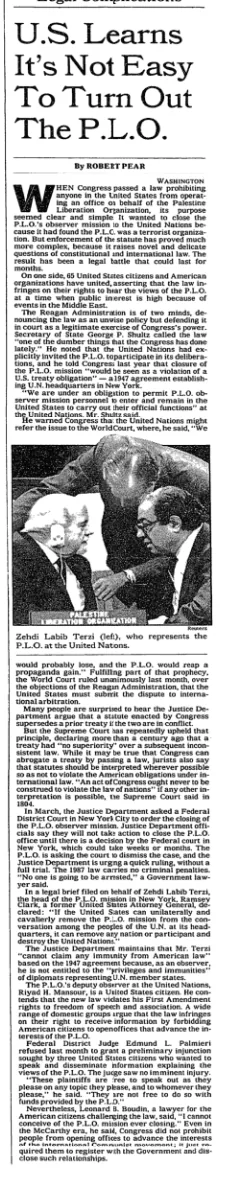
Shown from the top. The whole column — 4.9 times taller than it is wide — is in the enlargement.
Transcribed from the clipping
WASHINGTON WHEN Congress passed a law prohibiting anyone in the United States from operating an office on behalf of the Palestine Liberation Organization, its purpose seemed clear and simple. It wanted to close the P.L.O.'s observer mission to the United Nations because it had found the P.L.O. was a terrorist organization.
But enforcement of the statute has proved much more complex, because it raises novel and delicate questions of constitutional and international law. The result has been a legal battle that could last for months.
On one side, 65 United States citizens and American organizations have united, asserting that the law infringes on their rights to hear the views of the P.L.O. at a time when public interest is high because of events in the Middle East.
The Reagan Administration is of two minds, denouncing the law as an unwise policy but defending it in court as a legitimate exercise of Congress's power. Secretary of State George P. Shultz called the law “one of the dumber things that the Congress has done lately.”
He noted that the United Nations had explicitly invited the P.L.O. to participate in its deliberations, and he told Congress last year that closure of the P.L.O. mission “would be seen as a violation of a U.S. treaty obligation” — a 1947 agreement establishing U.N. headquarters in New York.
“We are under an obligation to permit P.L.O. observer mission personnel to enter and remain in the United States to carry out their official functions” at the United Nations, Mr. Shultz said. He warned Congress that the United Nations might refer the issue to the World Court, where, he said, “We [the] United States must submit the dispute to international arbitration.”
Many people are surprised to hear the Justice Department argue that a statute enacted by Congress supersedes a prior treaty if the two are in conflict. But the Supreme Court has repeatedly upheld that principle, declaring more than a century ago that a treaty had “no superiority” over a subsequent inconsistent law.
While it may be true that Congress can abrogate a treaty by passing a law, jurists also say that statutes should be interpreted wherever possible so as not to violate the American obligations under international law. “An act of Congress ought never to be construed to violate the law of nations” if any other interpretation is possible, the Supreme Court said in 1804.
In March, the Justice Department asked a Federal District Court in New York City to order the closing of the P.L.O. observer mission. Justice Department officials say they will not take action to close the P.L.O. office until there is a decision by the Federal court in New York, which could take weeks or months.
The P.L.O. is asking the court to dismiss the case, and the Justice Department is urging a quick ruling, without a full trial. The 1987 law carries no criminal penalties. “No one is going to be arrested,” a Government lawyer said.
In a legal brief filed on behalf of Zehdi Labib Terzi, the head of the P.L.O. mission in New York, Ramsey Clark, a former United States Attorney General, declared: “If the United Sates can unilaterally and cavalierly remove the P.L.O. mission from the conversation among the peoples of the U.N. at its headquarters, it can remove any nation or participant and destroy the United Nations.”
The Justice Department maintains that Mr. Terzi “cannot claim any immunity from American law” based on the 1947 agreement because, as an observer, he is not entitled to the “privileges and immunities” of diplomats representing U.N. member states. The P.L.O.'s deputy observer at the United Nations, Riyad H. Mansour, is a United States citizen.
He contends that the new law violates his First Amendment rights to freedom of speech and association.
How this transcription was made
Masthead not readable on the scan. The label on the slide read: [no masthead on clipping] — A single narrow column clipping with a kicker "Legal Complications" set above the headline (the kicker is sliced at the top of the scan and is read with difficulty; it is NOT a deck and dek is left empty). Read at 12x-20x. RESOLUTION WARNING, PLEASE READ BEFORE CITING: this source file is only 240 pixels wide. Magnification past about 12x is interpolation, not detail. Most of the text is confidently legible, but a few letterforms sit at or below the limit. Specifically: the word transcribed as "violates" in the final paragraph renders as "vidates" even at 20x, and I am reading it from context, not from clean letterforms — it is the one word in this record I would not swear to. By contrast "United Sates" in the Ramsey Clark quotation and "United Natons" in the photo caption ARE clean at magnification and are transcribed as the paper's own typographical errors. The last paragraphs of the clipping (on Leonard S. Boudin and the registration of American citizens with the Government) are below usable resolution and are not transcribed. The excerpt also fills one bracketed gap: the Shultz World Court quotation runs off the first column mid-sentence and resumes in a passage I could read; I have marked the joining words [the] in brackets rather than presenting them as read.
Cite this clipping
"U.S. Learns It's Not Easy To Turn Out The P.L.O.," (newspaper unidentified), 8 May 1988. Covering Palestine archive, CP-1988-122. https://coveringpalestine.org/archive/cp-1988-122
More from (newspaper unidentified)
- Kaiser Wilhelm's Trip to Palestine(newspaper unidentified) · 9 April 1898
- States the Arab Point of View Concerning Palestine(newspaper unidentified) · 1 January 1946
- Forcing Palestine to Become a World Problem(newspaper unidentified) · 1 January 1947
- Arab Terrorist Spokesman Killed As Auto Explodes(newspaper unidentified) · 8 July 1972
- Bomb in car kills Arab guerrilla chief(newspaper unidentified) · 8 July 1972
- Arab Who Claimed Massacre Credit Dies(newspaper unidentified) · 8 July 1972
- 57 more from this paper in the full text →
More from the 1980s
- Moderation Silenced by Israel RiotsThe Buffalo News · 3 January 1988
- Gaza Strip: the forgotten stepchildNorthwest Herald · 4 January 1988
- 'Iron Fist' Enslaves Gazans In Their LandThe Herald Sun · 6 January 1988
- Israel condemns U.N. vote on deportationsThe Birmingham News · 6 January 1988
- Israeli soldiers fire on protestersCarroll County Times · 6 January 1988
- Undaunted Palestinians resume violenceThe News & Observer · 6 January 1988
- All 527 clippings from the 1980s →
Last updated 2 November 2026
This record is part of Covering Palestine, an archive of American newspaper clippings about Palestinians, 1724 to 2023. Researched and assembled by Maria Robles.
The clipping belongs to the newspaper that printed it, or to the news agency that supplied the copy. It is reproduced here for research, criticism and commentary. A city here is where the newspaper was published, not where the story came from, and on most records it was taken from the masthead.
Something wrong here, or something you know about this clipping? The archive is still being built and corrections are wanted: maria@rozumstudio.com, quoting CP-1988-122.
Everything printed in 1988 · Printed on this day · See it in the archive reel · Full text of every clipping · Dataset