Standard Star · 16 April 1989
CP-1989-031
The Palestinian Diaspora
By Nicolas B. Tatro / The Associated Press
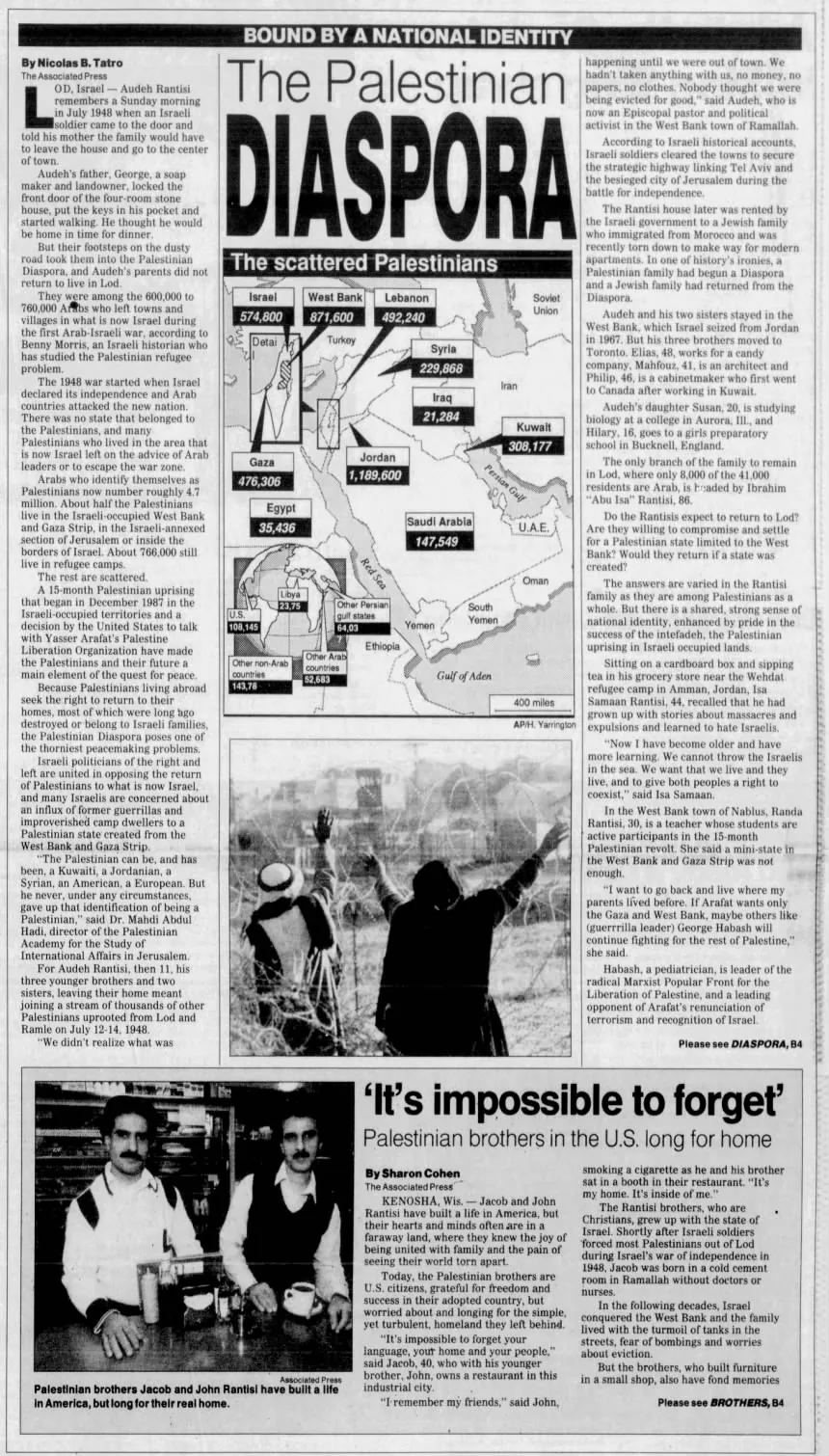
Transcribed from the clipping
LOD, Israel — Audeh Rantisi remembers a Sunday morning in July 1948 when an Israeli soldier came to the door and told his mother the family would have to leave the house and go to the center of town. Audeh's father, George, a soap maker and landowner, locked the front door of the four-room stone house, put the keys in his pocket and started walking.
He thought he would be home in time for dinner. But their footsteps on the dusty road took them into the Palestinian Diaspora, and Audeh's parents did not return to live in Lod.
They were among the 600,000 to 760,000 Arabs who left towns and villages in what is now Israel during the first Arab-Israeli war, according to Benny Morris, an Israeli historian who has studied the Palestinian refugee problem. The 1948 war started when Israel declared its independence and Arab countries attacked the new nation.
There was no state that belonged to the Palestinians, and many Palestinians who lived in the area that is now Israel left on the advice of Arab leaders or to escape the war zone. Arabs who identify themselves as Palestinians now number roughly 4.7 million.
About half the Palestinians live in the Israeli-occupied West Bank and Gaza Strip, in the Israeli-annexed section of Jerusalem or inside the borders of Israel. About 766,000 still live in refugee camps. The rest are scattered.
A 15-month Palestinian uprising that began in December 1987 in the Israeli-occupied territories and a decision by the United States to talk with Yasser Arafat's Palestine Liberation Organization have made the Palestinians and their future a main element of the quest for peace.
Because Palestinians living abroad seek the right to return to their homes, most of which were long ago destroyed or belong to Israeli families, the Palestinian Diaspora poses one of the thorniest peacemaking problems.
Israeli politicians of the right and left are united in opposing the return of Palestinians to what is now Israel, and many Israelis are concerned about an influx of former guerrillas and improverished camp dwellers to a Palestinian state created from the West Bank and Gaza Strip.
“The Palestinian can be, and has been, a Kuwaiti, a Jordanian, a Syrian, an American, a European. But he never, under any circumstances, gave up that identification of being a Palestinian,” said Dr. Mahdi Abdul Hadi, director of the Palestinian Academy for the Study of International Affairs in Jerusalem.
For Audeh Rantisi, then 11, his three younger brothers and two sisters, leaving their home meant joining a stream of thousands of other Palestinians uprooted from Lod and Ramle on July 12-14, 1948. “We didn't realize what was happening until we were out of town. We hadn't taken anything with us, no money, no papers, no clothes.
Nobody thought we were being evicted for good,” said Audeh, who is now an Episcopal pastor and political activist in the West Bank town of Ramallah.
Cite this clipping
"The Palestinian Diaspora," Standard Star, 16 April 1989. Covering Palestine archive, CP-1989-031. https://coveringpalestine.org/archive/cp-1989-031
More from Standard Star
- Gaza Bombed For Fourth Day, Civilians Fleeing Arab CapitalStandard Star · 19 October 1948
- Israel Opens Schools For Arab ChildrenStandard Star · 2 September 1967
- Zionism not racismStandard Star · 14 November 1975
More from the 1980s
- ArafatThe Times · 18 January 1989
- Israeli officials play down offer from Shamir to withdraw troopsThe Miami Herald · 3 February 1989
- Shamir offer not newWorcester Telegram · 3 February 1989
- Israelis Study Devices In Blasts in West BankThe New York Times · 16 February 1989
- Can't rule, absorb, bar or expel PalestiniansSt. Louis Jewish Light · 3 March 1989
- THE AMBIGUOUS YASIR ARAFATThe New York Times · 12 March 1989
- All 527 clippings from the 1980s →
Last updated 2 November 2026
This record is part of Covering Palestine, an archive of American newspaper clippings about Palestinians, 1724 to 2023. Researched and assembled by Maria Robles.
The clipping belongs to the newspaper that printed it, or to the news agency that supplied the copy. It is reproduced here for research, criticism and commentary. A city here is where the newspaper was published, not where the story came from, and on most records it was taken from the masthead.
Something wrong here, or something you know about this clipping? The archive is still being built and corrections are wanted: maria@rozumstudio.com, quoting CP-1989-031.
Everything printed in 1989 · Printed on this day · See it in the archive reel · Full text of every clipping · Dataset