The New York Times · New York, New York · 24 October 1990
CP-1990-030
Assassin or Muslim Avenger, He’s a Hero in the West Bank
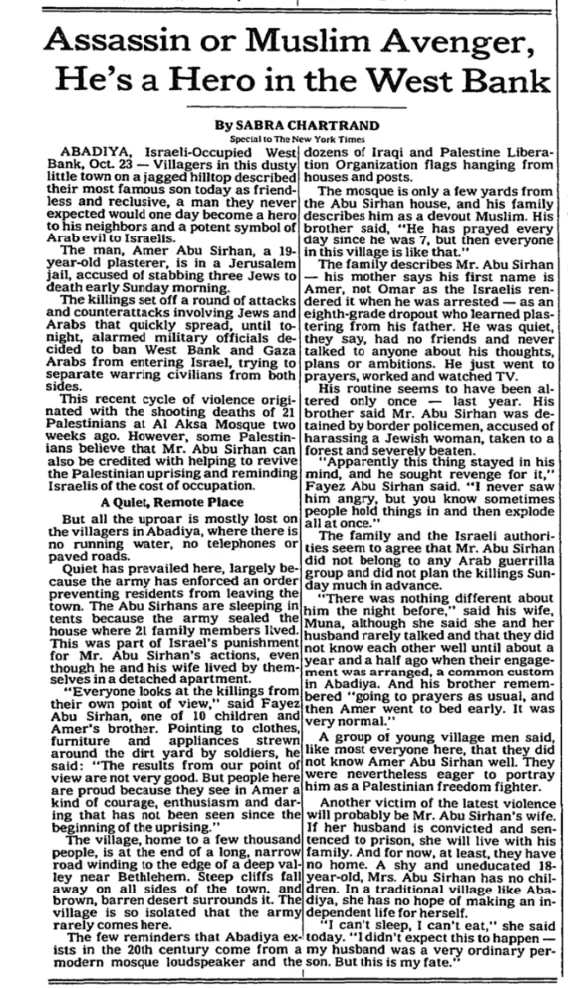
Transcribed from the clipping
ABADIYA, Israeli-Occupied West Bank, Oct. 23 — Villagers in this dusty little town on a jagged hilltop described their most famous son today as friendless and reclusive, a man they never expected would one day become a hero to his neighbors and a potent symbol of Arab evil to Israelis.
The man, Amer Abu Sirhan, a 19-year-old plasterer, is in a Jerusalem jail, accused of stabbing three Jews to death early Sunday morning.
The killings set off a round of attacks and counterattacks involving Jews and Arabs that quickly spread, until tonight, alarmed military officials decided to ban West Bank and Gaza Arabs from entering Israel, trying to separate warring civilians from both sides.
This recent cycle of violence originated with the shooting deaths of 21 Palestinians at Al Aksa Mosque two weeks ago. However, some Palestinians believe that Mr. Abu Sirhan can also be credited with helping to revive the Palestinian uprising and reminding Israelis of the cost of occupation.
A Quiet, Remote Place But all the uproar is mostly lost on the villagers in Abadiya, where there is no running water, no telephones or paved roads. Quiet has prevailed here, largely because the army has enforced an order preventing residents from leaving the town. The Abu Sirhans are sleeping in tents because the army sealed the house where 21 family members lived.
This was part of Israel’s punishment for Mr. Abu Sirhan’s actions, even though he and his wife lived by themselves in a detached apartment. “Everyone looks at the killings from their own point of view,” said Fayez Abu Sirhan, one of 10 children and Amer’s brother.
Pointing to clothes, furniture and appliances strewn around the dirt yard by soldiers, he said: “The results from our point of view are not very good. But people here are proud because they see in Amer a kind of courage, enthusiasm and daring that has not been seen since the beginning of the uprising.”
The village, home to a few thousand people, is at the end of a long, narrow road winding to the edge of a deep valley near Bethlehem. Steep cliffs fall away on all sides of the town. and brown, barren desert surrounds it. The village is so isolated that the army rarely comes here.
The few reminders that Abadiya exists in the 20th century come from a modern mosque loudspeaker and the dozens of Iraqi and Palestine Liberation Organization flags hanging from houses and posts. The mosque is only a few yards from the Abu Sirhan house, and his family describes him as a devout Muslim.
His brother said, “He has prayed every day since he was 7, but then everyone in this village is like that.” The family describes Mr. Abu Sirhan — his mother says his first name is Amer, not Omar as the Israelis rendered it when he was arrested — as an eighth-grade dropout who learned plastering from his father.
He was quiet, they say, had no friends and never talked to anyone about his thoughts, plans or ambitions. He just went to prayers, worked and watched TV. His routine seems to have been altered only once — last year. His brother said Mr. Abu Sirhan was detained by border policemen, accused of harassing a Jewish woman, taken to a forest and severely beaten.
“Apparently this thing stayed in his mind, and he sought revenge for it,” Fayez Abu Sirhan said. “I never saw him angry, but you know sometimes people hold things in and then explode all at once.” The family and the Israeli authorities seem to agree that Mr.
Abu Sirhan did not belong to any Arab guerrilla group and did not plan the killings Sunday much in advance.
“There was nothing different about him the night before,” said his wife, Muna, although she said she and her husband rarely talked and that they did not know each other well until about a year and a half ago when their engagement was arranged, a common custom in Abadiya. And his brother remembered “going to prayers as usual, and then Amer went to bed early.
It was very normal.” A group of young village men said, like most everyone here, that they did not know Amer Abu Sirhan well. They were nevertheless eager to portray him as a Palestinian freedom fighter. Another victim of the latest violence will probably be Mr. Abu Sirhan’s wife. If her husband is convicted and sentenced to prison, she will live with his family.
And for now, at least, they have no home. A shy and uneducated 18-year-old, Mrs. Abu Sirhan has no children. In a traditional village like Abadiya, she has no hope of making an independent life for herself. “I can’t sleep, I can’t eat,” she said today. “I didn’t expect this to happen — my husband was a very ordinary person.
But this is my fate.”
How this transcription was made
Read from the scan by a machine looking at the image of the page, not by optical character recognition and not by a person. The clipping carries no masthead or date line, so its date and newspaper rest on the record it arrived with, not on anything visible in the scan.
Context added by this archive
Date check: No masthead and no page date line — the clipping is cut to the two-line headline, the byline block and two full text columns, closing on a rule. The byline block reads “Special to The New York Times”, which confirms `pub`. The dateline reads “ABADIYA, Israeli-Occupied West Bank, Oct.
23”, one day before the labelled date, and the body dates itself twice over: the stabbings were “early Sunday morning” and the “shooting deaths of 21 Palestinians at Al Aksa Mosque two weeks ago” places this a fortnight after 8 October 1990. Both are consistent with `date` (1990-10-24).
Cite this clipping
"Assassin or Muslim Avenger, He’s a Hero in the West Bank," The New York Times, 24 October 1990. Covering Palestine archive, CP-1990-030. https://coveringpalestine.org/archive/cp-1990-030
More from The New York Times
- The Maine Colony in PalestineThe New York Times · 12 November 1866
- Jewish Colonization in PalestineThe New York Times · 9 December 1883
- Jewish State in Palestine OpposedThe New York Times · 9 July 1897
- ZIONIST CONGRESS IN BASELThe New York Times · 31 August 1897
- ROME FEARS THE ZIONISTSThe New York Times · 12 September 1897
- PROGRESS OF ZIONISMThe New York Times · 16 December 1901
- 852 more from this paper in the full text →
More from the 1990s
- Israel censoring news of Soviet immigrants(newspaper unidentified) · 1 January 1990
- PALESTINIANS MARK ’76 LAND SEIZURESThe New York Times · 30 March 1990
- KILLINGS OF ARABS BY ISRAELIS DROPThe New York Times · 4 April 1990
- Christians in Israel protest settlementThe Daily Press · 24 April 1990
- Israelis Consider Reopening the Palestinians' UniversitiesThe New York Times · 15 May 1990
- Report Charges Violence Against Arab ChildrenThe New York Times · 17 May 1990
- All 374 clippings from the 1990s →
Last updated 2 November 2026
This record is part of Covering Palestine, an archive of American newspaper clippings about Palestinians, 1724 to 2023. Researched and assembled by Maria Robles.
The clipping belongs to the newspaper that printed it, or to the news agency that supplied the copy. It is reproduced here for research, criticism and commentary. A city here is where the newspaper was published, not where the story came from, and on most records it was taken from the masthead.
Something wrong here, or something you know about this clipping? The archive is still being built and corrections are wanted: maria@rozumstudio.com, quoting CP-1990-030.
Everything printed in 1990 · Printed on this day · See it in the archive reel · Full text of every clipping · Dataset