The New York Times · 4 October 1990
CP-1990-031
Palestinians Struggling To Rebuild Their Lives
By CHRIS HEDGES
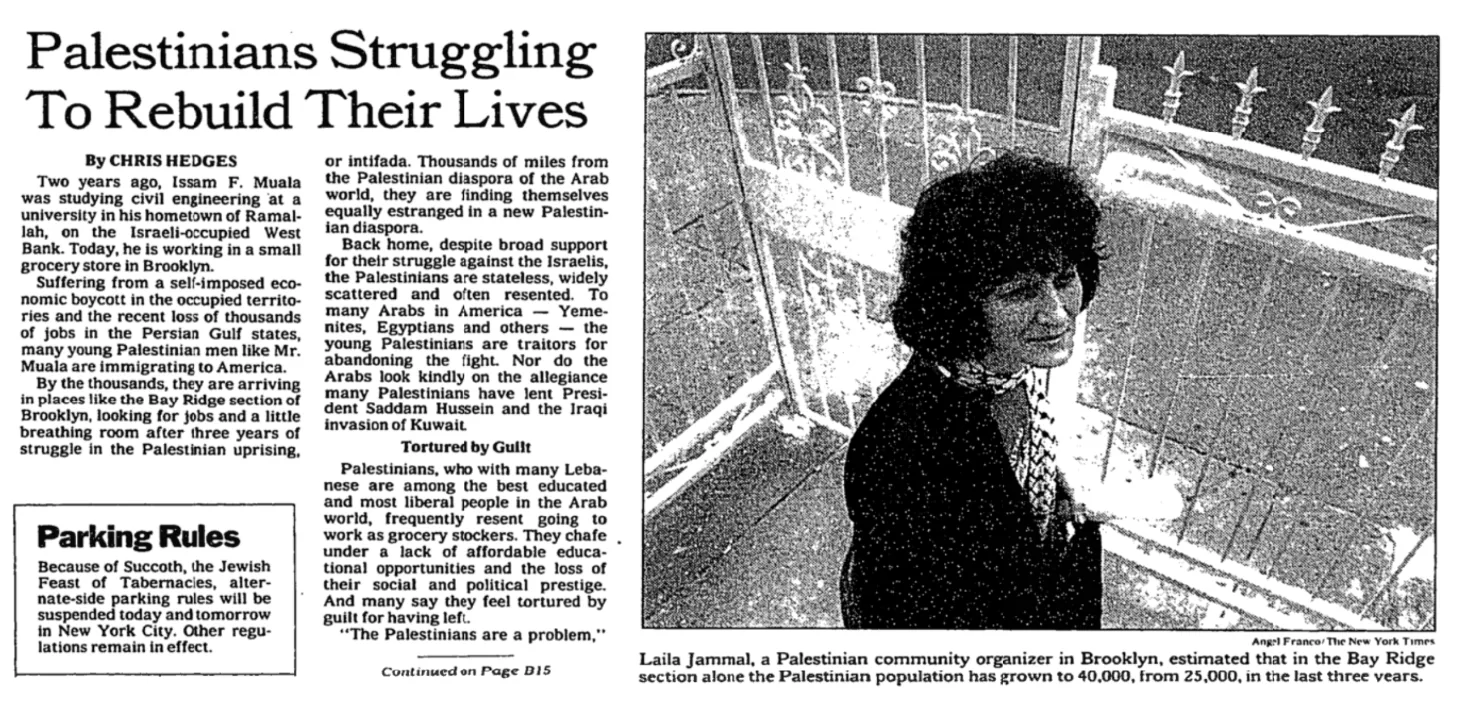
Transcribed from the clipping
Two years ago, Issam F. Muala was studying civil engineering at a university in his hometown of Ramallah, on the Israeli-occupied West Bank. Today, he is working in a small grocery store in Brooklyn. Suffering from a self-imposed economic boycott in the occupied territories and the recent loss of thousands of jobs in the Persian Gulf states, many young Palestinian men like Mr.
Muala are immigrating to America. By the thousands, they are arriving in places like the Bay Ridge section of Brooklyn, looking for jobs and a little breathing room after three years of struggle in the Palestinian uprising, or intifada.
Thousands of miles from the Palestinian diaspora of the Arab world, they are finding themselves equally estranged in a new Palestinian diaspora. Back home, despite broad support for their struggle against the Israelis, the Palestinians are stateless, widely scattered and often resented.
To many Arabs in America — Yemenites, Egyptians and others — the young Palestinians are traitors for abandoning the fight. Nor do the Arabs look kindly on the allegiance many Palestinians have lent President Saddam Hussein and the Iraqi invasion of Kuwait.
Tortured by Guilt Palestinians, who with many Lebanese are among the best educated and most liberal people in the Arab world, frequently resent going to work as grocery stockers. They chafe under a lack of affordable educational opportunities and the loss of their social and political prestige. And many say they feel tortured by guilt for having left.
How this transcription was made
Transcribed from the slide scan by a reader working off magnified crops, not by optical character recognition. The clipping carries no masthead, no folio and no dateline — the story is reported in Brooklyn. The newspaper is printed on it, in the photograph’s credit line “Angel Franco/The New York Times”. The date is derived from a boxed notice printed in the same column: “Because of Succoth, the Jewish Feast of Tabernacles, alternate-side parking rules will be suspended today and tomorrow in New York City.” Succoth began at sundown on 3 October in 1990, so a notice saying today and tomorrow places the paper on 4 October 1990, a Thursday; the year is independently fixed by the article’s references to the Iraqi invasion of Kuwait and to the intifada in its third year. The clipping ends mid-quotation at a jump line, so no quotation on it is complete.
Cite this clipping
"Palestinians Struggling To Rebuild Their Lives," The New York Times, 4 October 1990. Covering Palestine archive, CP-1990-031. https://coveringpalestine.org/archive/cp-1990-031
More from The New York Times
- The Maine Colony in PalestineThe New York Times · 12 November 1866
- Jewish Colonization in PalestineThe New York Times · 9 December 1883
- Jewish State in Palestine OpposedThe New York Times · 9 July 1897
- ZIONIST CONGRESS IN BASELThe New York Times · 31 August 1897
- ROME FEARS THE ZIONISTSThe New York Times · 12 September 1897
- PROGRESS OF ZIONISMThe New York Times · 16 December 1901
- 852 more from this paper in the full text →
More from the 1990s
- Israel censoring news of Soviet immigrants(newspaper unidentified) · 1 January 1990
- PALESTINIANS MARK ’76 LAND SEIZURESThe New York Times · 30 March 1990
- KILLINGS OF ARABS BY ISRAELIS DROPThe New York Times · 4 April 1990
- Christians in Israel protest settlementThe Daily Press · 24 April 1990
- Israelis Consider Reopening the Palestinians' UniversitiesThe New York Times · 15 May 1990
- Report Charges Violence Against Arab ChildrenThe New York Times · 17 May 1990
- All 374 clippings from the 1990s →
Last updated 2 November 2026
This record is part of Covering Palestine, an archive of American newspaper clippings about Palestinians, 1724 to 2023. Researched and assembled by Maria Robles.
The clipping belongs to the newspaper that printed it, or to the news agency that supplied the copy. It is reproduced here for research, criticism and commentary. A city here is where the newspaper was published, not where the story came from, and on most records it was taken from the masthead.
Something wrong here, or something you know about this clipping? The archive is still being built and corrections are wanted: maria@rozumstudio.com, quoting CP-1990-031.
Everything printed in 1990 · Printed on this day · See it in the archive reel · Full text of every clipping · Dataset