Los Angeles Times · Los Angeles, California · 27 July 1996
CP-1996-010
‘When I First Got My Legs, I Had to Practice Every Day’
Making a Difference
Interviewed by Kate Seelye
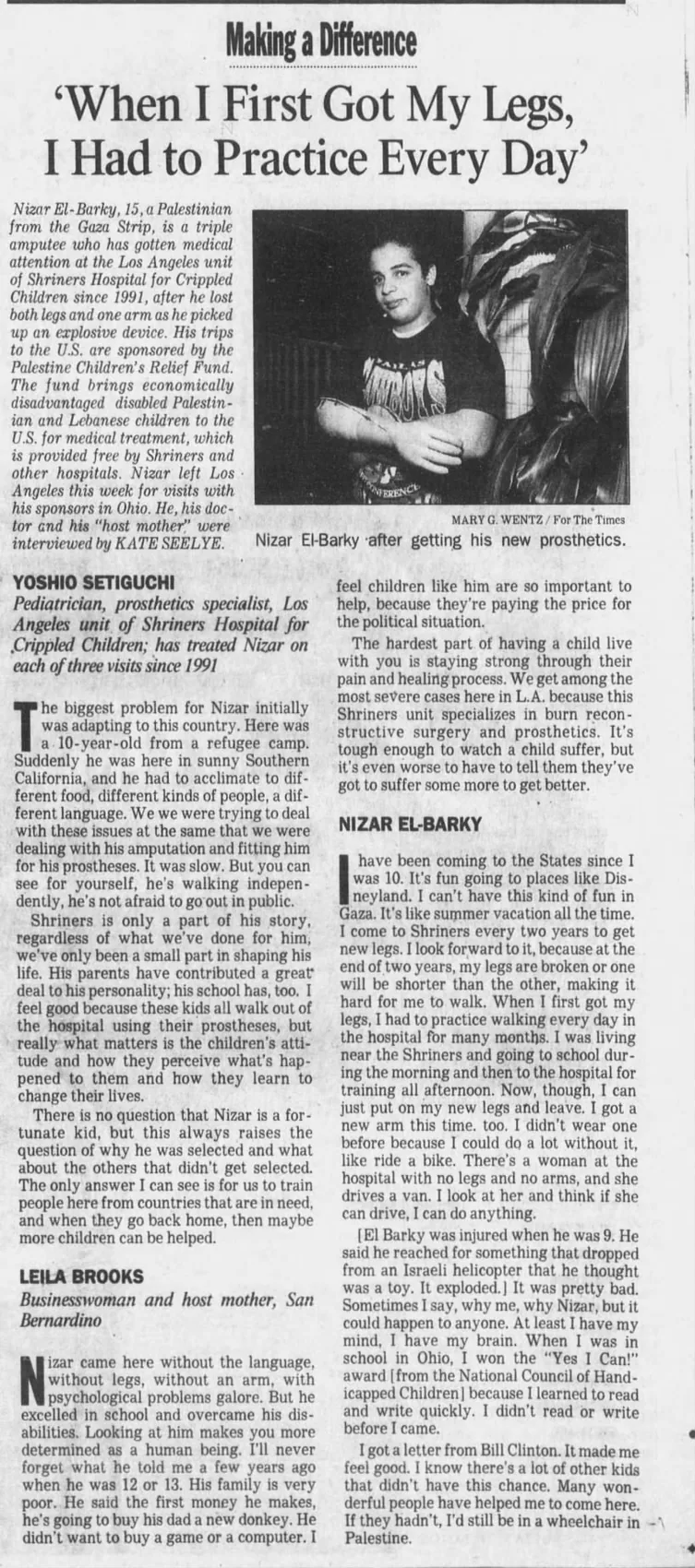
Transcribed from the clipping
“YOSHIO SETIGUCHI, pediatrician and prosthetics specialist: ‘The biggest problem for Nizar initially was adapting to this country. Here was a 10-year-old from a refugee camp.
Suddenly he was here in sunny Southern California… There is no question that Nizar is a fortunate kid, but this always raises the question of why he was selected and what about the others that didn’t get selected.’
LEILA BROOKS, businesswoman and host mother: ‘I’ll never forget what he told me a few years ago when he was 12 or 13. His family is very poor. He said the first money he makes, he’s going to buy his dad a new donkey. He didn’t want to buy a game or a computer.’
NIZAR EL-BARKY: ‘I have been coming to the States since I was 10. It’s fun going to places like Disneyland. I can’t have this kind of fun in Gaza… When I first got my legs, I had to practice walking every day in the hospital for many months… There’s a woman at the hospital with no legs and no arms, and she drives a van.
I look at her and think if she can drive, I can do anything.’ [El Barky was injured when he was 9. He said he reached for something that dropped from an Israeli helicopter that he thought was a toy. It exploded.] ‘It was pretty bad. Sometimes I say, why me, why Nizar, but it could happen to anyone.
At least I have my mind, I have my brain… I got a letter from Bill Clinton. It made me feel good. I know there’s a lot of other kids that didn’t have this chance. Many wonderful people have helped me to come here. If they hadn’t, I’d still be in a wheelchair in Palestine.’”
Context added by this archive
Three people are given headed sections of their own: a surgeon, a host mother, and a fifteen-year-old from Gaza who lost both legs and an arm at nine. He gets the longest. He talks about Disneyland, a donkey he means to buy his father, an award he won for learning to read, a letter from a president, and a woman at the hospital who drives a van.
How he was injured is printed in square brackets.
Cite this clipping
"‘When I First Got My Legs, I Had to Practice Every Day’," Los Angeles Times, 27 July 1996, p. 1. Covering Palestine archive, CP-1996-010. https://coveringpalestine.org/archive/cp-1996-010
More from Los Angeles Times
- The Palestinians’ EvolutionLos Angeles Times · 21 March 1969
- Bomb Victim Had Expected DeathLos Angeles Times · 10 July 1972
- Mrs. Meir's Safety StudiedLos Angeles Times · 11 January 1973
- Show of Artists from PalestineLos Angeles Times · 24 June 1977
- UCLA Jewish Groups Ask Palestinian BanLos Angeles Times · 21 October 1984
- UCLA Renews Rival Groups' StatusLos Angeles Times · 1 November 1984
- 60 more from this paper in the full text →
More from the 1990s
- Israel rejects blanket damagesSan Francisco Examiner · 3 January 1996
- Disabled Palestinians Sue Israelis for InjuriesOmaha World-Herald · 3 January 1996
- Israel Eldad, 86, a Top Leader In Palestine Jewish UndergroundThe New York Times · 23 January 1996
- Arrest Puts Israel Arabs Under CloudThe New York Times · 7 March 1996
- Runner on first Palestinian Olympic squadIndex-Journal · 7 April 1996
- Roadblocks blamed in baby’s deathTucson Citizen · 9 April 1996
- All 383 clippings from the 1990s →
In these collections
Last updated 17 November 2026
This record is part of Covering Palestine, an archive of American newspaper clippings about Palestinians, 1724 to 2023. Researched and assembled by Maria Robles.
The clipping belongs to the newspaper that printed it, or to the news agency that supplied the copy. It is reproduced here for research, criticism and commentary. A city here is where the newspaper was published, not where the story came from, and on most records it was taken from the masthead.
Something wrong here, or something you know about this clipping? The archive is still being built and corrections are wanted: maria@rozumstudio.com, quoting CP-1996-010.
Everything printed in 1996 · Printed on this day · See it in the archive reel · Full text of every clipping · Dataset