The New York Times · New York, New York · 9 November 1999
CP-1999-012
Israel and Palestinians Start Major Talks
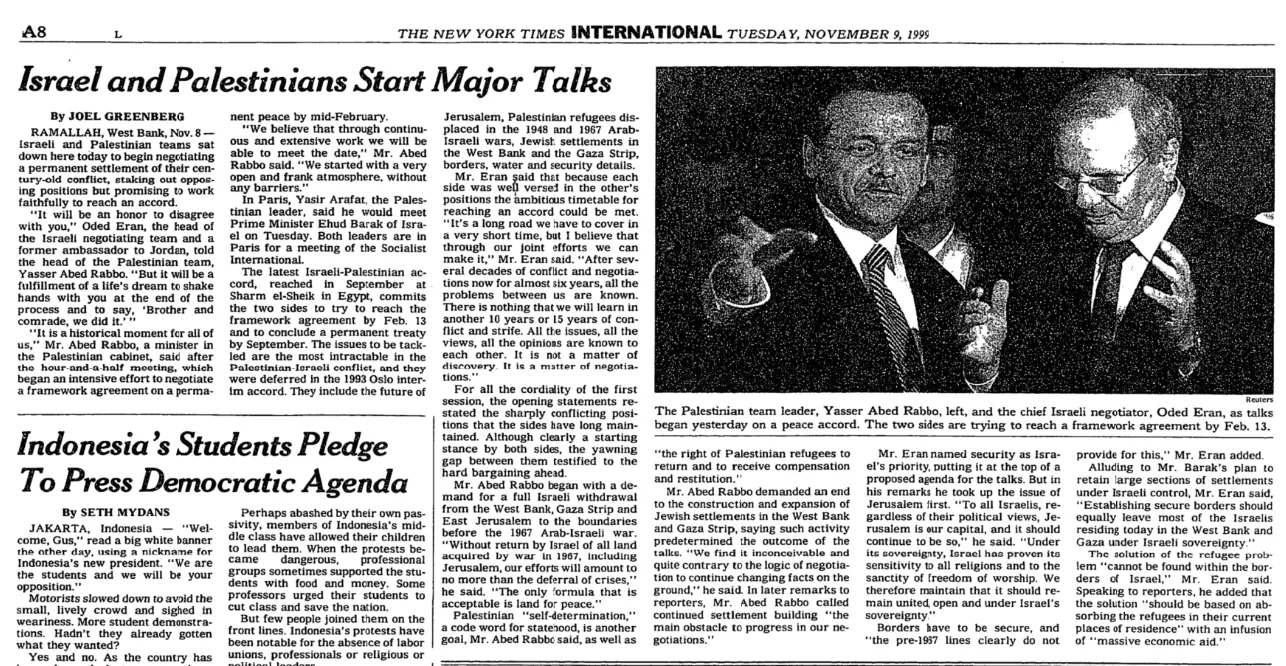
Transcribed from the clipping
RAMALLAH, West Bank, Nov. 8 — Israeli and Palestinian teams sat down here today to begin negotiating a permanent settlement of their century-old conflict, staking out opposing positions but promising to work faithfully to reach an accord.
“It will be an honor to disagree with you,” Oded Eran, the head of the Israeli negotiating team and a former ambassador to Jordan, told the head of the Palestinian team, Yasser Abed Rabbo.
“But it will be a fulfillment of a life’s dream to shake hands with you at the end of the process and to say, ‘Brother and comrade, we did it.’” “It is a historical moment for all of us,” Mr.
Abed Rabbo, a minister in the Palestinian cabinet, said after the hour-and-a-half meeting, which began an intensive effort to negotiate a framework agreement on a permanent peace by mid-February. “We believe that through continuous and extensive work we will be able to meet the date,” Mr. Abed Rabbo said.
“We started with a very open and frank atmosphere, without any barriers.” In Paris, Yasir Arafat, the Palestinian leader, said he would meet Prime Minister Ehud Barak of Israel on Tuesday. Both leaders are in Paris for a meeting of the Socialist International.
The latest Israeli-Palestinian accord, reached in September at Sharm el-Sheik in Egypt, commits the two sides to try to reach the framework agreement by Feb. 13 and to conclude a permanent treaty by September. The issues to be tackled are the most intractable in the Palestinian-Israeli conflict, and they were deferred in the 1993 Oslo interim accord.
They include the future of Jerusalem, Palestinian refugees displaced in the 1948 and 1967 Arab-Israeli wars, Jewish settlements in the West Bank and the Gaza Strip, borders, water and security details. Mr. Eran said that because each side was well versed in the other’s positions the ambitious timetable for reaching an accord could be met.
“It’s a long road we have to cover in a very short time, but I believe that through our joint efforts we can make it,” Mr. Eran said. “After several decades of conflict and negotiations now for almost six years, all the problems between us are known. There is nothing that we will learn in another 10 years or 15 years of conflict and strife.
All the issues, all the views, all the opinions are known to each other. It is not a matter of discovery. It is a matter of negotiations.” For all the cordiality of the first session, the opening statements restated the sharply conflicting positions that the sides have long maintained.
Although clearly a starting stance by both sides, the yawning gap between them testified to the hard bargaining ahead. Mr. Abed Rabbo began with a demand for a full Israeli withdrawal from the West Bank, Gaza Strip and East Jerusalem to the boundaries before the 1967 Arab-Israeli war.
“Without return by Israel of all land acquired by war in 1967, including Jerusalem, our efforts will amount to no more than the deferral of crises,” he said. “The only formula that is acceptable is land for peace.” Palestinian “self-determination,” a code word for statehood, is another goal, Mr.
Abed Rabbo said, as well as “the right of Palestinian refugees to return and to receive compensation and restitution.” Mr. Abed Rabbo demanded an end to the construction and expansion of Jewish settlements in the West Bank and Gaza Strip, saying such activity predetermined the outcome of the talks.
“We find it inconceivable and quite contrary to the logic of negotiation to continue changing facts on the ground,” he said. In later remarks to reporters, Mr. Abed Rabbo called continued settlement building “the main obstacle to progress in our negotiations.” Mr.
Eran named security as Israel’s priority, putting it at the top of a proposed agenda for the talks. But in his remarks he took up the issue of Jerusalem first. “To all Israelis, regardless of their political views, Jerusalem is our capital, and it should continue to be so,” he said.
“Under its sovereignty, Israel has proven its sensitivity to all religions and to the sanctity of freedom of worship. We therefore maintain that it should remain united, open and under Israel’s sovereignty.” Borders have to be secure, and “the pre-1967 lines clearly do not provide for this,” Mr. Eran added. Alluding to Mr.
Barak’s plan to retain large sections of settlements under Israeli control, Mr. Eran said, “Establishing secure borders should equally leave most of the Israelis residing today in the West Bank and Gaza under Israeli sovereignty.” The solution of the refugee problem “cannot be found within the borders of Israel,” Mr. Eran said.
Speaking to reporters, he added that the solution “should be based on absorbing the refugees in their current places of residence” with an infusion of “massive economic aid.”
How this transcription was made
Transcribed by optical character recognition and read back against the scan by hand.
A correction
The caption read 12 November 1999. The scan prints "Tuesday" with 9 November 1999, which was a Tuesday; the 12th was a Friday.
Cite this clipping
"Israel and Palestinians Start Major Talks," The New York Times, 9 November 1999. Covering Palestine archive, CP-1999-012. https://coveringpalestine.org/archive/cp-1999-012
More from The New York Times
- The Maine Colony in PalestineThe New York Times · 12 November 1866
- Jewish Colonization in PalestineThe New York Times · 9 December 1883
- Jewish State in Palestine OpposedThe New York Times · 9 July 1897
- ZIONIST CONGRESS IN BASELThe New York Times · 31 August 1897
- ROME FEARS THE ZIONISTSThe New York Times · 12 September 1897
- PROGRESS OF ZIONISMThe New York Times · 16 December 1901
- 852 more from this paper in the full text →
More from the 1990s
- The One-State SolutionThe New York Times · 10 January 1999
- How Jews Turn Houses Into Homes on West BankThe New York Times · 17 March 1999
- Palestinians Seem Resigned to a Delay in StatehoodThe New York Times · 28 April 1999
- Israeli Arabs face uphill battle for equal statusLas Cruces Sun News · 3 July 1999
- History of Palestinian-Israeli conflict can't be ignoredThe Beaufort Gazette · 16 August 1999
- Release of Palestinian prisoners tangled in years of suffering, rageThe Baltimore Sun · 4 September 1999
- All 383 clippings from the 1990s →
Last updated 17 November 2026
This record is part of Covering Palestine, an archive of American newspaper clippings about Palestinians, 1724 to 2023. Researched and assembled by Maria Robles.
The clipping belongs to the newspaper that printed it, or to the news agency that supplied the copy. It is reproduced here for research, criticism and commentary. A city here is where the newspaper was published, not where the story came from, and on most records it was taken from the masthead.
Something wrong here, or something you know about this clipping? The archive is still being built and corrections are wanted: maria@rozumstudio.com, quoting CP-1999-012.
Everything printed in 1999 · Printed on this day · See it in the archive reel · Full text of every clipping · Dataset