The New York Times · 11 October 1999
CP-1999-023
West Bank Shooting Starts What Accords Could Not
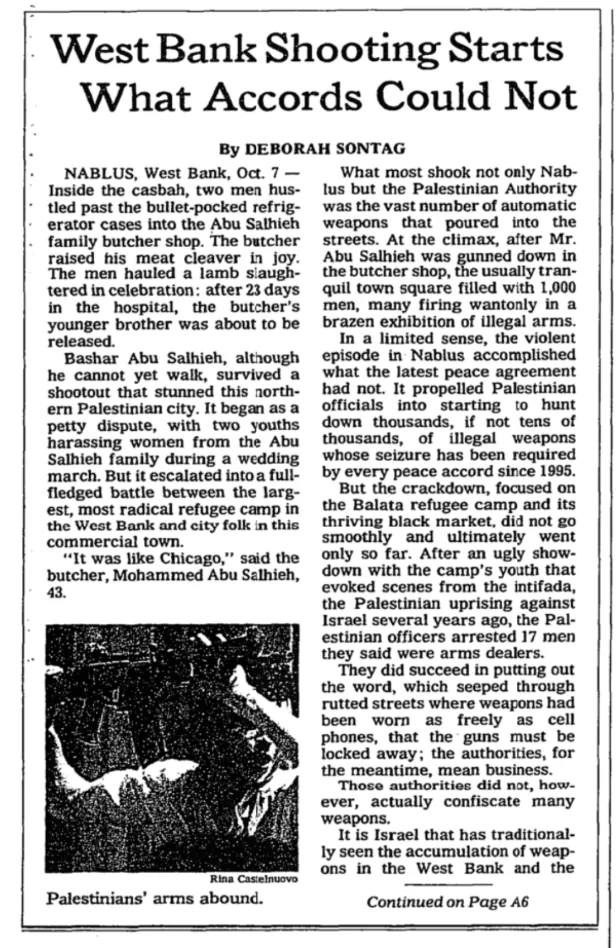
Transcribed from the clipping
NABLUS, West Bank, Oct. 7 — Inside the casbah, two men hustled past the bullet-pocked refrigerator cases into the Abu Salhieh family butcher shop. The butcher raised his meat cleaver in joy. The men hauled a lamb slaughtered in celebration: after 23 days in the hospital, the butcher’s younger brother was about to be released.
Bashar Abu Salhieh, although he cannot yet walk, survived a shootout that stunned this northern Palestinian city. It began as a petty dispute, with two youths harassing women from the Abu Salhieh family during a wedding march. But it escalated into a full-fledged battle between the largest, most radical refugee camp in the West Bank and city folk in this commercial town.
“It was like Chicago,” said the butcher, Mohammed Abu Salhieh, 43. What most shook not only Nablus but the Palestinian Authority was the vast number of automatic weapons that poured into the streets. At the climax, after Mr.
Abu Salhieh was gunned down in the butcher shop, the usually tranquil town square filled with 1,000 men, many firing wantonly in a brazen exhibition of illegal arms. In a limited sense, the violent episode in Nablus accomplished what the latest peace agreement had not.
It propelled Palestinian officials into starting to hunt down thousands, if not tens of thousands, of illegal weapons whose seizure has been required by every peace accord since 1995. But the crackdown, focused on the Balata refugee camp and its thriving black market, did not go smoothly and ultimately went only so far.
After an ugly showdown with the camp’s youth that evoked scenes from the intifada, the Palestinian uprising against Israel several years ago, the Palestinian officers arrested 17 men they said were arms dealers.
They did succeed in putting out the word, which seeped through rutted streets where weapons had been worn as freely as cell phones, that the guns must be locked away; the authorities, for the meantime, mean business. Those authorities did not, however, actually confiscate many weapons. It is Israel that has traditionally seen the accumulation of weapons in the West Bank and the
How this transcription was made
Transcribed from the slide scan by a reader working off magnified crops, not by optical character recognition. The clipping carries no masthead and no folio. The newspaper is not named anywhere on it: the photograph is credited to Rina Castelnuovo without a paper, so the attribution rests on the hand-typed slide label and on the page’s New York Times typography. The date likewise comes from the label; the printed dateline is 7 October, four days earlier, which is normal for a reported feature of this kind and corroborates the month and year without fixing the day.
Cite this clipping
"West Bank Shooting Starts What Accords Could Not," The New York Times, 11 October 1999. Covering Palestine archive, CP-1999-023. https://coveringpalestine.org/archive/cp-1999-023
More from The New York Times
- The Maine Colony in PalestineThe New York Times · 12 November 1866
- Jewish Colonization in PalestineThe New York Times · 9 December 1883
- Jewish State in Palestine OpposedThe New York Times · 9 July 1897
- ZIONIST CONGRESS IN BASELThe New York Times · 31 August 1897
- ROME FEARS THE ZIONISTSThe New York Times · 12 September 1897
- PROGRESS OF ZIONISMThe New York Times · 16 December 1901
- 852 more from this paper in the full text →
More from the 1990s
- The One-State SolutionThe New York Times · 10 January 1999
- How Jews Turn Houses Into Homes on West BankThe New York Times · 17 March 1999
- Palestinians Seem Resigned to a Delay in StatehoodThe New York Times · 28 April 1999
- Israeli Arabs face uphill battle for equal statusLas Cruces Sun News · 3 July 1999
- History of Palestinian-Israeli conflict can't be ignoredThe Beaufort Gazette · 16 August 1999
- Release of Palestinian prisoners tangled in years of suffering, rageThe Baltimore Sun · 4 September 1999
- All 374 clippings from the 1990s →
Last updated 2 November 2026
This record is part of Covering Palestine, an archive of American newspaper clippings about Palestinians, 1724 to 2023. Researched and assembled by Maria Robles.
The clipping belongs to the newspaper that printed it, or to the news agency that supplied the copy. It is reproduced here for research, criticism and commentary. A city here is where the newspaper was published, not where the story came from, and on most records it was taken from the masthead.
Something wrong here, or something you know about this clipping? The archive is still being built and corrections are wanted: maria@rozumstudio.com, quoting CP-1999-023.
Everything printed in 1999 · Printed on this day · See it in the archive reel · Full text of every clipping · Dataset